

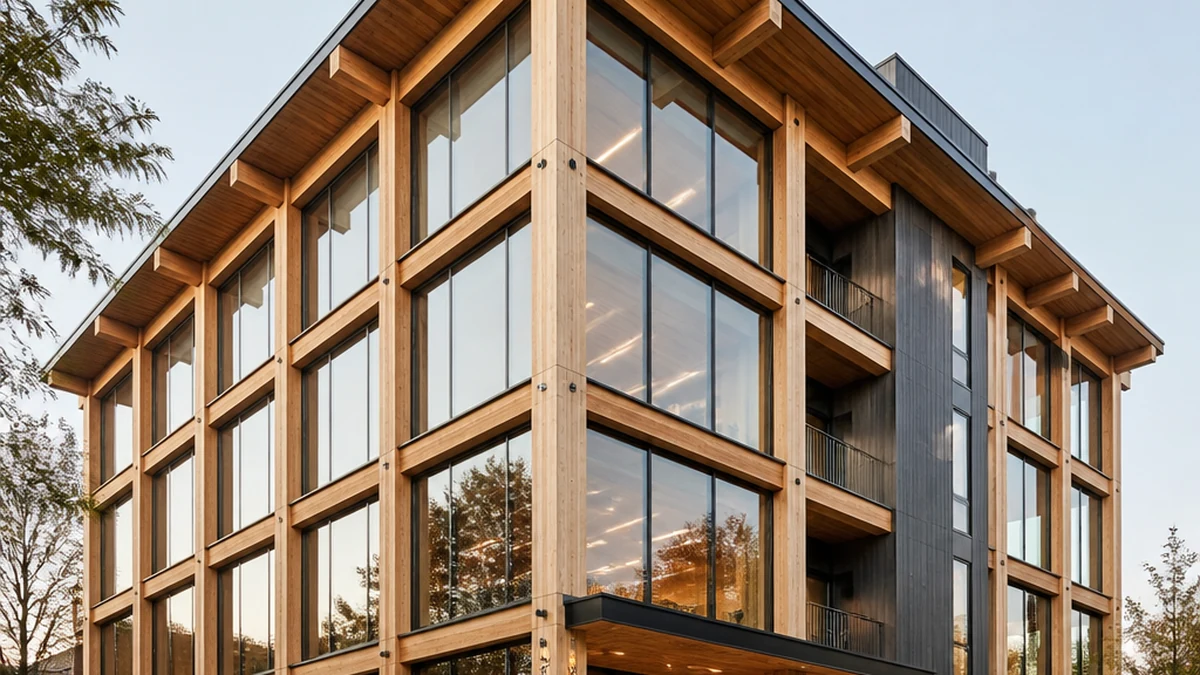
The landscape of the global timber industry is undergoing a significant reorientation, marked by an unprecedented surge in mass timber construction across the United States. Data compiled through late 2026 indicates that the number of mass timber buildings in the U.S. has risen more than 15-fold over the past decade, a development that is fundamentally reshaping demand profiles and supply chain priorities. This exponential growth arrives at a critical juncture for the sector, as a persistent housing slump continues to exert pressure on traditional softwood lumber markets, leading to numerous sawmill closures across North America and Europe. In response, timber growers and engineered wood manufacturers are strategically pivoting, actively pitching mass timber solutions to burgeoning industrial sectors, most notably data center developers, who seek sustainable, efficient, and rapidly deployable construction materials.
- Core Shift: U.S. mass timber project volume surged over 1,500% between 2016 and late 2026, driven by industrial and commercial sectors, notably data centers.
- Market Impact: This shift is rebalancing demand away from traditional residential construction, influencing North American softwood lumber benchmarks and regional sawmill operational strategies.
- 2026/2027 Outlook: Timber growers are strategically redirecting supply towards engineered wood manufacturers, signaling sustained investment in CLT/GLT production capacity and diversified procurement models across the global timber industry.
- Strategic Imperative: Sawmill owners and panel manufacturers must adapt to new demand vectors, focusing on higher-value engineered wood products and optimizing logistics for larger component delivery.
U.S. Mass Timber’s Exponential Growth: A 2026 Sector Reassessment Amidst Shifting Construction Paradigms
The trajectory of mass timber adoption in the United States represents one of the most compelling narratives in the global timber industry this decade. From a nascent market in 2016, the sector has matured significantly by late 2026, with Cross-Laminated Timber (CLT), Glued-Laminated Timber (GLT), and other engineered wood products gaining substantial traction beyond their initial niche applications. This growth is not merely incremental; it signifies a fundamental re-evaluation of construction methodologies, particularly in urban and industrial development. While residential construction, traditionally the largest consumer of softwood lumber, has faced headwinds from rising interest rates and subdued housing starts through 2025 and 2026, the commercial and industrial segments have emerged as robust demand drivers for mass timber. Data center development, in particular, has become a surprising but significant catalyst. These energy-intensive facilities require rapid construction, high structural integrity, and often benefit from the reduced carbon footprint associated with timber, aligning with corporate sustainability mandates. This diversification of end-use applications is providing a crucial counter-cyclical buffer for timber growers and processors grappling with a prolonged downturn in conventional housing markets.
Global Softwood Sawnwood & Mass Timber Component Pricing: 2025 Actuals vs. 2026/2027 Projections
The divergence in demand between traditional softwood lumber and engineered mass timber components is increasingly evident in pricing and market dynamics. While conventional lumber benchmarks have seen volatility and, in some regions, sustained downward pressure due to oversupply and reduced housing starts, mass timber products are demonstrating greater stability and even premium pricing. This reflects the specialized manufacturing processes, higher value-add, and specific performance characteristics required for structural applications in commercial and industrial projects. The following table provides a comparative overview of key market metrics, illustrating the evolving landscape for the global timber industry as we transition into 2027.
| Metric / Region | 2025 Actual (USD/m³) | 2026 Forecast (USD/m³) | 2027 Projection (USD/m³) | Y-o-Y Change (2026-27) |
|---|---|---|---|---|
| North American Softwood Lumber (Random Lengths Composite) | 485 | 460 | 475 | +3.3% |
| European Spruce-Pine-Fir (SPF) Sawnwood (FOB Baltic) | 390 | 375 | 380 | +1.3% |
| North American CLT (Average Structural Grade) | 810 | 835 | 860 | +3.0% |
| European GLT (Average Structural Grade) | 750 | 770 | 795 | +3.2% |
| U.S. Housing Starts (Million Units) | 1.38 | 1.32 | 1.35 | +2.3% |
Note: All prices are indicative and subject to regional variations and specific contract terms. Housing starts are annualized figures.
As illustrated in the table, while traditional softwood lumber markets show signs of stabilization or modest recovery into 2027 after a challenging 2025-2026, engineered wood products like CLT and GLT demonstrate consistent upward price trajectories. This underscores the premium value associated with these advanced materials and their growing market acceptance. For a deeper dive into these trends, our global timber and lumber price benchmarks offer continuous updates.
Pacific Northwest Sawlog Supply & Transatlantic Mass Timber Component Logistics: 2026/2027 Challenges
The shift towards mass timber construction introduces new complexities for raw material sourcing and logistics within the global timber industry. In regions like the Pacific Northwest, where sawmill closures have been a recurring theme due to reduced housing demand and increased operational costs, timber growers are now evaluating the economic viability of redirecting sawlog supply towards engineered wood product manufacturers. This requires specific log grades and species, potentially altering stumpage values and harvesting strategies. Simultaneously, the logistics of transporting large-format mass timber components, whether domestically or internationally, present significant challenges. Unlike standardized dimensional lumber, CLT and GLT panels often require specialized freight, larger transport vehicles, and meticulous planning to navigate infrastructure limitations and ensure timely delivery to construction sites. European manufacturers, who have a more established mass timber sector, are increasingly looking to export to the burgeoning U.S. market, necessitating robust transatlantic shipping solutions and adherence to stringent import regulations. This dynamic is further explored in our analysis of engineered wood and panel sector news.
C-Suite Playbook: Navigating Mass Timber’s Ascent and Diversifying Supply Chains for 2027
For C-suite leaders, sawmill owners, timber importers, and panel manufacturers, the rise of mass timber is not merely a trend but a fundamental recalibration of the global timber industry. Strategic adaptation is paramount for sustained profitability and market relevance through 2027 and beyond. Sawmill operators must assess the feasibility of investing in or partnering with engineered wood manufacturers to process higher-grade logs into billets for CLT and GLT production. This may involve significant capital expenditure but offers access to a growing, higher-value market segment. Timber importers need to diversify their portfolios, considering the procurement of pre-fabricated mass timber components from established European or Canadian producers, alongside traditional lumber. This requires a deep understanding of international trade policies, customs procedures, and specialized logistics for oversized cargo. Panel manufacturers, particularly those in Europe, should explore expanding their export capabilities to capitalize on the U.S. demand surge, while simultaneously innovating product lines to meet evolving architectural and engineering specifications for mass timber projects. Proactive engagement with architects, engineers, and developers will be crucial to understanding future demand and tailoring product offerings accordingly.
Frequently Asked Questions
How will the rise of mass timber impact traditional softwood lumber markets in 2027?
The increasing adoption of mass timber, particularly in commercial and industrial construction, is expected to stabilize or slightly reduce the overall demand pressure on traditional softwood lumber markets in 2027. While mass timber utilizes softwood, its specific grade and processing requirements mean it draws from a distinct, often higher-quality, segment of the log supply. This could lead to a bifurcation of the market, with traditional lumber prices remaining sensitive to residential housing starts, while mass timber components command a premium and exhibit more stable pricing, driven by large-scale project pipelines.
What are the primary logistical challenges for importing mass timber components into the U.S. by late 2026?
Importing mass timber components into the U.S. by late 2026 presents several logistical hurdles. These include managing oversized cargo dimensions that require specialized vessels and ground transport, navigating complex customs regulations and tariffs, ensuring compliance with U.S. building codes and material standards, and coordinating just-in-time delivery to often congested urban construction sites. Furthermore, the limited number of ports equipped to handle such large components efficiently adds to the complexity and cost.
What strategic adjustments should European panel manufacturers consider given the U.S. mass timber boom?
European panel manufacturers should consider several strategic adjustments. First, they should evaluate expanding production capacity for CLT and GLT specifically tailored to U.S. market specifications and building codes. Second, investing in robust export logistics and distribution networks within the U.S. is crucial. Third, fostering direct relationships with U.S. developers, architects, and general contractors can provide valuable market intelligence and secure long-term supply contracts. Finally, exploring joint ventures or partnerships with North American timber companies could mitigate market entry risks and optimize supply chain efficiencies.

