

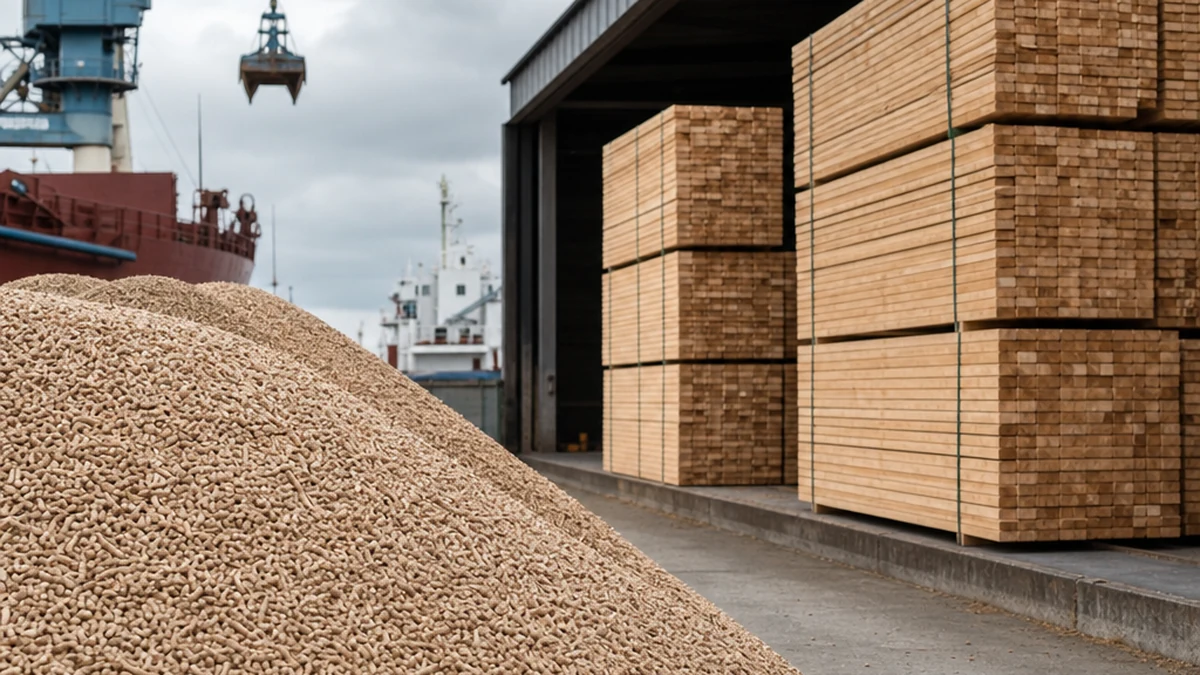
The United Kingdom’s wood pellet imports registered a notable 4.6% increase in the third quarter of 2026, a development that underscores the nation’s deepening reliance on biomass for energy generation and its broader implications for the global import landscape. This uptick, reported by Lesprom Network, reflects a strategic pivot towards diversified energy sources, driven by persistent geopolitical uncertainties and ambitious decarbonization targets. For C-suite leaders, sawmill owners, timber importers, and panel manufacturers, this trend is not merely a statistical anomaly but a critical indicator of shifting demand patterns, feedstock competition, and evolving logistical challenges across the international wood products sector as we approach 2027.
- Core Shift: UK wood pellet imports surged 4.6% in Q3 2026, reaching an estimated 2.15 million metric tons, driven by energy security and decarbonization mandates.
- Market Impact: Increased demand is exerting upward pressure on industrial wood pellet (IWP) CIF Rotterdam prices, projected to average $225-235/MT in Q1 2027, impacting procurement costs for European utilities.
- 2026/2027 Outlook: North American feedstock availability and transatlantic freight rates are tightening, necessitating proactive supply chain diversification and long-term contracting for biomass importers and panel manufacturers.
United Kingdom’s Biomass Surge: 2026 Import Dynamics and Energy Security Imperatives
The 4.6% growth in the United Kingdom’s wood pellet imports during Q3 2026 is a direct consequence of a multi-faceted energy strategy prioritizing stability and sustainability. With natural gas prices remaining volatile through 2025 and into 2026, and the ongoing imperative to meet net-zero emissions targets, biomass co-firing and dedicated biomass power generation have solidified their role in the UK’s energy mix. This sustained demand translates into a robust appetite for industrial wood pellets (IWP), primarily sourced from North America.
The UK’s energy policy, particularly its commitment to phasing out coal-fired power generation, has created a structural demand for biomass. Major power generators continue to convert or co-fire existing infrastructure, ensuring a baseline demand that is less susceptible to short-term market fluctuations than other commodities. This consistent demand underpins the strong global import volumes. Furthermore, the geopolitical landscape of late 2026, marked by continued tensions in Eastern Europe and the Middle East, has reinforced the strategic importance of energy sources with stable supply chains, making wood pellets an attractive option despite their own logistical complexities.
The increase also reflects a maturation of the biomass supply chain, with established relationships between UK utilities and major pellet producers in the US South and Canada. However, this growing reliance also exposes the UK to potential vulnerabilities in the global import supply chain, including feedstock availability, shipping capacity, and currency fluctuations. As we move into 2027, the resilience of these supply lines will be rigorously tested, particularly if other European nations intensify their own biomass procurement efforts.
Global Industrial Wood Pellet Benchmarks: 2025-2027 Pricing and Supply Chain Resilience
The consistent growth in UK wood pellet global import volumes has a tangible impact on international pricing benchmarks and the overall resilience of the biomass supply chain. Analyzing key metrics from 2025 actuals and projecting through 2027 reveals a market characterized by steady demand and escalating operational costs, particularly in logistics and raw material procurement. The table below illustrates these critical shifts:
| Metric | 2025 Actual (Avg.) | 2026 Estimate (Avg.) | 2027 Projection (Avg.) |
|---|---|---|---|
| Industrial Wood Pellet (IWP) CIF Rotterdam ($/MT) | $205.00 | $220.00 | $230.00 – $245.00 |
| IWP FOB US Gulf ($/MT) | $155.00 | $168.00 | $175.00 – $188.00 |
| Biomass Feedstock (Sawmill Residues) US South ($/Bone Dry Ton) | $42.00 | $46.00 | $48.00 – $55.00 |
| Transatlantic Bulk Freight (US Gulf to Europe) ($/MT) | $45.00 | $48.00 | $50.00 – $58.00 |
| European Natural Gas Futures (TTF, €/MWh) | €38.50 | €45.20 | €42.00 – €50.00 |
The data clearly indicates a persistent upward trajectory for IWP prices, both at the Free On Board (FOB) origin and Cost, Insurance, and Freight (CIF) destination points. The projected increase in CIF Rotterdam prices for 2027, potentially reaching $245/MT, reflects not only the UK’s heightened global import activity but also broader European demand and the compounding effect of rising input costs. Biomass feedstock prices in the US South, a primary source region, are forecast to continue their ascent, driven by competition from other wood products sectors and the increasing cost of harvesting and processing. This trend is further exacerbated by elevated transatlantic bulk freight rates, which remain sensitive to global shipping capacity and bunker fuel prices. These dynamics are critical considerations for C-suite executives monitoring global timber and lumber price benchmarks and making procurement decisions for 2027.
North American Biomass Feedstock & Transoceanic Logistics: Pressure on 2027 Global Import Supply
The sustained demand from the UK and other European markets places significant pressure on North American biomass feedstock supplies. The US South, with its vast timberlands and established sawmill infrastructure, remains the dominant supplier of industrial wood pellets. However, the availability of sawmill residues—a key component for pellet production—is not limitless. Competition for these residues from other industries, such as panel manufacturing (MDF, particleboard) and even pulp and paper, is intensifying. This competition can lead to localized price spikes and supply constraints, directly impacting the cost structure of pellet producers and, by extension, the final global import price.
Beyond raw material, transoceanic logistics present a formidable challenge. The specialized nature of wood pellet shipping, requiring bulk carriers with specific handling capabilities, means that vessel availability and port infrastructure are critical bottlenecks. Port congestion, particularly at major export hubs in the US Gulf and import terminals in the UK and Europe, can lead to significant delays and demurrage charges. Furthermore, the volatility of bunker fuel prices, influenced by global crude oil markets and environmental regulations, directly translates into fluctuating freight costs. These logistical complexities are integral to understanding international wood market developments and the true cost of biomass energy.
For pellet producers, securing long-term contracts for feedstock and shipping capacity is paramount. For importers, diversifying their sourcing geographically and establishing robust contingency plans for logistics disruptions are no longer optional but essential strategic imperatives for navigating the 2027 market.
C-Suite Playbook: Navigating 2027 Global Wood Pellet Import Volatility and Supply Diversification
The escalating demand for wood pellets, exemplified by the UK’s Q3 2026 global import surge, necessitates a proactive and sophisticated approach from C-suite leaders, sawmill owners, and procurement directors. Strategic planning for 2027 must focus on mitigating price volatility, ensuring supply security, and optimizing logistical efficiencies.
Firstly, long-term contracting with established pellet producers, often spanning 3-5 years, can provide a crucial hedge against spot market price fluctuations. These contracts should ideally include mechanisms for price adjustments based on transparent indices for feedstock, energy, and freight, rather than fixed rates that could expose either party to undue risk. Secondly, exploring supply diversification beyond traditional North American sources is becoming increasingly important. While North America remains dominant, emerging producers in regions like the Baltics, South America, and Southeast Asia, though smaller in scale, could offer supplementary supply and reduce over-reliance on a single geographical corridor. However, due diligence on sustainability certifications and logistical viability is critical for these alternative sources.
Thirdly, for sawmill owners and panel manufacturers, the increased demand for biomass feedstock presents both opportunities and challenges. Optimizing residue utilization for internal energy generation or selling excess to pellet producers can create new revenue streams. However, it also means competing with pellet mills for raw materials, potentially driving up local stumpage and residue prices. Strategic partnerships with pellet producers or even vertical integration into pellet manufacturing could offer a competitive advantage. Finally, investing in advanced analytics for supply chain visibility and predictive modeling can enable better inventory management, optimize shipping schedules, and anticipate potential disruptions, thereby enhancing the overall resilience of global import operations.
Frequently Asked Questions
How does increased UK pellet global import affect North American sawmill residue prices?
The heightened demand for wood pellets from the UK and other European markets directly increases the demand for biomass feedstock, particularly sawmill residues, in North America. This creates upward pressure on residue prices, as pellet producers compete with other wood product manufacturers (e.g., for particleboard or MDF) for available supply. Sawmills in key export regions, such as the US South, can leverage this demand to secure better prices for their by-products, but it also tightens the market for other industries relying on these same raw materials.
What are the key logistical challenges for global import of wood pellets to Europe in 2027?
In 2027, key logistical challenges for wood pellet global import to Europe include continued volatility in transatlantic bulk freight rates due to fluctuating bunker fuel costs and global shipping capacity constraints. Port congestion at both origin (US Gulf) and destination (UK/European terminals) remains a concern, leading to potential delays and increased demurrage. Furthermore, ensuring adequate rail and truck transport from inland pellet mills to export ports, and from European import terminals to power plants, adds another layer of complexity and cost.
How might the UK’s biomass strategy evolve beyond 2027, impacting global import trends?
Beyond 2027, the UK’s biomass strategy is likely to face increased scrutiny regarding sustainability criteria and carbon accounting, potentially leading to stricter regulations on feedstock sourcing. While biomass will likely remain a component of the energy mix, there could be a greater emphasis on domestic sourcing or advanced biomass technologies (e.g., bioenergy with carbon capture and storage – BECCS) to meet net-zero targets. This could lead to a gradual shift in the composition and origin of global import volumes, with a potential for diversification away from traditional sources or a focus on higher-value, more sustainable biomass products.

