

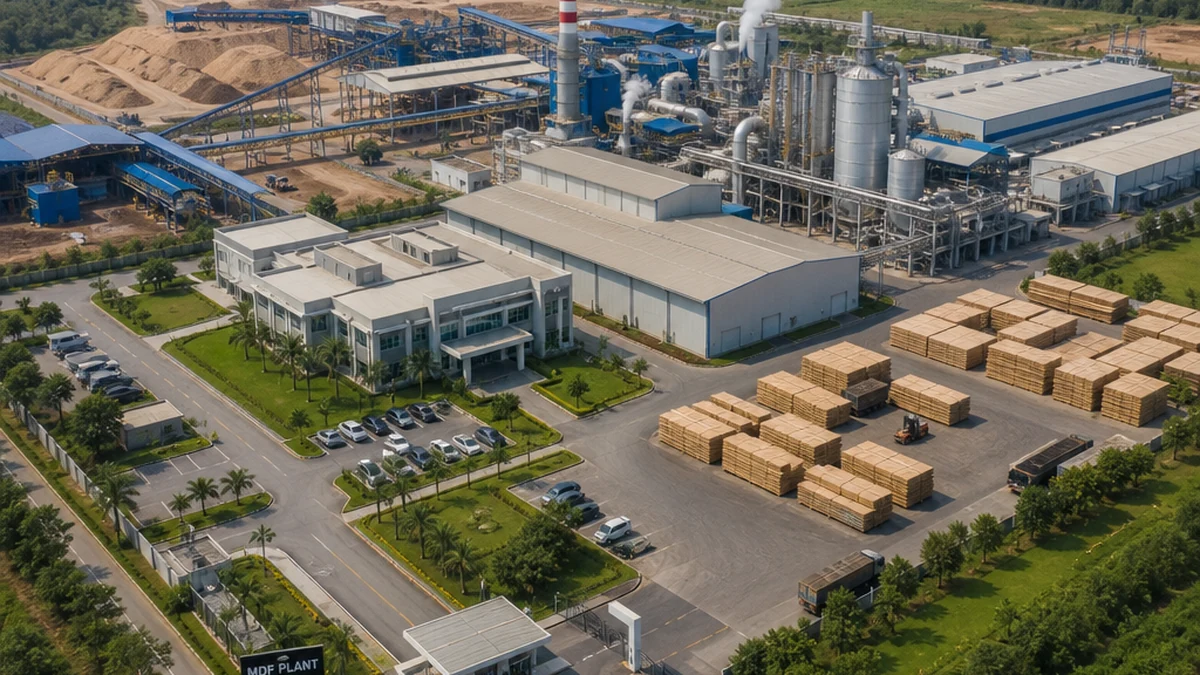
In a significant development reverberating across the European and broader global mdf markets, German fiberboard manufacturer Homann Holzwerkstoffe GmbH has announced its intention to idle its newly constructed medium-density fiberboard (MDF) plant in Pagiriai, Lithuania, by the close of 2026. This decisive operational curtailment is projected to mitigate an anticipated Euro 23 million loss for the facility, with expectations for the plant’s deficit to shrink to approximately Euro 3 million by 2027 once production ceases. The move underscores the acute financial pressures confronting even modern, efficient production assets within a highly competitive and oversupplied engineered wood panel landscape.
- Core Shift: Homann’s Pagiriai plant idling removes approximately 250,000 cubic meters of annual MDF capacity from the Baltic market by early 2027, representing a significant regional supply contraction.
- Market Impact: While localized European MDF prices may see marginal firming, persistent global oversupply and elevated energy costs are expected to cap any substantial benchmark price recovery through Q2 2027.
- 2026/2027 Outlook: Sawmill owners and panel manufacturers should anticipate continued margin compression, necessitating stringent cost control, strategic raw material procurement, and potential consolidation within the European engineered wood sector.
Homann’s Pagiriai MDF Plant: A Euro 23 Million Retraction in the Baltic Region
The Homann Pagiriai plant, a substantial investment in modern MDF production capacity, was designed to serve burgeoning demand in Eastern Europe and beyond. Its impending idling, however, is a stark indicator of the current disconnect between installed capacity and sustainable market demand, particularly in the European context. The Euro 23 million loss projected for 2026 reflects a confluence of factors: elevated raw material costs, particularly for wood fiber and resins; persistently high energy prices across the Eurozone; and a significant downturn in construction activity that has suppressed demand for finished panel products. This situation is not isolated to Homann but mirrors broader challenges observed across the engineered wood and panel sector news, where overcapacity has become a structural issue.
The decision to cease production, rather than continue operating at a loss, highlights a pragmatic approach to capital preservation. By reducing the anticipated loss to Euro 3 million in 2027, Homann aims to stabilize its broader financial performance. This strategic retreat from an unprofitable venture, even a new one, sends a clear signal to the market: profitability, not merely market share, is the paramount concern for C-suite executives navigating the current economic headwinds. The Baltic region, which has seen considerable investment in wood processing over the past decade, now faces a recalibration of its panel manufacturing footprint.
European MDF Market Benchmarks: 2025 Performance & 2026/2027 Price Projections
The European MDF market has experienced a turbulent period, characterized by demand fluctuations and cost volatility. While 2025 saw some stabilization after the post-pandemic surge and subsequent correction, the latter half of 2026 has witnessed renewed downward pressure on prices amidst persistent oversupply and subdued construction starts. The idling of Homann’s Pagiriai plant, while significant regionally, is unlikely to trigger a dramatic shift in the overall European price trajectory given the scale of existing capacity.
The following table provides a comparative overview of key European MDF market benchmarks, illustrating the shift from 2025 actuals to 2026/2027 projections. These figures are critical for sawmill owners, timber importers, and panel manufacturers in their strategic planning.
| Metric/Region | 2025 Actual (Avg. €/m³) | 2026 Projection (Avg. €/m³) | 2027 Forecast (Avg. €/m³) | Key Trend/Commentary |
|---|---|---|---|---|
| Western European MDF (Standard, 18mm) | 420 | 395 | 380-400 | Continued downward pressure due to subdued demand and import competition. |
| Eastern European MDF (Standard, 18mm) | 385 | 360 | 350-370 | Homann’s idling may offer minor support, but regional oversupply persists. |
| Baltic Wood Fiber Costs (€/BDMT) | 115 | 120 | 118-125 | Stable to slightly increasing, driven by competition from pulp and bioenergy. |
| European Natural Gas Prices (TTF Avg. €/MWh) | 45 | 52 | 48-55 | Volatile, with geopolitical factors maintaining upward pressure on energy-intensive production. |
| Global MDF Capacity Utilization (%) | 78% | 75% | 73-76% | Persistent global overcapacity continues to depress margins across all regions. |
The data clearly illustrates a challenging environment. While raw material costs for wood fiber remain relatively stable in the Baltic region, the significant increase in natural gas prices from 2025 to 2026, with continued volatility into 2027, directly impacts the energy-intensive MDF production process. This, coupled with a global MDF capacity utilization rate projected to remain below 80%, signals a market where supply continues to outstrip demand, leading to sustained pressure on selling prices and producer margins.
Baltic Timber Procurement & Energy Costs: Pressures on European Panel Producers Through Mid-2027
The operational challenges faced by Homann in Lithuania are emblematic of broader structural issues impacting European panel producers. Raw material procurement, particularly for suitable wood fiber, remains a critical cost component. While the Baltic states historically offered competitive timber prices, increased demand from the pulp and paper sector, as well as bioenergy production, has exerted upward pressure on industrial wood chip and small-diameter log prices. This competition for fiber, combined with logistical bottlenecks and rising transportation costs, directly erodes the profitability of MDF manufacturing.
Energy costs represent another formidable hurdle. MDF production is inherently energy-intensive, requiring significant thermal energy for drying wood fibers and powering presses. European natural gas prices, while having retreated from their 20

