

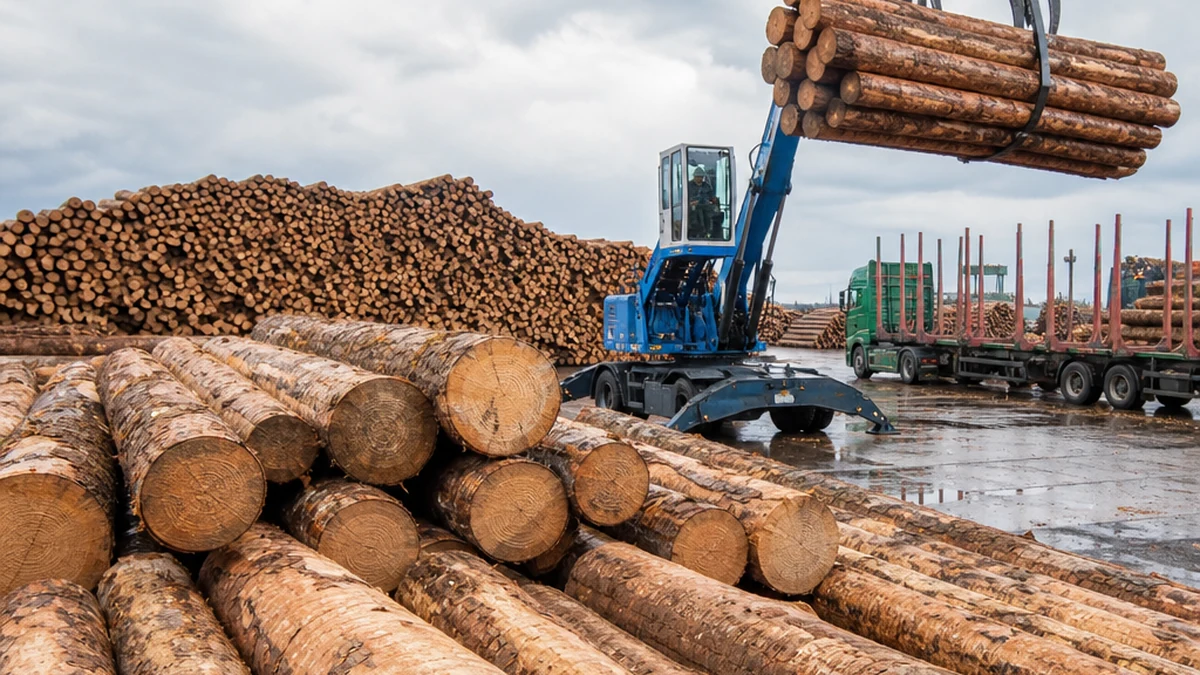
The European timber sector is closely monitoring a subtle yet significant shift: prices for German roundwood climbed 0.4% in September 2026. While seemingly minor in isolation, this uptick, reported by Lesprom Network, serves as a critical indicator of evolving supply-demand dynamics within Central Europe’s vital forestry sector. For C-suite leaders, sawmill owners, timber importers, and panel manufacturers, this movement signals potential tightening in regional log markets, with cascading effects that could influence broader European and ultimately, global prices for raw materials and finished products through late 2026 and into 2027.
- Core Shift: German roundwood prices rose 0.4% in September 2026, marking a departure from the relative stability observed in late 2025 and early 2026.
- Market Impact: European log supply is projected to tighten by an estimated 1.5-2.0% through Q2 2027, primarily due to reduced salvage logging volumes and sustained domestic demand, impacting regional sawmill input costs.
- 2026/2027 Outlook: C-suite leaders should anticipate moderate upward pressure on European softwood lumber prices, potentially influencing specific segments of global prices by 1-3% as supply chains adjust to regional raw material constraints.
German Roundwood’s Modest Ascent and European Supply Chain Pressures (2026)
The 0.4% increase in German roundwood prices, specifically for spruce and pine sawlogs, reflects a complex interplay of factors emerging in late 2026. Following several years of elevated salvage logging necessitated by extensive bark beetle infestations, the volume of distressed timber entering the market has begun to normalize. While still present, the acute phase of oversupply that characterized 2023-2024 has receded, leading to a more balanced, albeit tightening, supply landscape.
Domestic demand within Germany and neighboring Central European countries remains robust, driven by resilient construction sectors and a steady appetite from the panel manufacturing industry. This consistent internal consumption, coupled with a slight reduction in available harvesting capacity due to labor shortages and rising operational costs (including fuel and energy), creates an environment conducive to price firming. Furthermore, export demand, particularly from Asian markets, has shown signs of cautious resurgence in 2026, adding another layer of competitive pressure on European log resources.
This German trend is not isolated. Across Scandinavia and other Central European nations, similar dynamics are at play. While some regions still grapple with localized oversupply or specific species challenges, the overarching sentiment points towards a gradual rebalancing where supply is becoming more responsive to demand, rather than being dictated by catastrophic events. This shift is critical for understanding the trajectory of European timber markets through 2027.
Global Timber and Lumber Price Benchmarks: 2025 Actuals & 2026/2027 Projections
The German roundwood price movement, while regional, contributes to the intricate tapestry of global timber and lumber price benchmarks. Analyzing 2025 actuals against 2026 and 2027 projections reveals a nuanced picture of regional divergence and interconnectedness. North American markets, for instance, continue to navigate the complexities of US housing starts and the ongoing US lumber tariff stalemate, which has created volatility in SPF (Spruce-Pine-Fir) futures. Meanwhile, Asian demand, particularly from China, remains a significant determinant for log and lumber prices originating from Oceania and Europe.
The table below provides a comparative overview of key regional metrics and their projected trajectories, offering C-suite leaders a data-driven perspective on anticipated shifts in global prices:
| Metric/Region | 2025 Actual (Avg.) | 2026 Forecast (Avg.) | 2027 Projection (Avg.) | Key Drivers |
|---|---|---|---|---|
| German Spruce Sawlogs (€/m³) | 98.50 | 101.20 | 103.50 | Reduced salvage volumes, domestic demand, energy costs |
| North American SPF 2×4 (#2&Btr, $/MBF) | 485 | 510 | US housing starts, interest rates, tariff uncertainty | |
| Nordic Pine Sawlogs (€/m³) | 82.30 | 84.80 | Export demand (Asia), energy costs, pulpwood competition | |
| Asian Log Imports (NZ Radiata, $/m³) | 125 | 128 | China construction activity, shipping rates, inventory levels | |
| Global Softwood Lumber Index (Base 100) | 100 | 102.5 | Macroeconomic stability, regional supply-demand balances |
The table illustrates a general upward trend across most key timber and lumber benchmarks, albeit with varying magnitudes. The Global Softwood Lumber Index, which serves as a broad indicator, is projected to see a modest increase, reflecting a cautious optimism tempered by ongoing geopolitical and economic uncertainties. The German roundwood increase, while small, aligns with this broader trend of gradual price firming in raw material inputs.
Raw Material Procurement & Trans-Continental Logistics: Navigating 2026/2027 Volatility
Beyond stumpage costs, the efficiency and resilience of raw material procurement and logistics chains are paramount for profitability. As international wood market developments continue to evolve, C-suite executives must contend with several critical factors influencing the delivered cost of timber and lumber through 2027.
Freight Rates: While container shipping rates have stabilized from their pandemic-era peaks, geopolitical tensions and energy price volatility continue to introduce unpredictability. Trans-Atlantic and Trans-Pacific routes, crucial for moving European and North American lumber to Asian markets, remain susceptible to sudden shifts. Bulk cargo rates for logs, particularly from regions like New Zealand and Europe to Asia, are also sensitive to global trade volumes and bunker fuel costs.
Energy Costs: The cost of energy directly impacts harvesting, processing, and transportation. Sawmills and panel manufacturers, being energy-intensive operations, face persistent pressure from fluctuating electricity and natural gas prices. This directly translates into higher operational expenditures, which are often passed on, at least partially, to the end product price.
Labor Availability: Skilled labor shortages across forestry, logging, and sawmill operations remain a structural challenge in many developed markets, including Germany and Scandinavia. This scarcity can constrain harvesting volumes, increase labor costs, and impact production efficiency, contributing to tighter supply and upward price pressure.
Geopolitical Factors: Trade policies, sanctions, and regional conflicts can rapidly alter supply routes and market access. The ongoing re-evaluation of supply chain dependencies, particularly in Europe, is leading to a greater emphasis on regional sourcing where feasible, but also necessitates diversification for global players.
Strategic Imperatives for Sawmill Operators and Importers Through Mid-2027
In this dynamic environment, strategic foresight is critical for maintaining competitive advantage and ensuring operational continuity. Sawmill operators, timber importers, and panel manufacturers must adopt proactive measures to navigate the projected market conditions through mid-2027.
Optimized Inventory Management: Balancing inventory levels to mitigate price volatility without incurring excessive carrying costs is crucial. Utilizing advanced softwood lumber and sawmill analytics can help forecast demand and optimize raw material procurement schedules, reducing exposure to short-term price spikes.
Diversification of Supply Sources: Relying heavily on a single region or supplier for raw materials carries inherent risks. Exploring alternative sourcing regions, even if they entail slightly higher logistics costs, can provide a buffer against localized supply disruptions or sudden price surges. This strategy also applies to species diversification, where market conditions allow.
Long-Term Contracting and Hedging: For high-volume players, securing long-term supply contracts with forestry owners or log suppliers can provide price stability and guaranteed volumes. Additionally, exploring futures markets for lumber or related commodities can offer hedging opportunities against adverse price movements, though this requires sophisticated market analysis.
Investment in Efficiency and Automation: Mitigating rising labor and energy costs through capital investments in modern, efficient sawmill and panel production technologies is a long-term imperative. Automation can enhance yield, reduce waste, and lower per-unit production costs, improving margins even in a rising raw material price environment.
Market Intelligence and Adaptability: Continuous monitoring of global economic indicators, regional forestry policies, and competitor strategies is non-negotiable. The ability to rapidly adapt procurement, production, and sales strategies in response to emerging market signals will differentiate resilient enterprises.
Frequently Asked Questions on 2026/2027 Global Timber Markets
How will German log price increases affect European lumber exports?
The modest increase in German log prices will likely translate into marginally higher input costs for German and Central European sawmills. This could slightly reduce their competitiveness in export markets, particularly for lower-margin products, potentially leading to a re-evaluation of export strategies or a focus on higher-value domestic markets. Other European exporters, such as those from Scandinavia, might see a relative advantage if their raw material costs remain more stable.
What are the primary risks to global prices for softwood lumber in 2027?
The primary risks to global prices for softwood lumber in 2027 include a significant slowdown in global construction activity due to persistent high interest rates or a broader economic recession, escalating geopolitical conflicts impacting trade routes and energy prices, and unforeseen climate events (e.g., severe wildfires, widespread pest outbreaks) that could disrupt supply in major producing regions. Currency fluctuations also pose a continuous risk for international trade.
How can panel manufacturers mitigate raw material cost volatility?
Panel manufacturers can mitigate raw material cost volatility by diversifying their fiber basket to include alternative species or recycled content where technically feasible, establishing long-term supply agreements with fixed or capped pricing mechanisms, and investing in advanced manufacturing technologies that optimize fiber utilization and reduce waste. Strategic inventory management and exploring vertical integration opportunities (e.g., acquiring logging operations) can also provide greater control over raw material supply and cost.

