

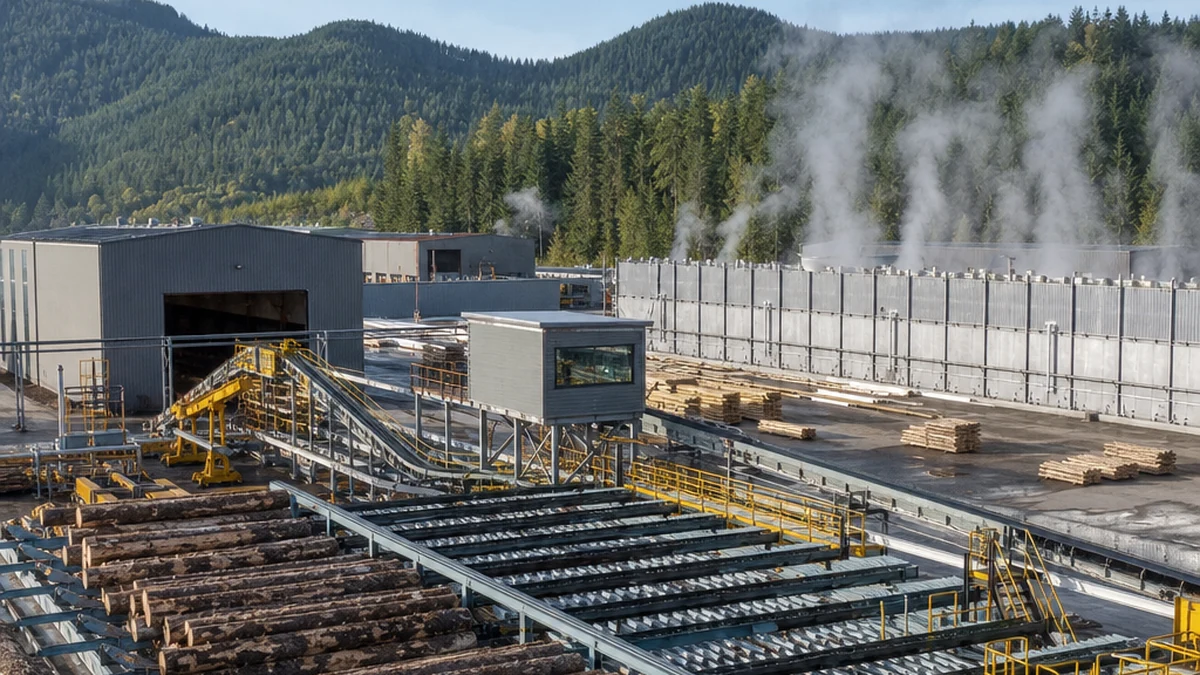
Canfor’s Iron Mountain Expansion: A Strategic Play Amidst Evolving Global Sawmill Dynamics
Canfor Southern Pine’s recent announcement to invest approximately US$96 million in its Iron Mountain sawmill in El Dorado, Arkansas, marks a significant strategic maneuver within the North American timber industry. This substantial capital injection is projected to more than double the mill’s annual net production capacity to approximately 220 million board feet. This development is not merely an isolated corporate decision; it is a potent indicator of underlying market forces, regional competitive advantages, and the long-term outlook for the global sawmill sector.
- Canfor’s US$96M investment will more than double Iron Mountain’s annual production to ~220 MMbf.
- This capacity surge will intensify North American lumber supply, potentially impacting regional pricing and competitive landscapes.
- By 2026/2027, sawmills and procurement must strategize for increased lumber availability and evolving market dynamics from this significant expansion.
The expansion comes at a critical juncture for the industry, characterized by persistent volatility in lumber pricing, escalating operational costs, and an ongoing recalibration of supply chains. Canfor’s commitment to such a substantial capacity increase in the U.S. South underscores a calculated bet on the region’s enduring fiber basket strength and its strategic position relative to key demand centers.
Market Context & Financial Realities
The North American lumber market has experienced a tumultuous period since the unprecedented highs of 2021-2022. While prices have retreated from those peaks, they remain subject to significant fluctuations driven by housing starts, repair and remodel (R&R) activity, and broader macroeconomic indicators. The Random Lengths Framing Lumber Composite Price, a key industry benchmark, has demonstrated this volatility, reflecting periods of robust demand followed by corrections as interest rates and inflation impact consumer spending and construction activity.
For sawmills, the financial realities extend beyond mere lumber prices. Operational costs, including labor, energy, and transportation, have seen sustained upward pressure. Log costs, particularly stumpage prices, represent the single largest input cost for most sawmills, and their regional variability significantly influences profitability. Investments like Canfor’s are designed to enhance efficiency, reduce per-unit production costs through economies of scale, and improve product recovery, thereby bolstering margins even in a more challenging pricing environment. The move to double output at Iron Mountain is a clear signal of optimizing asset utilization and leveraging existing infrastructure to meet anticipated long-term demand.
Comparative Industry Data
The U.S. South has emerged as a dominant force in North American softwood lumber production, largely due to its favorable growing conditions for Southern Yellow Pine (SYP), lower labor costs compared to the Pacific Northwest, and proximity to major construction markets. This regional advantage is further highlighted when comparing operational metrics and investment trends across different timber baskets.
The following table illustrates key comparative data points relevant to sawmill operations and regional competitiveness:
| Metric | US South (SYP) | US Pacific Northwest (SPF/DFIR) | Canadian Interior (SPF) |
|---|---|---|---|
| Average Stumpage Cost (Q4 2023, $/ton) | $25 – $35 | $40 – $60 | $10 – $20 (Crown Land Fees) |
| Fiber Supply Reliability | High (Private Land Ownership) | Moderate (Public Land Constraints) | Moderate (Forest Fires, Beetle Kill, Policy) |
| Typical Mill Gate Price (MBF, Q4 2023) | $400 – $550 | $450 – $600 | $380 – $500 |
| Recent Investment Trend | Strong Expansion & Modernization | Limited New Capacity, Modernization | Rationalization & Efficiency Focus |
| Logistics Advantage | Proximity to SE Markets, Rail/Truck | Coastal Ports for Export, Rail | Rail to US Midwest/East |
Note: Figures are illustrative averages and can vary significantly by specific location, species, and market conditions.
Canfor’s decision to expand in Arkansas aligns perfectly with the prevailing trend of investment gravitating towards the U.S. South, capitalizing on its robust and sustainably managed timber resources. This region continues to attract capital due to its competitive cost structure and strategic market access, making it a pivotal area for any global sawmill operator seeking growth.
Supply Chain & Raw Material Dynamics
The success of the Iron Mountain expansion hinges critically on stable and cost-effective raw material sourcing. Arkansas, situated within the expansive SYP timber belt, offers a significant advantage in terms of fiber availability. However, even in resource-rich regions, stumpage costs are subject to local demand-supply dynamics, competition from other wood products sectors (e.g., pulp and paper, biomass), and land-use changes.
Logistics represent another crucial element. Doubling output to 220 million board feet will necessitate a substantial increase in log procurement and lumber distribution. This places increased pressure on local trucking capacity, rail infrastructure, and overall supply chain efficiency. Investment in modernizing mill operations often includes optimizing log yard management and outbound shipping logistics to mitigate these challenges.
While the Iron Mountain expansion primarily serves domestic U.S. markets, broader trade policies can indirectly influence its competitive position. For instance, ongoing softwood lumber duties on Canadian imports continue to impact overall North American supply, potentially creating more favorable conditions for U.S. domestic producers. Furthermore, evolving global regulations such as the EU Deforestation Regulation (EUDR), while not directly impacting U.S. domestic sales, highlight an increasing global emphasis on sustainable sourcing and traceability, which larger, integrated producers like Canfor are well-positioned to address through their established forestry practices.
Strategic Outlook & Operational Implications
Canfor’s US$96 million investment at Iron Mountain is a clear strategic move to solidify its position in the highly competitive U.S. South. For Canfor, this means enhanced economies of scale, improved product mix capabilities, and a stronger foothold in a key growth market. The increased capacity will allow the company to better serve its customer base, potentially offering more consistent supply and competitive pricing.
For the broader industry, the implications are multifaceted:
- Increased Regional Supply: An additional 110 million board feet of SYP lumber entering the market will intensify competition, particularly for smaller, less efficient sawmills in the immediate vicinity. This could exert downward pressure on regional lumber prices or, conversely, help stabilize supply during periods of high demand.
- Competitive Landscape: Major players like Canfor, Weyerhaeuser, and West Fraser are continually optimizing their mill networks. This expansion signals a continued trend of consolidation and modernization, where scale and technological advancement are key differentiators.
- Importers and Panel Producers: For lumber importers, increased domestic production from efficient mills like Iron Mountain could reduce reliance on foreign supply, particularly for standard dimension lumber. Panel producers (e.g., OSB, plywood) will also monitor this expansion, as increased lumber production can influence the availability and pricing of residual chips and other by-products, which are critical inputs for their operations.
- Technological Advancement: Modern sawmill investments typically incorporate advanced scanning, optimization, and automation technologies. This not only boosts recovery rates and reduces waste but also addresses labor availability challenges, a persistent concern across the manufacturing sector.
Ultimately, this expansion reinforces the U.S. South’s role as a powerhouse in the global sawmill industry, capable of attracting significant capital investment due to its robust fiber base and strategic market access.
Frequently Asked Questions (FAQ)
Q1: What does this expansion mean for Southern Yellow Pine lumber prices?
A significant capacity increase like Canfor’s Iron Mountain expansion adds substantial volume to the market. While short-term price impacts depend on overall demand, in the long term, increased supply from efficient mills can contribute to greater price stability and potentially temper upward price movements during demand surges. It also intensifies competition among producers.
Q2: How does this investment align with broader industry trends in North America?
This investment aligns with a clear trend of capital migration and modernization towards the U.S. South, driven by superior fiber economics, lower operational costs, and proximity to major construction markets. It also reflects a strategic focus on optimizing existing assets and achieving economies of scale to navigate volatile market conditions.
Q3: What are the primary challenges for large-scale sawmill expansions today?
Key challenges include securing consistent, cost-effective log supply amidst competition, managing escalating labor and energy costs, navigating complex permitting processes, and ensuring efficient logistics for both raw material inbound and finished product outbound. Attracting and retaining skilled labor for advanced mill operations also remains a significant hurdle.

