



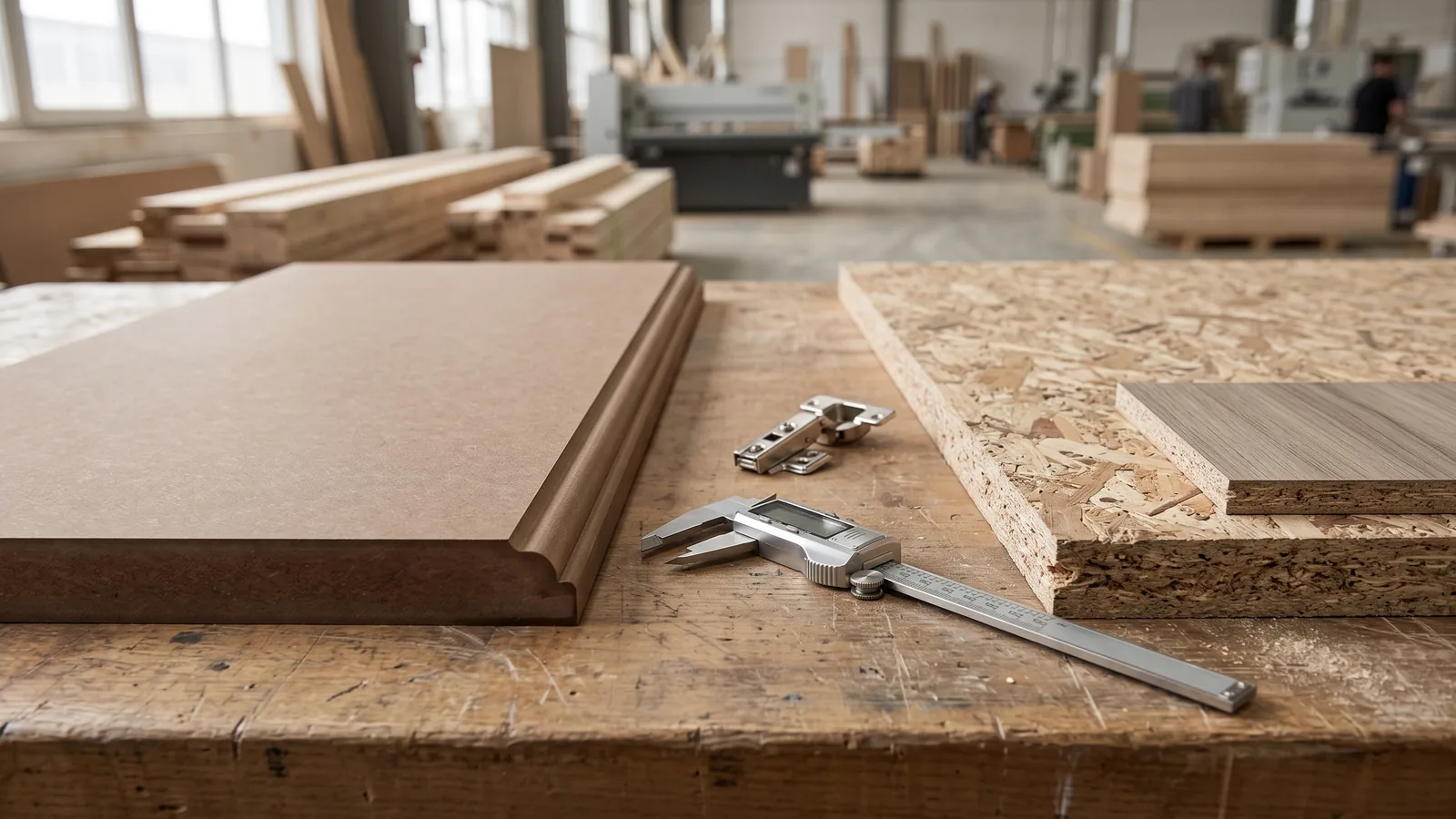


Particleboard is usually the practical substrate for cost-sensitive, laminated furniture components, while MDF is the stronger choice when a project needs smooth painted faces, routed profiles, detailed machining or consistently finished edges. Neither panel is universally better: buyers should select a grade against the required mechanical properties, surface treatment, moisture exposure, fastener performance and emissions rules.
Key findings
- MDF is made from cellulosic fibres bonded under heat and pressure. Its homogeneous density and smooth, grain-free surface support precise machining and finishing.
- Particleboard and MDF are covered by different North American product standards: ANSI A208.1-2022 for particleboard and ANSI A208.2-2022 for interior MDF.
- For products sold or imported in the United States, both panel types fall under EPA TSCA Title VI formaldehyde requirements.
- A purchasing specification should name the panel grade, thickness tolerance, mechanical requirements, intended finish, emissions certification and exposure conditions—not merely “MDF” or “particleboard.”
Information reviewed: July 2026. This guide compares interior-use panels and does not replace an engineer’s design specification, the applicable ANSI standard, local building rules or the manufacturer’s technical data.
Particleboard vs MDF at a glance
| Buyer criterion | Particleboard | MDF | Practical selection signal |
|---|---|---|---|
| Typical furnish | Wood particles bonded into a panel | Cellulosic fibres combined with resin and consolidated under heat and pressure | Specify the product standard and grade, not only the generic panel name |
| Surface and profiling | Common substrate for laminates and flat components | Smooth, uniform and well suited to precise routing, moulding and painted finishes | Prefer MDF for detailed profiles and demanding paint finishes |
| Cost control | Often selected for value-engineered, laminated furniture | May justify its cost where machining and finishing quality reduce downstream work | Compare total fabricated-component cost, not panel price alone |
| Moisture | Standard interior grades should not be assumed suitable for wet service | Request a moisture-resistant grade and verify the manufacturer’s declared limits | |
| Compliance | ANSI A208.1; TSCA Title VI where applicable | ANSI A208.2; TSCA Title VI where applicable | Check labels, certification, lot traceability and destination-market rules |
What is MDF?
The Composite Panel Association describes MDF as a composite panel typically made from cellulosic fibres combined with a synthetic resin or another suitable bonding system, then joined under heat and pressure. Its flat, smooth and uniform surface is free from natural knots and grain patterns. The homogeneous density profile is the reason MDF is widely used for intricate machining, edge shaping, mouldings, doors, furniture, store fixtures and painted cabinet components.
This does not mean every MDF panel performs alike. ANSI A208.2 classifies interior MDF through physical and mechanical properties, product grades, dimensional tolerances and formaldehyde requirements. Procurement teams should therefore request the relevant grade and the producer’s technical data rather than treating density alone as a complete performance specification.
What is particleboard?
Particleboard is a wood-based composite made by bonding wood particles into a panel. It is extensively used as a flat, stable substrate for decorative surfaces in furniture, cabinetry, shelving and interior components. The Composite Panel Association identifies ANSI A208.1-2022 as the current North American particleboard standard.
Particleboard is especially useful when the component will receive a laminate or other decorative surface and does not require deep routed profiles. Its commercial advantage should be evaluated at component level: yield, cutting, edge treatment, hardware system, laminate process, packaging damage and rejection rates can matter more than the purchase price per sheet.
Which panel machines and finishes better?
For routed profiles, mouldings, embossed faces and high-quality painted surfaces, MDF normally has the clearer advantage. CPA attributes this to its smooth surface and homogeneous density. Particleboard remains a logical substrate for flat laminated parts, where the decorative surface and balanced panel construction are central to final performance.
Machining quality still depends on panel grade, tool condition, feed speed, dust extraction, edge design and the coating system. Buyers evaluating a new supplier should test actual production samples, including routed edges, fastener locations and the intended finish.
Strength, fastening and shelving
Generic statements such as “MDF is always stronger” are too broad for professional purchasing. Both ANSI standards contain grade-specific physical and mechanical requirements. Panel thickness, density profile, modulus properties, internal bond, screw-holding requirements, span, load duration and support layout all influence performance.
For shelving, use span-and-load calculations or supplier engineering tables. For ready-to-assemble furniture, test the exact connector and edge distance in the intended panel grade. A small change in fastener geometry or pilot-hole specification can matter more than the generic panel category.
Moisture and dimensional risk
Standard interior MDF and particleboard should not be specified as though they were waterproof. Moisture-resistant products are engineered for defined conditions, but the designation does not remove the need for sealed edges, suitable finishes, controlled storage and correct installation. Ask the supplier for thickness-swell data, conditioning requirements and the limits of the declared grade.
Balanced construction is also important for laminated panels. Applying dissimilar materials or coatings to opposite faces can contribute to warp. Storage humidity, panel conditioning and fabrication practices should be included in the quality plan.
Formaldehyde rules buyers must verify
EPA TSCA Title VI regulates hardwood plywood, MDF—including thin MDF—and particleboard sold, supplied, offered for sale, manufactured or imported in the United States. EPA states emission limits of 0.11 ppm for MDF, 0.13 ppm for thin MDF and 0.09 ppm for particleboard. Covered products require compliant certification and labelling; finished goods containing regulated panels are also within the supply-chain requirements.
Canada’s composite wood product regulations likewise cover MDF, thin MDF, particleboard, hardwood plywood and certain laminated products. Destination-market compliance should be confirmed before shipment. Purchasing documents should identify the required regime and retain supplier, lot, test and certification records.
Buyer decision matrix
| Application | Starting preference | What to validate |
|---|---|---|
| Painted routed cabinet door | MDF | Profile quality, edge sealing, coating adhesion, moisture grade |
| Flat laminated cabinet carcass | Particleboard or MDF | Hardware performance, laminate balance, dimensional tolerances, total cost |
| Long loaded shelf | Engineering decision | Grade-specific stiffness, span, load, creep and support spacing |
| Machined moulding or decorative profile | MDF | Density profile, tool finish, paint system and edge quality |
| Humid interior location | Qualified moisture-resistant grade | Declared exposure limits, edge protection and installation details |
Procurement checklist
- Name the governing standard, grade, nominal thickness and tolerances.
- Define the finished component, surface, machining and edge requirements.
- State the mechanical properties or functional tests that matter.
- Specify moisture exposure and storage/conditioning requirements.
- Identify TSCA Title VI, Canadian or other destination-market obligations.
- Request certification, lot traceability and current technical data.
- Approve production samples using the actual finish, hardware and machining process.
- Compare total component cost, yield and rejection risk—not only sheet price.
Bottom line
Choose MDF when finish quality, tight machining tolerances and routed detail drive value. Choose particleboard when a flat, laminated, cost-controlled component meets the grade-specific performance requirement. For either panel, the professional decision is made at standard-and-grade level, backed by supplier data and testing for the final component.
Methodology and sources
TimberInsider compared current official regulatory guidance with industry product and standards information. Application recommendations are procurement-oriented interpretations and must be checked against the selected manufacturer’s technical data.
- U.S. EPA — Formaldehyde Emission Standards for Composite Wood Products
- Composite Panel Association — Medium Density Fiberboard
- Composite Panel Association — Product Standards
- USDA Forest Products Laboratory — Wood-based Composites and Panel Products
- Health Canada — Composite Wood Products Regulations Guidance
Continue with the MDF vs plywood comparison, MDF sheet price method, particleboard price guide and product hub.
Methodology and sources
Data period: Reviewed July 2026
Comparison of official regulatory guidance, USDA technical literature and Composite Panel Association standards information.


