



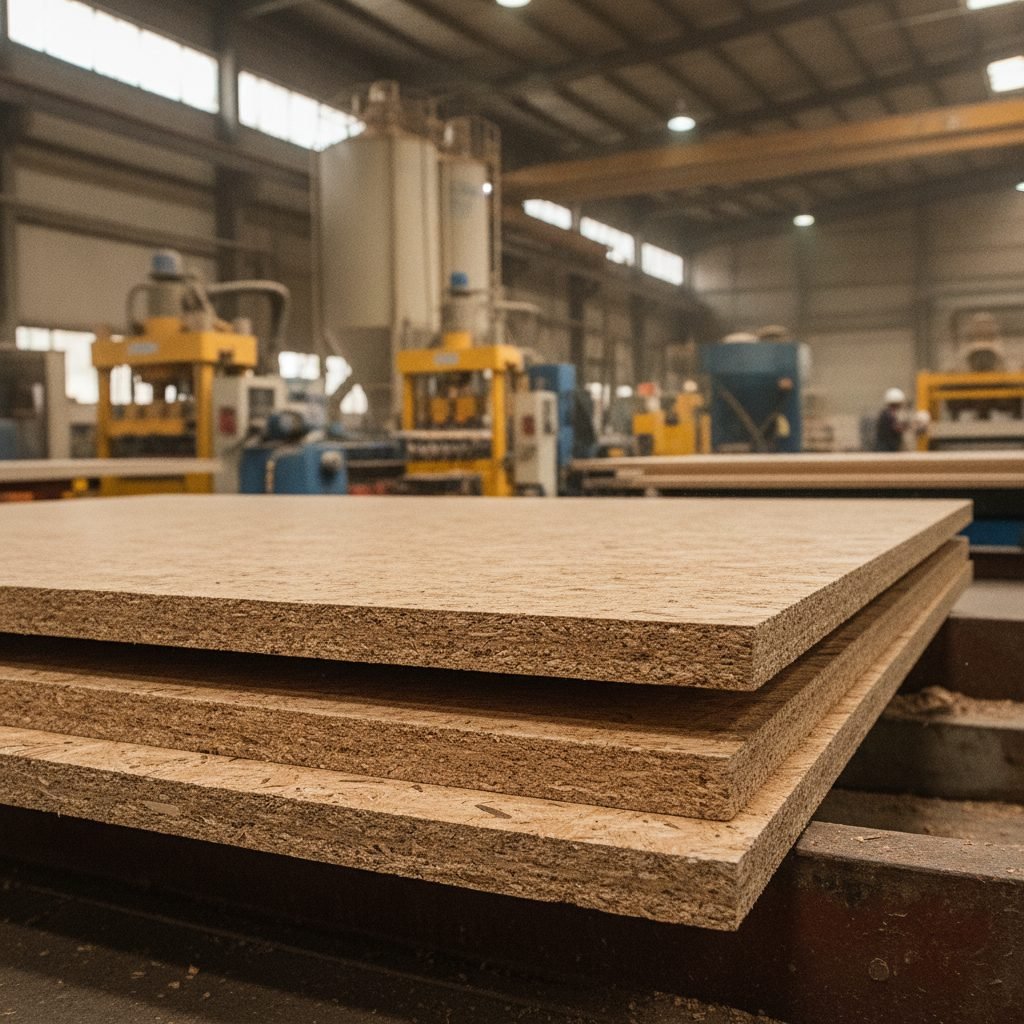


European particleboard prices climbed 8–12% in the opening quarter of 2025, marking the steepest advance since late 2021, as sawmill fiber tightness and elevated energy costs converge to squeeze margins across the continent. For procurement managers tracking global wood markets, the shift demands immediate contract strategy review.
Market Snapshot
The data paints a picture of sustained inflationary pressure across European particleboard trading:
- Central European pricing: Standard P2 particleboard (18mm) traded at €195–€210/m³ ex-mill in Poland and Czech Republic in March 2025, up 9% quarter-on-quarter from Q4 2024 (€178–€192/m³).
- German premium segment: FSC-certified P2 grades at Egger and Pfleiderer mills in Baden-Württemberg reached €225–€240/m³, reflecting tight domestic supply and strong furniture OEM demand from Southwestern Germany.
- Scandinavian softwood fiber: Swedish and Finnish sawmill availability fell to 62% of typical quarterly throughput in January–February 2025, due to planned maintenance and export demand to North America, restricting raw material inflow for particleboard producers like Norbord and Egger’s Nordic operations.
- Energy cost pass-through: Natural gas in Northwest Europe (TTF futures) averaged €34/MWh in Q1 2025, compared to €28/MWh in Q4 2024—a 21% increase reflected in mill operating costs and final pricing.
- Import displacement: Chinese particleboard imports to the EU fell 14% year-on-year in Q1 2025 (to 187,000 m³), as sea freight costs (Shanghai–Hamburg) rose to $1,840/TEU, making landed costs in Germany exceed domestic mill pricing for the first time since 2022.
- Certification premium: PEFC-certified stock commands a €12–€18/m³ uplift over standard grades, reflecting furniture buyer preference and compliance requirements for Scandinavian retailers (IKEA supply chain impact).
Deep Analysis
Sawmill Fiber Supply Crunch and Seasonal Capacity Loss
The root of price inflation lies in a paradox: European softwood sawmill production is robust, yet particleboard fiber availability has tightened unexpectedly. In Scandinavia—the primary feedstock region for Central European particleboard mills—annual maintenance shutdowns typically occur in May through June. However, mills advanced and extended shutdowns into January–March 2025 to capitalize on elevated sawn timber prices (Softwood Sawlog Index up 6% YoY). This pre-emptive move starved particleboard producers of wood chips exactly when demand from Italian, German, and Polish furniture manufacturers peaked heading into spring. Kronospan and Egger both cited fiber procurement delays in earnings calls, signaling the constraint is industry-wide rather than producer-specific.
Additionally, North American demand for Scandinavian chips has rebounded post-tariff stabilization, pulling supply away from the EU. West Fraser and Tolko’s Canadian mills have stepped up European chip purchasing to support their own particleboard lines in the UK and Central Europe, competing directly with traditional suppliers in Poland and the Czech Republic.
Energy Costs as a Secondary Cost Driver
While fiber is the headline story, energy represents 12–15% of European particleboard mill operating costs. Natural gas prices, though down from 2022 peaks, remain elevated relative to 2019–2020 baselines. Mills in Germany, Poland, and Austria are particularly exposed: German producers at Pfleiderer and Egger rely heavily on grid electricity and gas for dryer and press operations. Mills with biomass-fired boilers (Sonae in Portugal, Norbord in the UK) enjoyed a modest cost advantage, translating to €5–€8/m³ pricing relief—but this competitive edge has not yet shifted market prices broadly downward, as supply remains the binding constraint.
Trade Flow Rebalancing and Chinese Competition
For the first time since 2019, European producers face reduced competitive pressure from Chinese imports. Landed cost for Chinese P2 particleboard (18mm, ex-Qingdao mill, 40ft container) sits at €210–€225/m³ delivered to Frankfurt, nearly parity with premium domestic grades and above Central European standard pricing. This eliminates the traditional 8–12% Chinese discount that once forced European mills to chase volume. The shift has psychological and structural significance: European mills can now sustain margin at higher list prices, and procurement teams cannot rely on import arbitrage to suppress domestic quotes.
| Region / Grade | Q1 2025 (€/m³) | Q4 2024 (€/m³) | QoQ Change (%) | Primary Driver |
|---|---|---|---|---|
| Central Europe, Standard P2 (18mm) | 195–210 | 178–192 | +9.5% | Fiber supply tightness |
| Germany, P2 FSC (18mm) | 225–240 | 210–225 | +7.0% | OEM demand + certification |
| Scandinavia, Standard P2 (22mm) | 205–220 | 190–205 | +8.2% | Sawmill maintenance cycles |
| Southern Europe (Spain/Portugal), P2 | 188–202 | 172–186 | +9.3% | Fiber + energy |
| UK, Standard P2 (18mm) | 210–225 | 198–212 | +6.8% | Pound weakness + import costs |
| Chinese Import, ex-Qingdao (18mm) | 210–225 | 195–210 | +7.7% | Freight costs |
Market Implications
Impact on Furniture OEMs
Italian and Polish furniture manufacturers—the largest regional end-users—have absorbed the price increases but are reaching margin constraints. Major OEMs such as Natuzzi and Paged are extending payment terms with particleboard suppliers from 30 to 60 days to preserve working capital. Some smaller manufacturers are testing lower-grade P1 and industrial-grade stock as substitutes, trading durability for cost relief. Expect upstream pricing pressure on retail furniture through mid-2025; European furniture price indices are already rising 2–3% QoQ.
Impact on Construction and Distribution
Residential construction and panel distributors face a dual squeeze: higher cost inputs and mixed demand signals. Construction activity in Germany and France remains steady (housing starts up 4% YoY), supporting demand, yet merchant distributors report lengthening inventory hold periods as customers defer non-essential renovation projects. Distributors like Baumarkt Group (Germany) and BuildSupply (Central Europe) are narrowing margins on particleboard SKUs to move stock, compressing their own profitability and limiting their ability to absorb further supplier price hikes.
Impact on Laminate and Veneer Processors
Engineered wood product manufacturers (laminate, MDF-veneer composites) are experiencing acute cost pressure. These businesses operate on thin 8–12% gross margins and have limited pricing power downstream to retail (IKEA, Kingfisher Group). A €15/m³ particleboard price increase translates to €0.50–€0.75 per finished laminate panel, forcing processors to renegotiate supply contracts or accept margin compression. Some Eastern European processors are exploring partial substitution with higher-density fiberboard (HDF) or MDF for select applications, but this is a tactical workaround, not a structural solution.
Regional Price Divergence
Central Europe (Poland, Czech Republic) remains the pricing epicenter due to mill concentration and strong OEM clustering. Germany maintains a 4–6% premium to Poland due to higher domestic labor costs, stricter certification requirements, and proximity to wealthy consumer markets. Southern Europe (Spain, Portugal) shows faster price acceleration (+9–10% QoQ) because mills are smaller and more exposed to energy costs; they lack the scale to absorb margin pressure. Scandinavian pricing sits between Germany and Central Europe, anchored by stable sawmill supply but elevated transportation costs to key OEM hubs in Italy and Germany.
Outlook & Buyer Recommendations
Price Direction (Q2–Q3 2025): Expect particleboard prices to remain elevated (€195–€220/m³ Central Europe) through June, with modest upward bias if Scandinavian sawmill maintenance extends into April. The single most important driver is fiber availability: any extended shut-downs or export diversion to North America will sustain the floor at current levels. A modest 2–4% correction is possible in Q3 (July–September) if energy prices ease and demand seasonally softens, but the 2024 baseline is unlikely to re-test before Q4 2025.
Risk Scenarios:
- Upside Risk (Prices +5–8% further): Additional North American tariff uncertainty or supply disruption (mill fire, extended maintenance) could trigger panic buying and forward-contract acceleration, pushing Central European prices to €215–€230/m³. Furniture OEMs would respond by cutting production volumes.
- Downside Risk (Prices –3–6%): Faster-than-expected economic slowdown in Germany or Italy (residential construction decline) combined with energy price deflation could ease demand and allow mills to stabilize supply-demand balance. This scenario is less probable but would emerge visibly by late May 2025.
Buyer Recommendations:
- Lock in Q2 and Q3 forward contracts immediately (March–April 2025): At current pricing (€195–€210/m³ Central Europe), a 90-day fixed-price agreement locks in margin and eliminates weekly quote volatility. Furniture OEMs and large distributors should prioritize 500–1,000 m³ volume commitments to secure best-available rates.
- Diversify supplier base across regions: Single-sourcing from a German mill exposes you to a 4–6% premium. Negotiating parallel relationships with Polish (Kronospan, local mills) and Portuguese (Sonae) suppliers creates competitive discipline and hedge risk. Requires 2–3 months of relationship building but yields sustainable cost benefit.
- Stress-test laminate and veneer processing economics: If your finished product margin is <10%, particleboard price increases are non-absorbable. Model a €20/m³ additional increase and identify either (a) retail price adjustments, (b) material substitution, or (c) production volume reductions now, rather than react in April–May.
- Monitor sawmill maintenance schedules: Egger, Kronospan, and Norbord publish maintenance calendars 6–8 weeks in advance. May–June shutdowns are standard, but extensions signal fiber tightness. Buyers should front-load purchases before May shutdowns and reduce forward exposure in July when supply typically rebounds.
- Evaluate Chinese import arbitrage—cautiously: At parity with European mill pricing (€210–€225/m³ landed), Chinese imports are no longer a cost tool, but they are still available for specialty grades (lightweight, fire-retardant) where European mills operate at lower capacity. Freight costs remain your biggest variable; negotiate FOB Qingdao in USD and lock in freight rates separately.
European particleboard pricing has shifted from a buyer’s market to a constrained supply environment in Q1 2025. The combination of fiber tightness, elevated energy, and waning Chinese competition has handed pricing power to European mills—a reversal of the 2019–2023 dynamic. Procurement teams must adapt: short-term fixes (spot buying, import substitution) are no longer viable; strategic contract negotiation, supply diversification, and volume forecasting are now the competitive differentiators. Price relief is unlikely before Q4 2025, and procurement budgets should reflect €15–€25/m³ adders to 2024 baselines through year-end. For live data and price benchmarks, visit our timber prices tracker on TimberInsider.
Frequently Asked Questions
Why are European particleboard prices rising in 2025?
Softwood sawmill capacity constraints in Scandinavia, elevated energy costs in Central Europe, and strong furniture OEM demand from Italy and Germany are pushing prices upward. Chinese import competition has eased due to rising logistics costs and anti-dumping tariffs.
What is the typical price range for particleboard in Europe right now?
Standard P2 particleboard (18mm) ranges from €185–€215 per m³ ex-mill in Central Europe (Poland, Czech Republic), with premium grades in Germany and Scandinavia commanding €220–€245/m³. Prices vary by supplier, certification (FSC/PEFC), and order volume.
Which European suppliers should buyers monitor for price stability?
Kronospan (Austria/Poland), Egger (multiple European mills), Pfleiderer (Germany), Sonae (Portugal), and Norbord (UK) are the largest producers. Smaller regional players in Romania and Hungary offer discount pricing but less consistency.
How long are particleboard price contracts typically locked in?
Most European suppliers offer 30–90 day price fixes for standard volumes (50+ m³ per shipment). Larger OEMs (furniture, construction) negotiate quarterly or semi-annual price agreements with volume commitments of 500+ m³.
Will European particleboard prices fall before year-end 2025?
Unlikely before Q3. Sawmill maintenance shutdowns in May–June may tighten fiber supply further. Relief is possible in Q4 if energy prices fall and demand slows seasonally, but expect prices to remain 5–8% above 2024 baseline through December.
Update policy and background sources
This page was editorially reviewed on 13 July 2026. Dated prices and market shares are reference-period observations, not live quotations. Buyers should confirm specification, Incoterm, currency, tax, freight and quote validity before using a number commercially. Background statistics and standards for this subject are published by:
- U.S. Bureau of Labor Statistics PPI
- Eurostat producer prices
- FAOSTAT Forestry Production and Trade
- UNECE forest-products markets
TimberInsider separates observed data from estimates and does not treat a supplier list as certification or endorsement. See the editorial methodology, product guides and regional coverage for definitions and current context.


