



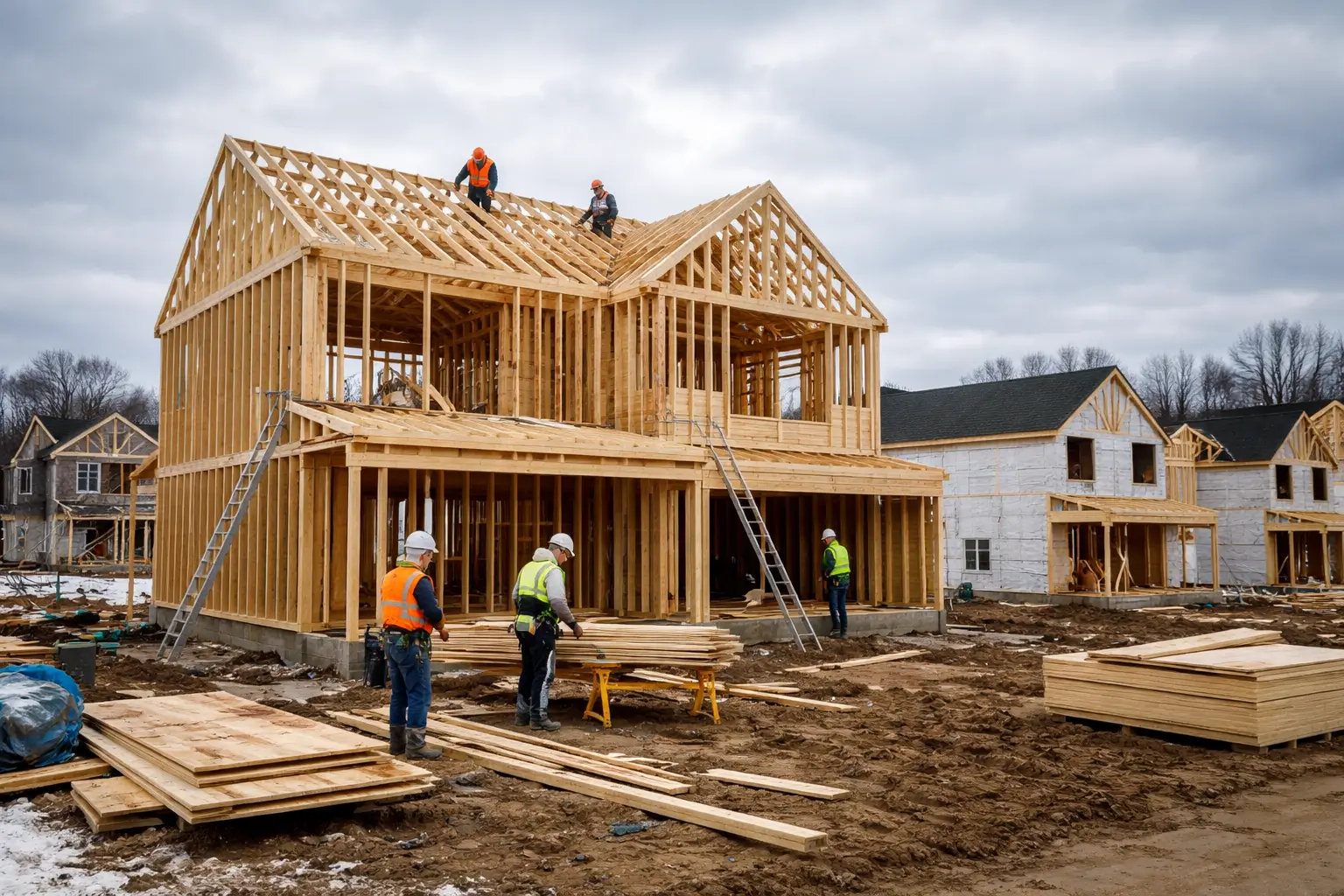


NAHB Housing Market Index weakened further at the start of the year, with US homebuilder confidence falling to 37 in January, underscoring persistent pressure from affordability constraints and weak buyer traffic. The latest reading confirms that residential builders remain cautious despite the continued use of price cuts and sales incentives to sustain demand.
The January decline marks a two-point drop from the previous month and keeps the NAHB Housing Market Index well below the neutral 50 threshold that separates expansion from contraction. According to the latest NAHB Housing Market Index release, builders continue to report limited near-term momentum across most housing segments.
Housing sentiment is closely monitored by panel markets participants tracking demand signals linked to OSB prices, given the strong relationship between single-family construction activity and structural panel consumption.
NAHB Housing Market Index signals weak builder confidence
The NAHB Housing Market Index is based on three components measuring current sales conditions, sales expectations over the next six months, and prospective buyer traffic. In January, all three components remained in contraction territory, reinforcing the view that residential construction activity has yet to regain sustained momentum.
Builder assessments of current sales conditions continued to point to subdued activity, while expectations for the next six months showed only limited stabilization. Buyer traffic remained the weakest element of the index, reflecting the ongoing impact of mortgage rates and affordability pressures on household purchasing decisions.
Extended periods of sub-50 readings in the NAHB Housing Market Index are typically associated with cautious land acquisition, slower project starts, and more conservative procurement strategies across the residential construction sector.
Incentives and pricing strategies in a soft housing market
Sales incentives remain a central tool for builders operating in a fragile demand environment. These incentives commonly include price reductions, mortgage rate buydowns, or non-cash upgrades designed to support transaction volumes despite affordability challenges.
While incentives can help sustain short-term sales activity, they also compress margins and signal underlying demand weakness. Persistent reliance on incentives often reflects limited pricing power rather than improving market fundamentals, a dynamic that remains evident in the current NAHB Housing Market Index readings.
For suppliers of construction materials, this environment tends to translate into cautious ordering behavior and reduced willingness to commit to long-term volume agreements.
Implications for structural panels and OSB demand
Single-family housing starts are a primary driver of oriented strand board consumption in the US market. Continued weakness in the NAHB Housing Market Index suggests that near-term OSB demand is likely to remain uneven, particularly outside of seasonal construction peaks.
When builder sentiment remains depressed, procurement strategies often shift toward shorter buying cycles and just-in-time deliveries. This behavior increases sensitivity to short-term price movements and can amplify volatility in spot panel markets, even when production capacity remains unchanged.
Panel producers and distributors closely monitor housing sentiment indicators alongside data on single-family construction activity, published by US housing authorities, to assess demand visibility and inventory risk.
Market impact
From a pricing perspective, subdued housing sentiment tends to cap upside momentum for structural panels while reinforcing buyer resistance to price increases. Mills and distributors typically view sustained weakness in the NAHB Housing Market Index as a signal to prioritize volume discipline and inventory management.
The January reading suggests that builders remain cautious heading into the early part of the construction year. Unless buyer traffic improves meaningfully, structural panel demand is likely to track sideways, with pricing influenced more by supply-side discipline than by end-market pull.
As long as incentives remain elevated and confidence subdued, the NAHB Housing Market Index will continue to serve as a key leading indicator shaping expectations across the US OSB market.


