



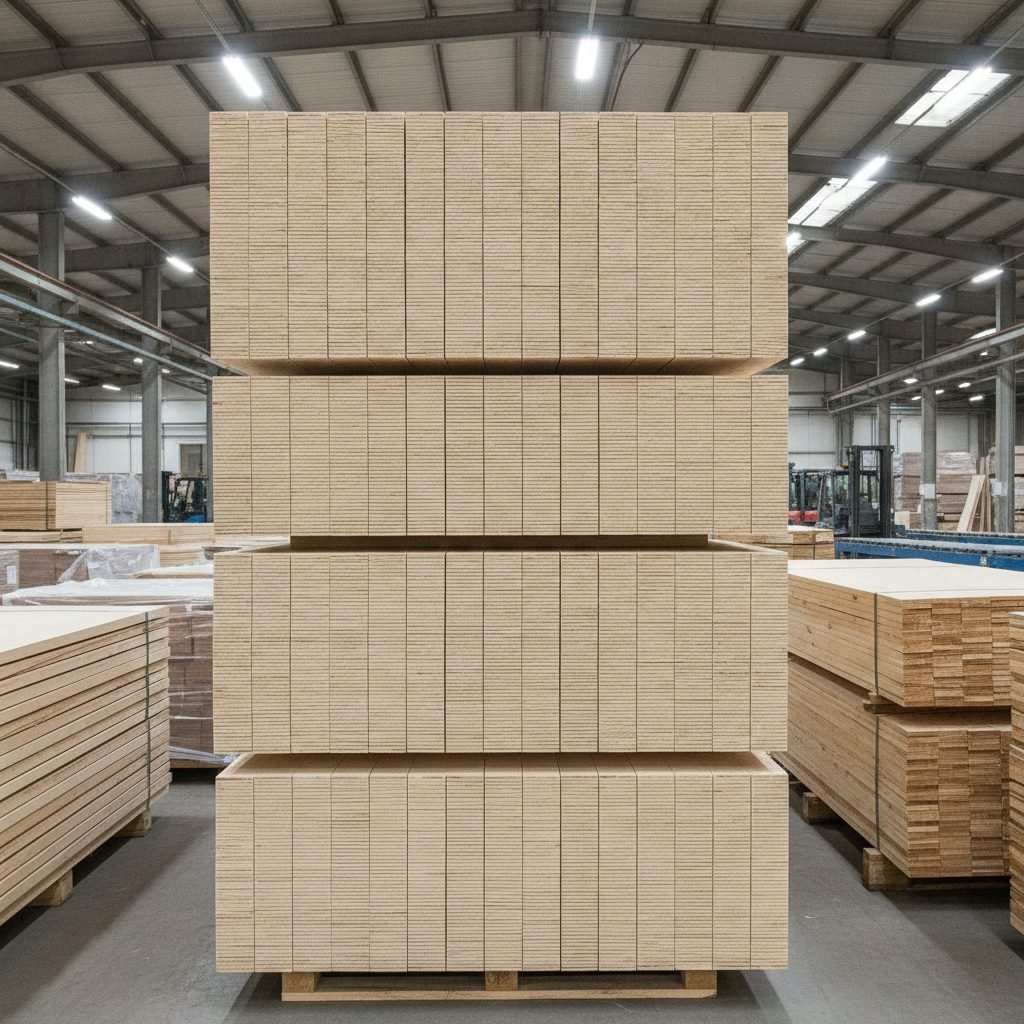


Updated July 13, 2026. There is no single reliable “plywood price today.” A valid price observation must include the quote date, country or delivery point, panel dimensions, thickness, species or product type, grade, bond classification, certification, quantity and commercial terms. This guide explains how to compare current quotes without presenting undated estimates as live market data.
For product selection and adjacent markets, see TimberInsider’s plywood grades guide, birch plywood sourcing, panel price overview and OSB price methodology.
Minimum data for a plywood quote
- length, width and performance category or actual thickness;
- plywood type, species and veneer construction;
- face/back grade and structural rating where applicable;
- bond classification and permitted exposure;
- sanded, overlaid, film-faced or unfinished surface;
- certification, emissions and origin documents;
- sheet count, pack size and minimum order;
- currency, tax, discount and payment terms;
- Incoterm or domestic delivery basis;
- quote timestamp and validity period.
Convert sheet prices correctly
A 4-by-8-foot sheet covers 32 square feet before cutting waste. Divide its price by 32 for price per square foot. A 2440-by-1220-mm sheet covers approximately 2.9768 m².
For cubic-metre comparison:
Sheet volume = length × width × thickness
A 2440 × 1220 × 18 mm panel contains about 0.05358 m³. A hypothetical $500/m³ material quote therefore equals about $26.79 per sheet before freight, tax, duties and handling. This is a calculation example, not a TimberInsider market quote.
Normalize North American MSF quotes
Some structural-panel benchmarks use dollars per thousand square feet (MSF) on a stated thickness basis. For a 4-by-8 sheet, multiply the sheet price by 31.25 to obtain the price per MSF. Divide an MSF quote by 31.25 for the sheet equivalent.
Thickness basis matters. Do not compare two MSF figures when one is normalized to a different thickness or product category.
Calculate delivered cost
Delivered sheet cost = material + freight + handling + duties + non-recoverable tax + finance cost − rebates
Then include expected waste, damage, storage, machining yield and rejects. A lower FOB or ex-mill price can become more expensive after ocean freight, inland haulage, inspection and working-capital costs.
Why grade changes the price
Finish-quality veneers, structural ratings, marine construction, exterior bonds, overlays, tight tolerances and verified certifications add different costs. A sheathing panel and a cabinet-grade birch panel serve different applications and should never be averaged as though they were one commodity.
APA explains that plywood is available in numerous appearance grades, thicknesses and performance categories. The certification mark, not a retailer’s short product name, provides the basis for comparison.
Global supply context
FAO reports 2024 global production of plywood and laminated veneer lumber combined at 113 million m³, up 4% from 2023. Because the published aggregate includes LVL, it must not be described as a plywood-only production figure.
FAO also reports 393 million m³ of total wood-based panel production in 2024. These annual volumes provide market scale but do not reveal a current local sheet price.
Demand indicators
Structural plywood demand responds to housing starts, repair and remodelling, industrial packaging and other construction. Decorative and hardwood plywood respond additionally to furniture, cabinetry and fit-out demand.
The U.S. Census Bureau estimated May 2026 housing starts at an annualized 1.177 million and single-family starts at 882,000. These survey estimates are revised and are not a plywood price index.
Trade and currency
Imported plywood costs depend on product classification, declared origin, duties, trade remedies, exchange rates, container rates and inland transport. Record the applicable HS code and customs decision rather than assuming every plywood panel receives the same treatment.
Currency conversion should use a documented rate tied to the quote or payment date. An undated exchange rate can create a false price movement.
Trade remedies can be exporter-, country- and product-specific and may change over time. Buyers should obtain a current customs classification and written landed-cost calculation from qualified advisers. TimberInsider does not infer a duty rate from a product name or apply one country’s measure to a different origin.
Quote-comparison table
| Field | Supplier A | Supplier B | Supplier C |
|---|---|---|---|
| Specification and standard | Record | Record | Record |
| Dimensions and thickness | Record | Record | Record |
| Grade and bond class | Record | Record | Record |
| Sheet / m² / m³ equivalent | Calculate | Calculate | Calculate |
| Delivered sheet cost | Calculate | Calculate | Calculate |
| Date and validity | Record | Record | Record |
Buyer checklist
- Define the performance and appearance requirement.
- Request identical specifications and quantities.
- Verify certification, emissions and origin documents.
- Normalize sheet, area, volume and thickness basis.
- Calculate delivered cost and expected yield.
- Keep the dated original quotation.
- Refresh the comparison when quotes expire.
Frequently asked questions
What is plywood price today?
It depends on the dated local quote and exact specification. There is no decision-grade global number without those details.
How do I compare sheet and cubic-metre prices?
Multiply length, width and thickness in metres to obtain sheet volume, then multiply the m³ quote by that volume.
Why is birch plywood more expensive than sheathing?
Species, veneer quality, layup, finish, tolerances, certification and market conditions differ.
Does Exterior plywood mean it can remain unfinished outdoors?
No. The bond classification is only one part of product and assembly suitability.
How often should prices be updated?
Whenever the underlying quote expires or its specification, currency or delivery terms change.
Sources and methodology
- APA — Plywood products and performance categories
- APA — Panel grades, ratings and standards
- FAO — 2024 forest-products statistics
- FAO — Forest-product classification methods
- U.S. Census Bureau — May 2026 housing starts
- U.S. EPA — Hardwood plywood formaldehyde requirements
Hypothetical conversions are labelled and are not price observations. See TimberInsider’s sources and methodology policy.


