



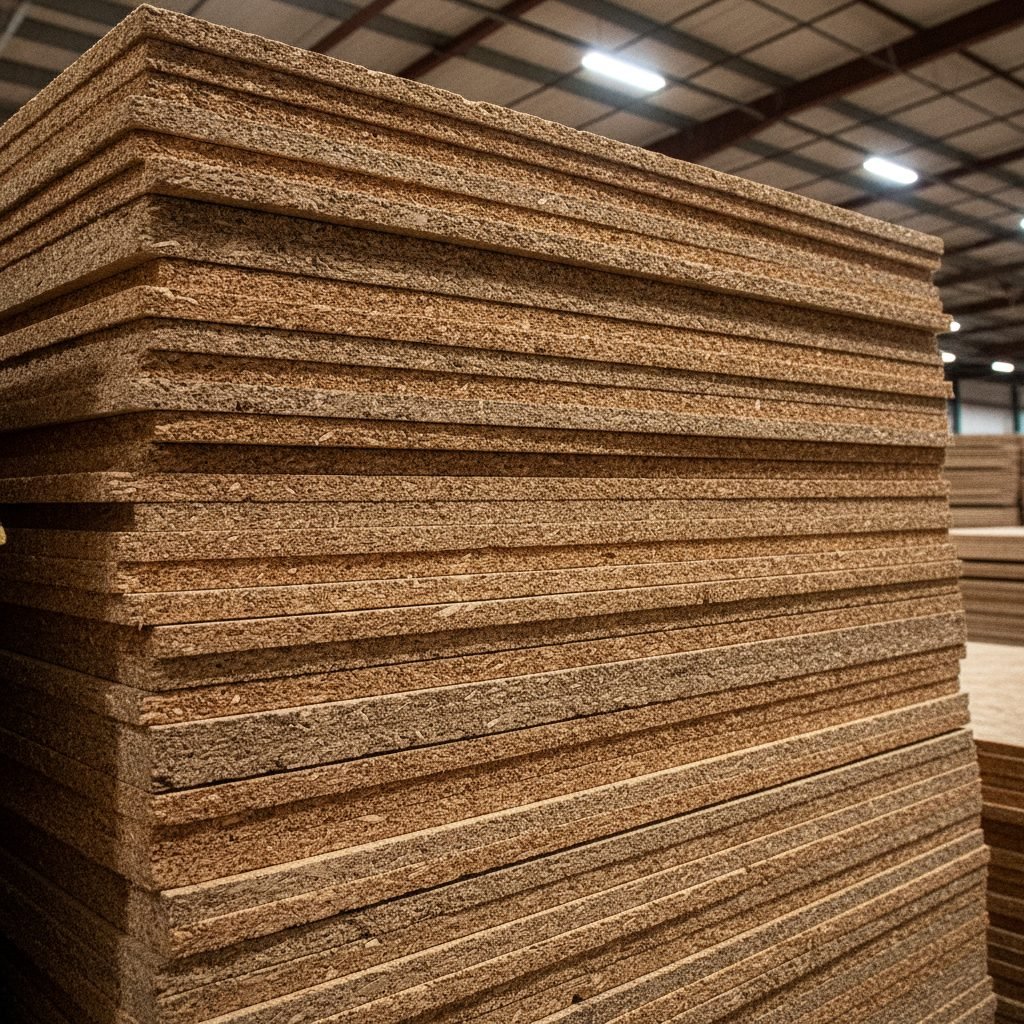


Updated July 13, 2026. There is no single global “OSB board price.” A usable 2026 benchmark must identify the panel thickness, dimensions, grade, certification, market, quote date, order volume and delivery terms. Retail shelf prices, distributor quotes and mill-level benchmarks are not interchangeable.
This guide explains how to compare current quotes without presenting an unsupported number as a live market price. For related coverage, see TimberInsider’s OSB prices hub, panel prices overview and OSB versus plywood subfloor guide.
OSB price snapshot for 2026
The demand and supply signals available in mid-2026 are mixed. The U.S. Census Bureau estimated May housing starts at a seasonally adjusted annual rate of 1.177 million, 15.4% below April and 8.7% below May 2025. Single-family starts were estimated at 882,000, but the reported month-to-month change was not statistically significant at the stated confidence interval. These figures describe construction activity; they are not an OSB price index.
On supply, West Fraser announced the indefinite curtailment of its High Level, Alberta OSB mill, expected to remove 860 million square feet of annual capacity on a 3/8-inch basis. It also said a 440-million-square-foot line at Cordele, Georgia would remain idled. The company attributed the High Level decision to weaker OSB demand. A capacity reduction can tighten supply in some lanes, but it does not by itself prove that prices will rise: inventories, competing mills, imports, freight and construction demand also matter.
What an OSB quote must specify
Before comparing two quotes, record all of the following:
- panel dimensions and performance category or nominal thickness;
- application and grade, such as Rated Sheathing or Sturd-I-Floor;
- span rating, edge profile and exposure or bond classification;
- applicable standard and certification mark;
- number of sheets or thousand square feet ordered;
- currency, taxes, rebates and payment terms;
- origin, destination, freight terms and delivery date;
- quote timestamp and validity period.
APA describes OSB as a structural wood panel and lists product categories and recognized standards in its manufacturer directory, including Voluntary Product Standard PS 2, CSA O325 and EN 13986. The APA trademark also identifies the span rating and bond classification. “Exposure 1” concerns the glue bond’s resistance to moisture during normal construction delays; it does not mean the panel is intended for permanent exterior exposure.
How to normalize North American quotes
A standard 4-by-8-foot sheet covers 32 square feet before waste. To convert a sheet quote into dollars per thousand square feet (MSF), multiply the sheet price by 31.25. Conversely, divide an MSF quote by 31.25 to obtain the equivalent price per 4-by-8 sheet. This conversion is valid only when thickness, grade and terms match.
Example: a hypothetical $14.00 sheet quote equals $437.50/MSF before freight, tax and waste. This is a calculation example, not a TimberInsider market quotation.
For a project estimate, use:
Required sheets = project area ÷ 32 × (1 + waste rate)
Round up to full sheets, then add delivery, handling, tax and any job-site surcharge. Do not compare a home-center shelf price with a truckload mill quote without adjusting for volume and logistics.
How to normalize European quotes
European offers may be stated per sheet or per cubic metre. The volume of one panel is length × width × thickness, with every dimension converted to metres. A 2.44 m × 1.22 m × 0.015 m panel contains about 0.04465 m³. A hypothetical €300/m³ ex-works quote therefore corresponds to about €13.40 per sheet before VAT, freight, packaging and distributor margin.
Do not compare that result directly with a North American 7/16-inch sheet. The thickness, standard, grade, dimensions and commercial terms differ. Currency conversion should use the rate applicable to the quote or payment date, not an undated rate copied into an article.
Delivered cost matters more than the headline price
The most useful procurement measure is delivered cost for a compliant panel:
Delivered unit cost = material + freight + handling + duties + non-recoverable tax + finance cost − rebates
Buyers should also account for breakage, moisture damage, waste, storage and lead-time risk. A lower ex-mill offer can be more expensive at the job site when the haul is longer or the pack configuration creates excess waste.
Demand indicators to monitor
North American OSB demand is closely linked to residential sheathing, subflooring and roof decking, as West Fraser notes in its capacity announcement. Useful public indicators include Census housing starts, permits, completions, new-home sales and construction spending. May 2026 private residential construction spending was estimated at a seasonally adjusted annual rate of $930.2 billion, 0.3% above April, while total construction spending was 1.5% below May 2025.
These releases contain sampling and revision uncertainty. A single monthly movement should not be treated as a direct forecast of next week’s panel quote. Watch several months, regional activity, distributor inventories and mill announcements together.
Cost indicators to monitor
Wood furnish, resin, energy, labour and freight all affect mill economics, but the pass-through to buyers depends on market balance and contracts. Eurostat’s industrial producer price index can provide broad context; its wood-products coverage includes NACE division 16. The headline EU industrial producer price increase of 0.2% in May 2026 is for total industry, however, and should not be presented as an OSB-specific movement.
For purchasing decisions, supplier quotes with identical specifications are stronger evidence than a broad commodity or industry index. Keep at least three comparable quotes where possible and preserve the quote date and terms.
Buyer checklist for 2026
- Define the required structural rating before requesting prices.
- Ask every supplier for the same thickness, dimensions, grade, quantity and delivery basis.
- Normalize offers to cost per sheet, MSF or cubic metre.
- Calculate delivered cost rather than comparing headline prices.
- Confirm the certification mark and product documentation.
- Record quote timestamps and validity periods.
- Use public construction and mill-capacity data as context, not as substitute quotations.
Frequently asked questions
What is the average OSB board price in 2026?
An average without a date, location, specification and delivery basis is not decision-grade. Request current local quotes for the same panel and normalize them using the methods above.
Can I compare a per-sheet price with an MSF quote?
Yes, when both refer to 4-by-8 sheets with the same thickness, grade and terms. Multiply the sheet price by 31.25 to calculate the equivalent price per MSF.
Does Exposure 1 mean OSB can remain outdoors permanently?
No. APA states that bond classifications may be Exterior or Exposure 1. Exposure 1 is associated with moisture exposure during construction, not permanent weather exposure.
Will a mill closure automatically raise OSB prices?
No. It reduces available capacity, but the price effect also depends on demand, inventory, other producers, imports, freight and the affected region.
How often should an OSB price page be updated?
Update dated market observations whenever the underlying quote or release changes. Keep the methodology stable and label every numerical observation with its period and source.
Sources and methodology
- U.S. Census Bureau — New Residential Construction, May 2026
- U.S. Census Bureau — Construction Spending, May 2026
- West Fraser — OSB capacity reduction announcement
- APA — Oriented Strand Board
- APA — Understanding the APA trademark
- Eurostat — Industrial producer prices, May 2026
TimberInsider does not represent the hypothetical conversion examples as live offers. See the site’s sources and methodology policy for the distinction between observed data, calculations and editorial interpretation.


