



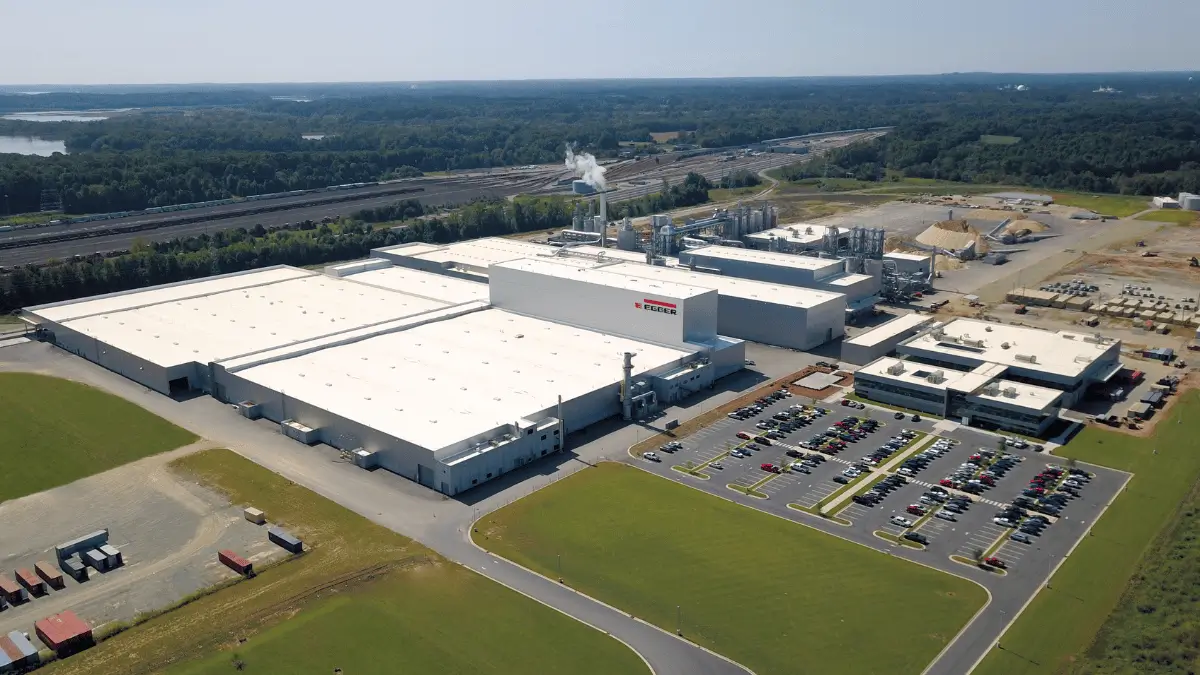


EGGER’s Markt Bibart programme is a multi-stage industrial upgrade, not simply the opening of one lamination line. The group says it is investing more than €200 million at the German site through 2026 in sustainability, upgrading and automation. For panel buyers, the relevant questions are how the programme changes finishing capability, recycled-wood use and supply reliability.
What EGGER has confirmed
EGGER acquired Markt Bibart in 2023 and integrated it as its 22nd production site. Its official 2025 reporting describes the first expansion phase as advanced and identifies the project as one of the group’s largest investments. A short-cycle press adds value by applying decorative surfaces to particleboard; it does not by itself increase every type of board capacity.
Investment scope
The stated programme covers more than decorative lamination. EGGER links the spending to modernisation, automation, sustainability and recycled-wood processing. Buyers should therefore separate three effects: additional finishing flexibility, changes in the fibre mix and operational improvements that can reduce bottlenecks.
Why lamination matters
A short-cycle press bonds resin-impregnated decorative paper to a wood-based panel under heat and pressure. The output is used in furniture, cabinetry and interior applications. Moving more finishing onto the site can shorten the chain between raw particleboard and a saleable decorative panel, but lead times still depend on décor paper, resin, press scheduling and logistics.
Recycled wood and circularity
EGGER also announced recycled-wood processing at Markt Bibart. Recovered fibre can reduce demand for virgin roundwood, subject to contamination controls and product specifications. Procurement teams should request product-specific recycled-content declarations rather than applying a site-level statement to every board.
Capacity claims require care
EGGER’s public releases confirm the investment value and direction, but they do not provide a single simple figure for incremental saleable square metres across all products. TimberInsider therefore does not convert the €200 million programme into an unsupported capacity estimate. Nameplate press capacity, usable output and market supply are different measures.
Buyer implications
- Ask which thicknesses, formats and décors are qualified on the new equipment.
- Confirm minimum order quantities and allocation rules during ramp-up.
- Request current declarations for formaldehyde, recycled content and chain of custody.
- Compare ex-works price with freight and service level, not with an isolated board price.
Market context
European panel demand remains exposed to furniture production, renovation and construction. A modernised site may be positioned for a recovery, but an investment announcement is not evidence that demand has already recovered. Our European wood panel market review tracks those demand indicators, while the particleboard price guide explains quote comparison.
How to monitor the ramp-up
Useful checkpoints are commissioning announcements, product-range updates, delivery performance and later financial disclosures. For broader comparisons, see our product guides, regional coverage and source methodology.
Specification questions for buyers
A new finishing line does not make every décor immediately interchangeable. Buyers should document board core, thickness tolerance, surface texture, colour reference, gloss level, abrasion class and permitted end use. Sample approval should precede a large order, particularly when panels from an established line are being matched with panels from newly commissioned equipment. Batch-to-batch colour control, protective film and packaging also affect the result received by a furniture factory.
Compliance files should be linked to a named product and production site. Relevant documents may include declarations of performance where applicable, formaldehyde-emission evidence, chain-of-custody claims and technical data sheets. A general corporate sustainability report is useful context, but it is not a substitute for the current certificate scope or product declaration.
What the investment does not prove
The investment amount is not a forecast of annual revenue, output or market share. Construction spending includes buildings, energy systems, material handling, environmental controls and automation as well as production machinery. Nor does commissioning mean full utilisation on day one: qualification, operator training, maintenance optimisation and customer approvals can make a ramp-up gradual.
It is also too early to claim a specific effect on European particleboard prices. Market prices depend on utilisation across many mills, furniture orders, construction, energy, wood availability, imports and freight. The project can improve EGGER’s competitive position without producing a measurable regional price decline.
Delivered-cost comparison
For a valid comparison, normalise quotes to the same board thickness, usable square metres, décor, edge requirements and destination. Add freight, pallet or packaging charges, payment terms, expected rejects and the cost of holding safety stock. A panel with a lower ex-works price can be more expensive if minimum lots, lead time or quality variation increase working capital and waste.
Frequently asked questions
Is Markt Bibart a new EGGER site?
It became part of EGGER through the 2023 acquisition. The current programme modernises and expands an existing industrial site.
Does €200 million refer only to lamination?
No. EGGER describes a broader programme covering sustainability, modernisation and automation, including recycled-wood processing.
When is the project complete?
The company’s public timetable points to work through 2026. Individual equipment can enter service before the full programme is complete.
Will all panels contain recycled wood?
That cannot be inferred. Recycled content varies by product, specification and production recipe and should be confirmed in product-specific documentation.
Editorial conclusion: the confirmed story is a broad site transformation with lamination as one visible milestone. Future updates should be tied to EGGER commissioning notices and product documentation, not estimates derived from the investment value.
Sources and methodology
This article was checked on 13 July 2026 against EGGER’s 2025/26 half-year results, its 2025 annual press conference, Eurostat PRODCOM, the European Commission’s EUDR guidance and FSC chain-of-custody guidance. Corporate statements establish project facts; market implications are TimberInsider analysis.


