



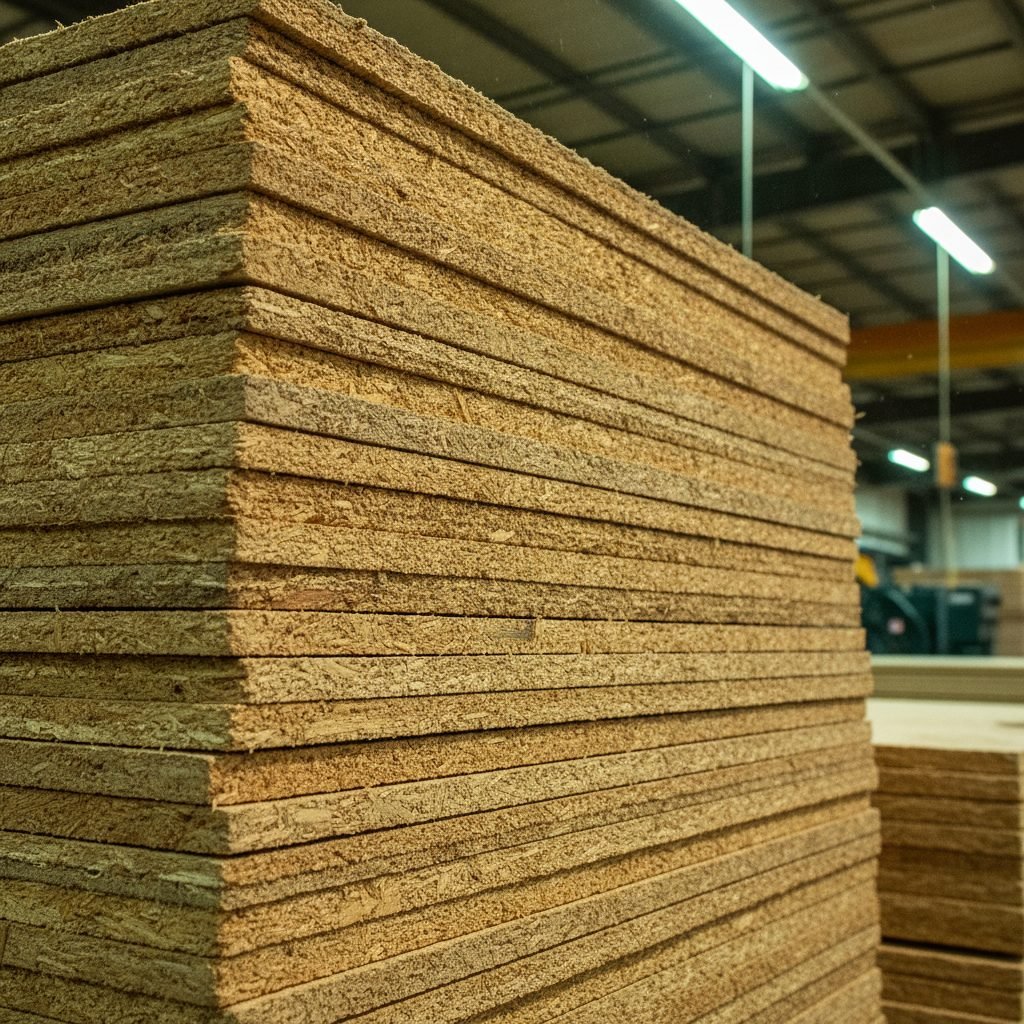


OSB sheathing prices in the USA hover near $400 per thousand square feet in early 2025, but regional divergence is widening as Southeast homebuilding outpaces Midwest and Western activity. After a softer Q4 2024, mills are gradually tightening operating windows, signaling a more balanced supply-demand picture heading into spring construction season.
Market Snapshot
OSB sheathing pricing across major North American regions reflects a market in flux:
- Southeastern region (Georgia, North Carolina): $410–$425/msf ex-mill, up 3.2% quarter-over-quarter. Regional builders absorb premiums due to concentrated residential permit growth and limited alternative suppliers.
- Midwest (Minnesota, Wisconsin, Iowa): $385–$395/msf ex-mill, flat to down 1.8% QoQ. Norbord and Tolko maintain competitive pricing to hold volume amid softer regional new construction.
- West Coast (Oregon, Washington): $405–$418/msf, plus $18–$22/msf freight to Los Angeles or San Francisco. Weyerhaeuser capacity utilization at 81% supports steady pricing.
- Aspen and pine chip costs: Averaging $58–$64/green ton at mill door, up 4.2% year-over-year due to expanded OSB demand and tighter pulpwood supply in the Upper Midwest.
- Mill capacity utilization: Industry-wide average of 79% in Q1 2025 versus 74% in Q1 2024—producers running harder but not constrained, leaving room for price volatility rather than sustained runs.
- Random Lengths Framing Lumber Index: Softwood 2×4 studs averaged $385–$410/MBF in early 2025, creating mixed signals for panel demand as builders weigh total framing system costs.
Check the panel prices overview for real-time competitive positioning against plywood and particleboard alternatives.
Deep Analysis
Residential Permit Momentum Drives Uneven Regional Demand
U.S. housing starts climbed 8.3% year-over-year in Q4 2024 and remained elevated in January–February 2025. However, growth is geographically concentrated: the Southeast (Florida, Texas, Georgia, North Carolina) is running 12–15% above prior-year levels, while the Upper Midwest and Northeast grow only 2–4%. This bifurcated demand is pushing Southeast OSB sheathing prices upward faster than the national average. Southeastern mills—primarily Norbord’s Southaven, Mississippi facility and a cluster of smaller regional converters—operate above 85% capacity, leaving them less price-sensitive to spot buyer negotiations. Midwest mills, including Tolko’s Bemidji and Weyerhaeuser’s Longview operations, run at 74–78% utilization and actively compete for volume, depressing regional prices.
Aspen Pulpwood Supply Tightness Sustains Input Cost Floor
Aspen and pine chip availability—the primary furnish for OSB manufacture—remains constrained in the Upper Midwest and Great Lakes. Sawmill residue volumes are adequate, but pulpwood harvest rates are 4–6% below prior-year levels due to wet weather in Minnesota and Wisconsin logging seasons and steady demand from tissue manufacturers competing for the same feedstock. Chip prices at the mill gate averaged $60/green ton in February 2025, versus $55/ton in February 2024. This 9% year-over-year cost increase is being partially absorbed by producers (margins compressed 8–12 per unit) and partially passed to buyers through modest price increases. Producers are not yet rationing supply, but they are less aggressive on discounting, supporting a price floor near $385/msf even in soft regions.
Natural Gas Cost Trajectory and Dryer Operations
OSB drying is energy-intensive; natural gas represents 8–12% of total manufacturing cost. Spot natural gas prices in the USA averaged $2.65–$2.85/MMBtu in early 2025, down from $3.10 in early 2024 but up 18% from the pandemic lows of 2020. Producer hedging strategies have locked in Q1–Q2 natural gas costs at levels $0.20–$0.40/MMBtu above current spot, providing some cost insulation but reducing the margin benefit of falling commodity gas. If natural gas rebounds to $3.50+/MMBtu during summer cooling demand, OSB producers will have less pricing flexibility. Current forward curves suggest stability through Q2, so mill economics remain resilient but not expansive.
| Region | Price Range ($/msf) | QoQ Change (%) | YoY Change (%) | Mill Utilization (%) | Primary Producers |
|---|---|---|---|---|---|
| Southeast | $410–$425 | +3.2 | +6.8 | 85–87 | Norbord Southaven, Regional Converters |
| Midwest | $385–$395 | −1.8 | +1.2 | 74–78 | Tolko Bemidji, Weyerhaeuser Longview |
| West Coast | $405–$418 + $18–$22 freight | +2.1 | +4.5 | 81–83 | Weyerhaeuser, Potlatch Deltic |
| Northeast (Delivered) | $440–$465 | +1.9 | +3.1 | Implied 76–79 | Canadian imports (Tolko, Norbord), Regional stock |
| Raw Aspen Chip Cost ($/green ton) | $58–$64 | +2.8 | +9.1 | Supply: Moderate constraint | Sawmill residue, harvest-dependent |
Market Implications
Specialty Residential and Light Commercial Segment
Custom home builders and light commercial contractors (schools, small office) buy smaller volumes and often procure spot or on 30-day rolling orders through regional distributors. They face delivered prices 8–14% above mill quotes due to distributor margin (typically 12–18%) and smaller purchase volumes. In the Southeast, delivered OSB sheathing to job sites runs $475–$520/msf; in the Midwest, $430–$460/msf. This segment is most price-sensitive and most likely to pivot to plywood alternatives (15–22% premium but offering superior moisture resistance and fastener holding) if OSB pricing approaches $420/msf on a spot basis. Currently, most stick with OSB for cost discipline, but further price increases will shift marginal projects to plywood or engineered lumber products.
Outlook & Buyer Recommendations
3–6 Month Price Direction
OSB sheathing prices are expected to remain in a $390–$425/msf range through Q2 2025, with slight upward bias in the Southeast (+2–3%) and flat to down pressure in the Midwest (−1% to flat). The single most important driver is residential construction permit trends: if March–May 2025 permits exceed 1.45 million annualized starts, producers will tighten pricing and utilization will push above 82%. If permits soften to below 1.35 million, excess Midwest and West Coast mill capacity will reappear, and spot pricing could slide to $375–$385/msf in those regions. Aspen chip costs are the secondary driver; a sustained climb above $65/green ton would limit producer flexibility below $395/msf, whereas a correction to $55/ton would unlock 3–5% pricing downside.
Risk Scenarios
Upside Risk (Pricing to $430–$450/msf by Q3): A confluence of spring permit strength (permits exceed 1.5M annualized), a cold snap reducing aspen harvest productivity, and natural gas futures spiking to $3.75/MMBtu would compress producer margins if not quickly passed through. Southeastern mills would lead pricing upward, and the national average could spike 8–12% within 8–10 weeks. Builders with unhedged Q3 volume would face serious budget pressure.
Downside Risk (Pricing to $370–$380/msf by mid-Q2): A surprise softening of housing permits below 1.3M annualized starts, combined with aspen chip prices falling to $52/ton due to logging resumption, would see Midwest mills aggressively cut pricing to maintain utilization. Retail and distributor promotions would accelerate, and spot buyer pricing could fall below $375/msf across the Midwest and parts of the West Coast. Builders with forward contracts locked at $410+/msf would face margin pressure.
Buyer Recommendations
- Lock 60–70% of Q2 and Q3 volume on forward contracts now. At current pricing ($390–$420/msf by region), forward orders offer reasonable price certainty. The 2–3% forward premium to spot is cheap insurance against a 5–8% upside spike if permits accelerate. Negotiate 90–120 day terms to align with quarterly cash flow cycles.
- Maintain 30–40% volume flexibility for spot or spot-plus deals. Hold cash flow reserves to capitalize on promotional periods from distributors or spot weakness in high-utilization regions. This optionality is especially valuable if mills soften in May–June.
- Evaluate plywood substitution economics for specialty projects. If OSB sheathing prices drift above $420/msf on a spot basis, model the cost-benefit of switching to 1/2” exterior plywood ($520–$570/msf) for projects with extended exposure to weather or high fastener loads. The 18–25% premium may shrink if labor rework costs are reduced.
- Monitor regional mill capacity reports monthly. Utilization rates above 85% in your region signal producer pricing power; below 75% signals weakness. Adjust forward lock percentages accordingly.
- Diversify supplier relationships across regions where logistically feasible. Relying solely on Southeast suppliers locks you into higher regional pricing. Building secondary relationships with Midwest and West Coast mills—even at slightly higher freight cost—preserves negotiating leverage.
OSB sheathing pricing in the USA is entering a balanced market phase in 2025: sufficient mill capacity to prevent supply crunches, but enough regional demand concentration to prevent a collapse to 2020 lows. Residential builders and contractors who lock 60–70% of forward volume at current levels while maintaining spot flexibility will navigate the next two quarters most effectively. Producers are rebuilding margin after a margin-compressed 2024, so aggressive spot discounting is unlikely unless permit data turns sharply negative. Conversely, with aspen chip costs likely to stabilize and natural gas remaining moderate, structural upside is capped unless external shocks materialize. For live data and price benchmarks, visit our OSB price tracker on TimberInsider.
Frequently Asked Questions
What is the current price range for OSB sheathing in the USA in 2025?
As of early 2025, OSB sheathing prices in North America range from $385–$420 per thousand square feet (msf) at the mill, depending on region and grade. Southeastern mills quote higher premiums due to regional demand, while Midwest mills trade at the lower end of the range. Prices fluctuate weekly based on raw material costs and order flow.
Why do OSB sheathing prices vary by region?
Regional price differences reflect local supply-demand balance, transportation costs, and mill capacity utilization. The Southeast (Georgia, North Carolina) commands 5–8% premiums over Midwest producers due to concentrated homebuilding activity. West Coast mills factor in longer haul distances to major markets, adding $15–25/msf to delivered costs.
How does OSB sheathing pricing compare to plywood?
OSB typically trades 15–25% below softwood plywood on a per-unit basis, though the gap narrows during supply constraints. For roof and wall sheathing applications where structural equivalence is acceptable under code, OSB remains the cost leader for budget-conscious builders and production home manufacturers.
What factors are driving OSB prices in 2025?
Key drivers include aspen and pine chip availability, natural gas costs for dryer operations, mill capacity utilization rates (currently 78–82%), and residential construction starts. Spring 2025 showed uptick in single-family permits, lifting demand and mill operating rates quarter-over-quarter.
Should I lock in OSB sheathing prices forward, or buy spot?
Forward contracts (90–120 day) offer price certainty but typically carry a 2–4% premium to spot pricing. Spot purchases work if you have immediate project needs and can absorb 3–5% weekly volatility. Most regional builders hedge 60–70% of quarterly volume through forward orders and keep 30–40% flexible for spot buys.
Update policy and background sources
This page was editorially reviewed on 13 July 2026. Dated prices and market shares are reference-period observations, not live quotations. Buyers should confirm specification, Incoterm, currency, tax, freight and quote validity before using a number commercially. Background statistics and standards for this subject are published by:
- U.S. Bureau of Labor Statistics PPI
- Eurostat producer prices
- FAOSTAT Forestry Production and Trade
- UNECE forest-products markets
TimberInsider separates observed data from estimates and does not treat a supplier list as certification or endorsement. See the editorial methodology, product guides and regional coverage for definitions and current context.


