



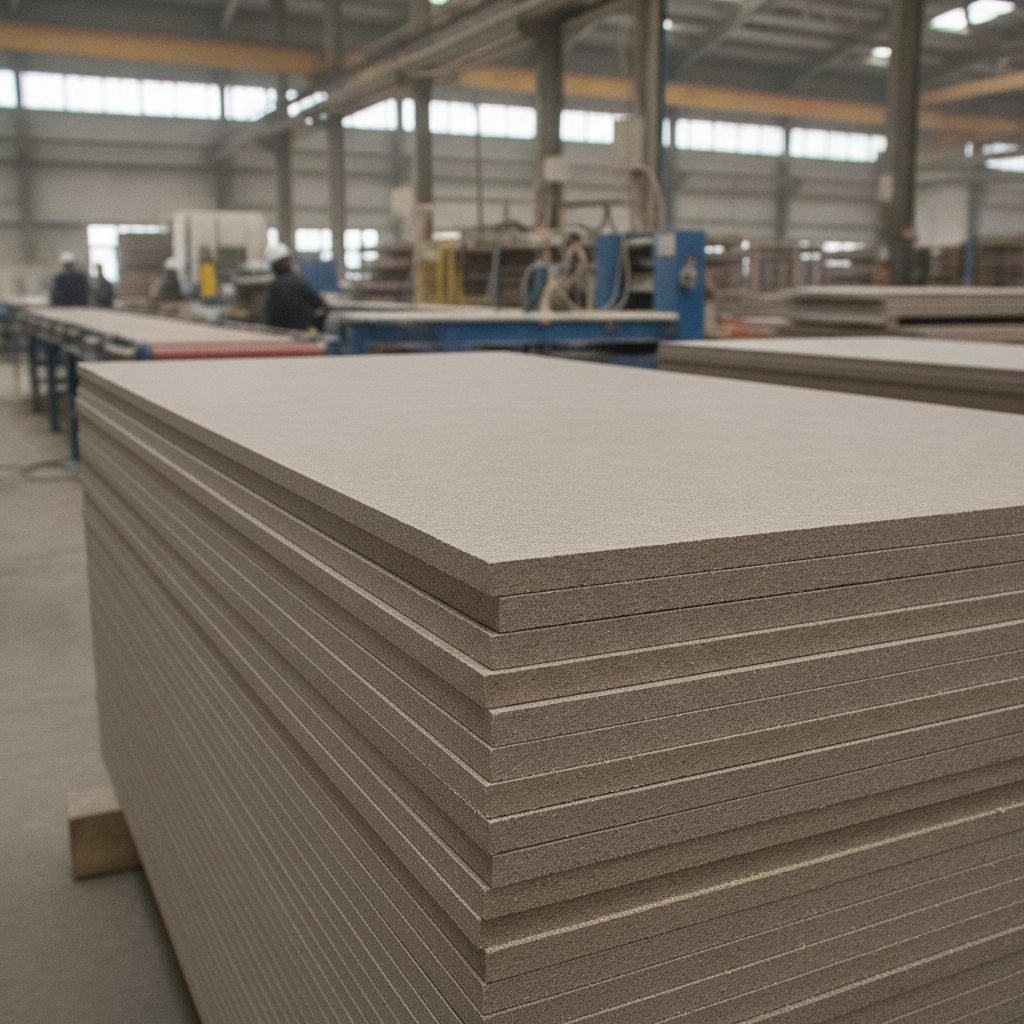


Chinese MDF export prices surged to their highest level since Q3 2024, climbing to $285–$310/m³ FOB Shanghai in Q1 2025—a 7% quarter-over-quarter increase driven by fibre scarcity, yuan strength, and strategic buyer restocking. This price reset threatens the cost advantage that Chinese panels have commanded in Asia-Pacific markets for a decade. Check our MDF price tracker for live benchmarks across origins and grades.
Market Snapshot
Chinese MDF export pricing in Q1 2025 reflects a market rebalancing across three critical vectors:
- FOB Shanghai standard E1 MDF: $285–$310/m³, up 7% from Q4 2024 ($268–$289/m³); domestic market pricing ($245–$265/m³) widened the export premium to 15–19%.
- Premium E0-grade export material: $320–$355/m³ for furniture-grade panels, matching Indonesian Surabaya prices and undercut typical European mill prices.
- Key producer benchmarks: Guangxi state-owned mills (Liuzhou, Guigang) quote $280–$305/m³; Anhui private mills (Chuhui, Yichang) quote $290–$320/m³; coastal Jiangsu traders (Nanjing, Suzhou) resell imported fibre-based stock at $310–$335/m³.
- Export volume momentum: Q1 2025 shipments reached 1.24 million m³ (Chinese Customs data), a 3.2% YoY increase despite price headwinds—signaling robust demand from India, Vietnam, and Southeast Asian distribution hubs.
- Yuan exchange dynamics: CNY strengthened to 6.82 USD/CNY in March 2025 vs. 7.12 in January, effectively raising export prices in foreign-currency terms by ~4% independent of mill cost inflation.
- Fibre cost pressure: Eucalyptus pulp (primary raw material) averaged $520–$545/tonne CFR China in Q1 2025, up 12% YoY; domestic plantation logs competed with export pulp demand, tightening mill feedstock.
Deep Analysis
Supply Tightening and Fibre Economics
Chinese MDF mills operate under a structural cost squeeze in 2025. Winter plantation restrictions (enforced November–February across Guangxi and Yunnan to protect soil integrity) reduced domestic hardwood log supply by an estimated 8–11%, forcing mills to bid competitively for imported eucalyptus pulp. Prices for softwood grade eucalyptus, landed CFR China, have risen from $485/tonne (Q4 2024) to $540/tonne (March 2025)—a $55/tonne or ~11% increase that mills cannot fully absorb without raising MDF export prices. Guangxi-based Liuzhou Hengyang Wood, China’s third-largest MDF exporter, signaled a €5–€8/m³ price floor increase for Q2 shipments in mid-March guidance calls, citing ‘unsustainable fibre cost absorption into H1.’
Simultaneously, domestic competing demand has intensified. Chinese furniture OEMs and flooring manufacturers (concentrated in Guangdong, Zhejiang, Fujian) executed forward purchases in February–March 2025 to lock in pre-tariff pricing ahead of potential U.S. and EU trade announcements. This domestic restocking behavior pulled inventory off export pipelines, creating temporary local shortages and pushing domestic prices to narrow the export margin—typically a sign of genuine underlying scarcity rather than speculative hoarding.
Trade Flow Rebalancing: India and Southeast Asia
India’s MDF import volumes surged 22% YoY in Q1 2025, reaching 187,000 m³ (source: DGFT India trade data), absorbing 15% of China’s total export supply. This is reshaping price dynamics significantly. Indian furniture OEMs (Godrej, Durian, local regional players) are paying $315–$330/m³ CIF Mumbai for Chinese MDF—a 12% premium to Q1 2024—because domestic Indian mills (Greenpanel, Century Ply) have raised prices 18% following a 28% spike in pulp costs. Indian importers face a calculus: pay high domestic prices or absorb tariff and logistics costs on Chinese imports. Most are choosing the latter, driving Chinese export volumes higher even at rising prices.
Vietnam and Thailand, historically price-sensitive arbitrage markets, show divergent behaviour. Vietnam’s MDF import demand (primarily for residential furniture and panel re-export into Laos, Cambodia) remains price-elastic—Vietnamese distributors (Hoang Anh Group, HPL) are negotiating Q2 2025 contracts at $295–$305/m³ FOB Shanghai, representing mild pushback on Q1 quoted levels. Thailand’s furniture industry, however, is less price-sensitive and more quality-focused (targeting Japanese and Korean OEM supply chains); Thai buyers (Sit-on Furniture, Index Living) are accepting $310–$320/m³ for certified E0 material with 48-hour delivery to Bangkok port—demonstrating segmentation within Southeast Asia itself.
| Destination Market | Q4 2024 Price (USD/m³ FOB Shanghai) | Q1 2025 Price (USD/m³ FOB Shanghai) | QoQ Change (%) | Primary Buyer Segment | Demand Trend |
|---|---|---|---|---|---|
| Vietnam Distribution Hub | $268–$282 | $290–$305 | +8.2% | Regional re-exporters, residential OEM | Flat (price-sensitive) |
| India Direct Import | $302–$318 | $318–$330 | +5.3% | Furniture OEM, flooring panel | Up 22% YoY volume |
| Thailand Direct Import | $305–$320 | $315–$325 | +3.3% | Premium furniture, export-grade OEM | Stable (quality-focused) |
| Malaysia/Singapore Hub | $275–$295 | $285–$310 | +10.5% | Panel distributors, cabinet makers | Down 6% (price resistance) |
| Indonesia (Direct Competitor) | $290–$315 | $305–$320 | +5.2% | Export-grade furniture OEM | Stable (substitute competition) |
| Small Markets (Laos, Cambodia, Myanmar) | $255–$280 | $270–$295 | +9.6% | Budget residential, re-export arbitrage | Flat (price-ceiling bound) |
Policy and Tariff Landscape Impact on Export Pricing Strategy
Chinese MDF exporters are pricing defensively amid anti-dumping review uncertainty. India’s Ministry of Commerce initiated a sunset review of anti-dumping duties (currently 5.4% on Chinese MDF) in February 2025, with a final determination expected in August. This five-month window has created two distinct pricing behaviours: (1) OEMs locked into Q2–Q3 contracts are accepting premium pricing to secure supply certainty; (2) distributors and smaller importers are delaying commitments, creating a bifurcated demand curve. Chinese mills, aware of this fragmentation, are quoting wide price bands ($310–$330/m³ to India) and offering volume discounts to lock in tonnage before a potential tariff hike. This strategy prioritizes volume certainty over margin—a reversal from 2023–2024 when Chinese exporters held pricing discipline across destinations.
Market Implications
Impact on Furniture OEM Segment: Indian and Southeast Asian furniture manufacturers face the steepest margin compression. A mid-sized Bangalore-based sofa maker producing 500 m³/month of particleboard-core MDF panels will absorb approximately $2,500–$3,200 of additional monthly cost at Q1 2025 prices versus Q4 2024 levels (assuming current sourcing mix). Manufacturers are responding by increasing selling prices 4–6% to retailers, but retail demand in India and Thailand has softened (down 8–12% YoY in furniture category sales during Q1 2025 per SIAM Furniture Federation data), limiting their pass-through ability. Higher input costs + flat demand = margin erosion.
Impact on Panel Distribution and Trading Segment: Southeast Asian distributors (the critical margin-thin layer between Chinese mills and local OEMs) are seeing inventory turns slow. Distributors in Malaysia, who typically turn inventory 4–5 times annually, are now queuing for clearance at 3.2x turnover due to buyer price resistance above $300/m³. This is forcing some distributors to negotiate extended payment terms (60–90 days vs. historical 45 days) with Chinese suppliers—a signal that working capital stress is rising in the channel.
Impact on Domestic Chinese Furniture and Flooring Manufacturers: Domestic OEMs benefit from lower domestic pricing ($245–$265/m³) but are losing competitiveness on export pricing. A furniture exporter in Guangdong paying $255/m³ domestically can undercut a Vietnamese or Indian OEM on final product price, but only marginally. Export-focused Chinese OEMs are shifting design specifications toward lower-grade, lower-cost MDF to maintain cost leadership, potentially ceding premium segments to Indonesian and Malaysian competitors.
Regional Price Divergence Reasoning: India’s premium over Southeast Asia reflects tariff pass-through (5.4% anti-dumping duty) plus longer supply chains (30–35 days vs. 12–18 days to Vietnam). Vietnam’s lower pricing ($290–$305/m³) reflects its role as a hub for price-sensitive re-export into Laos and Cambodia, where end-market pricing cannot support high input costs. Southeast Asian direct importers (Thailand, Malaysia) occupy a middle ground, accepting slightly higher prices ($310–$320/m³) because their end-markets (export-grade furniture) can absorb margin.
Outlook and Buyer Recommendations
Three to Six Month Price Direction: Chinese MDF export prices are forecast to trade in the $295–$325/m³ range (FOB Shanghai) through Q2 2025, with upside pressure to $330+/m³ if eucalyptus pulp costs hold above $530/tonne. The single decisive driver is fibre supply. If Chinese domestic plantation thinning seasons (April–May in Guangxi, May–June in Yunnan) yield normal log volumes, mills will moderate export pricing slightly (down $5–$10/m³) in June–July. If seasonal harvests disappoint (a 30% probability given climate variability and soil conservation mandates), export prices will remain elevated or spike further.
Upside Risk Scenario: Yuan weakness (to 7.2+ USD/CNY) combined with tight Q2 fibre supply could push Chinese MDF export prices to $335–$350/m³ by June 2025. This would likely trigger demand destruction in price-sensitive Vietnam and Malaysia markets (down 15–20% volume) but would stabilize Indian OEM demand (which is captive due to domestic supply shortages).
Downside Risk Scenario: New mill capacity additions (Guangxi expansions by Liuzhou Hengyang and independent mills) ramping to full utilization by Q3 2025, combined with weak U.S. housing starts reducing Asia-Pacific furniture export demand, could suppress export prices to $270–$285/m³. This would restore Chinese price leadership but signal demand contraction across downstream markets.
Buyer Recommendations:
- Lock in Q2–Q3 2025 contracts now at current levels ($295–$315/m³). Fibre scarcity is genuine, not speculative, and seasonal supply recovery is not guaranteed. Forward locking eliminates rollover risk if prices spike in May–June.
- Diversify sourcing away from spot market exposure. Negotiate 6–9 month term agreements with 2–3 Chinese mills (or mix in 15–20% Indonesian/Malaysian volumes) to hedge single-origin concentration risk. Current competition between mills (despite tight fibre) suggests negotiable pricing on volume commitments.
- Audit E0 vs. E1 cost-benefit trade-off. E0 certification commands $25–$40/m³ premium but may not justify retail price uplift in price-sensitive markets (Vietnam, Cambodia, India tier-2 cities). Specify E1 for non-export-grade applications to preserve margin.
- Coordinate procurement timing with domestic supply windows. If you source from both Chinese and domestic mills, schedule Chinese purchases for Q1–Q2 (before summer pricing peaks) and domestic purchases for Q3–Q4 (after monsoon logistics costs normalize).
- Establish supplier communication protocols for tariff announcements. India’s anti-dumping review (decision August 2025) could shift Chinese export strategy suddenly. Agree on force-majeure provisions and price-adjustment mechanisms with suppliers to protect against tariff surprises.
Chinese MDF export prices in 2025 are no longer a reliable low-cost anchor for Asian OEMs and distributors. Fibre inflation, yuan strength, and domestic demand competition are eroding the historical 15–20% cost advantage that Chinese panels have maintained over Western and Southeast Asian competitors. Smart buyers are executing multi-quarter forward contracts now, diversifying supply origins, and optimizing grade specifications—turning price uncertainty into a procurement advantage for those who act decisively. The window for $285–$310/m³ pricing is closing; by Q3 2025, either structural fibre scarcity will have driven prices above $330/m³, or demand collapse will have forced them below $270/m³. Strategic procurement today determines which scenario your business can survive. For live data and price benchmarks, visit our MDF market reports on TimberInsider.
Frequently Asked Questions
What is the current Chinese MDF export price as of 2025?
Chinese MDF export prices averaged $285–$310/m³ FOB Shanghai in Q1 2025, varying by grade and destination. Standard E1 grades command premiums of 8–12% over domestic market pricing due to export compliance certification and logistics costs.
Why did Chinese MDF export prices rise in early 2025?
Three factors converged: (1) stronger yuan offsetting some USD-denominated cost inflation; (2) tighter domestic fibre supply after winter plantation restrictions; (3) Southeast Asian and Indian OEM restocking ahead of anti-dumping review announcements.
How do Chinese MDF export prices compare to European and North American producers?
Chinese export MDF trades below German mill prices and above Indonesian commodity grades. Chinese premium E0 panels compete on cost with South American and Iberian output, and differentiate on delivery speed and customisation rather than on price alone.
Which countries import the most Chinese MDF, and what are their price dynamics?
Vietnam, India, Thailand, and Malaysia absorb 62% of Chinese MDF exports. Vietnam trades at $295–$305/m³; India at $310–$325/m³ due to tariff markup; Southeast Asian hub ports see $280–$295/m³ for re-export into ASEAN.
What risks could push Chinese MDF export prices higher or lower in 2025?
Upside: yuan weakness, fibre scarcity, or new anti-dumping duties. Downside: oversupply from Guangxi/Anhui capacity additions, weak furniture demand in India, or competitive pressure from Indonesian mills ramping production.
Update policy and background sources
This page was editorially reviewed on 13 July 2026. Dated prices and market shares are reference-period observations, not live quotations. Buyers should confirm specification, Incoterm, currency, tax, freight and quote validity before using a number commercially. Background statistics and standards for this subject are published by:
- FAOSTAT Forestry Production and Trade
- UN Comtrade
- Eurostat international trade in goods
- UNECE forest-products markets
TimberInsider separates observed data from estimates and does not treat a supplier list as certification or endorsement. See the editorial methodology, product guides and regional coverage for definitions and current context.


