



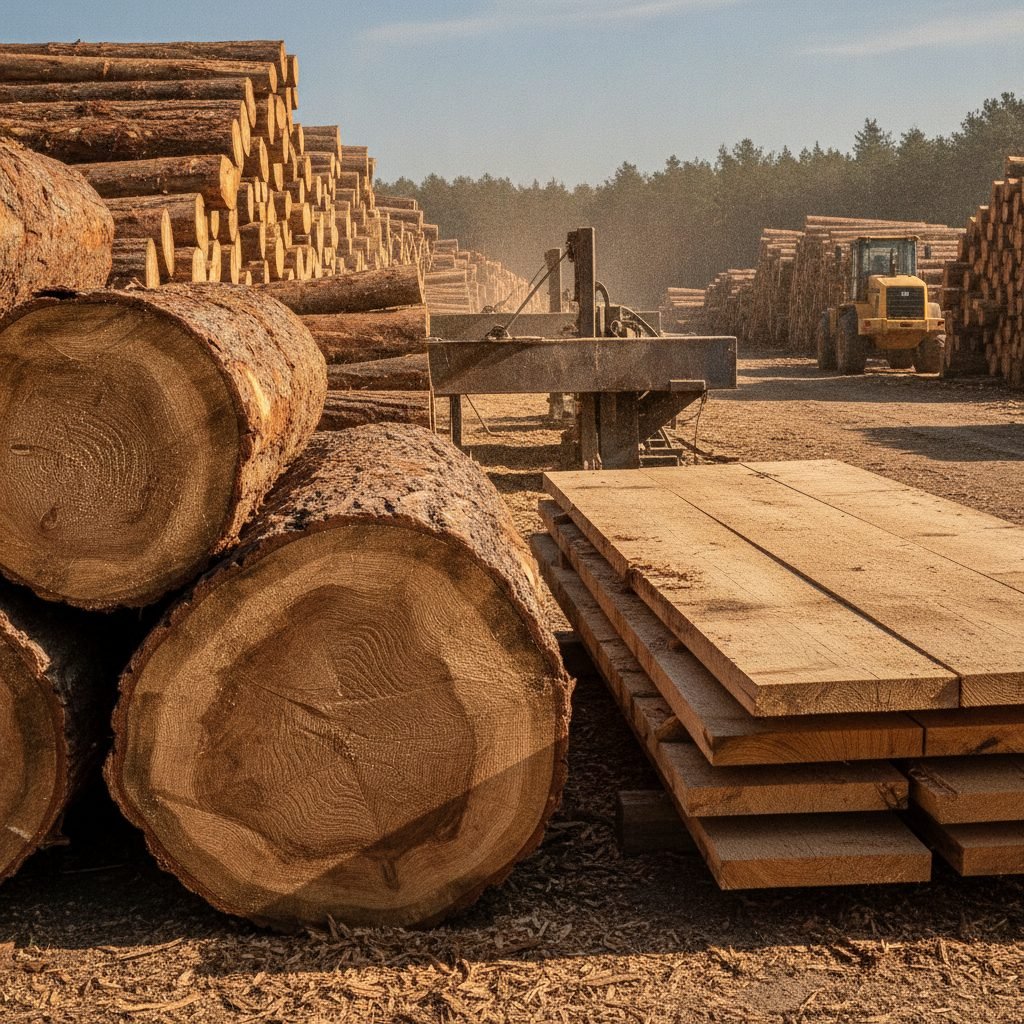


U.S. hardwood lumber prices climbed into a narrow band of volatility throughout Q1 2025, with premium species like walnut and cherry reaching their highest levels since early 2023, while commodity reds and whites absorbed regional supply tightness. For buyers accustomed to 2021–2022 pricing euphoria followed by 2023–2024 correction cycles, 2025 signals a more disciplined supply-demand reset—one driven by selective harvest constraints, brisk international demand, and mill operators running at roughly 78% capacity utilization across major Appalachian and Midwest facilities. Our timber price tracker reflects daily movements on 15 hardwood species across 8 North American regions.
Market Snapshot: Hardwood Lumber Pricing and Regional Dynamics
Here are the defining price and supply indicators for hardwood lumber in 2025:
- Red Oak (4/4 Select & Better, ex-mill Appalachia): $1,240–$1,380 per MBF in Q1 2025, up 4.2% year-over-year; spot trades between $1,310–$1,350 mid-quarter.
- White Oak (4/4 Select & Better, ex-mill Midwest): $1,520–$1,680 per MBF, up 6.8% YoY; premium for tight grain and heritage specifications adds 8–12%.
- Walnut (4/4 Select, ex-mill Tennessee): $2,840–$3,120 per MBF, up 11.3% YoY; luxury furniture OEMs and export volumes to EU account for the sustained lift.
- Hard Maple (4/4 Select & Better, ex-mill Ontario): $1,650–$1,920 per MBF; Canadian supply tightness and flooring demand support price floor; tariff risk on cross-border trade looms.
- Mill Operating Rates (U.S. hardwood sawmills): 78% capacity utilization in Q1 2025, down from 84% in Q4 2024; inventory correction completed, but cautious re-stocking by distributors limits production increases.
- Export Volumes (U.S. hardwood lumber to Europe & China): 2.1 billion board feet projected for 2025 (vs. 2.3 billion in 2024); European demand for appearance-grade oak and walnut remains firm; Chinese furniture OEMs retreat slightly on domestic oversupply.
Deep Analysis: Supply Tightness, Trade Flows, and Policy Headwinds
The Selective Harvest Constraints Reshaping Appalachian Supply
A series of regional conservation initiatives across Appalachia—particularly in eastern Kentucky, West Virginia, and eastern Tennessee—have imposed selective cutting restrictions on prime hardwood timber stands. These rules, introduced in late 2024 and enforced through 2025, limit diameter limits on certain oak and ash species and mandate habitat retention protocols. As a result, sawmills in the region face longer log procurement cycles, driving up delivered log costs by 6–9% and forcing mills to run split shifts or defer production days. Walnut and cherry, already supply-constrained due to their slower growth cycles and lower yield-per-acre economics, feel the pressure most acutely. Mills like Hebdon Sawmill (Paintsville, KY) and Murray Sawmill (Grundy, VA) have publicly reduced their 2025 lumber production targets by 8–12%, citing log supply uncertainty.
Export Demand Bifurcation: Europe Strong, China Softening
European furniture and flooring OEMs, facing tariff barriers on Chinese panel imports and seeking FSC-certified alternatives, have accelerated hardwood lumber procurement from North America. Q1 2025 saw U.S. hardwood exports to Germany, Italy, and Scandinavia rise 14% quarter-over-quarter, with red oak and white oak commanding the majority. Conversely, Chinese demand softened: furniture OEMs that expanded capacity in 2023–2024 now face domestic overcapacity and slower consumption, trimming U.S. hardwood purchases by 8–11% YoY. This creates a paradox—premium Eastern hardwoods are pulled toward the Atlantic while commodity grades face softer Pacific rim appetite.
Raw Material Cost Pass-Through and Mill Margin Compression
Delivered hardwood log prices rose 5–7% in Q1 2025 relative to Q4 2024, reflecting longer haul distances, fuel surcharges, and harvest labor constraints. Mills are absorbing roughly 60% of this cost increase through margin compression while passing 40% to lumber buyers. Forward-contracting becomes economically rational for both mills and buyers, reducing spot-price volatility but locking in higher plateaus.
| Species & Grade | Region (Ex-Mill) | Q1 2025 Price (USD/MBF) | Q4 2024 Price | YoY Change (%) | Key Driver |
|---|---|---|---|---|---|
| Red Oak, 4/4 Select & Btr | Appalachia | $1,310 | $1,260 | +4.0 | Log supply tightness |
| White Oak, 4/4 Select & Btr | Midwest | $1,600 | $1,495 | +7.0 | EU export demand |
| Walnut, 4/4 Select | Tennessee | $2,980 | $2,680 | +11.2 | Luxury OEM demand |
| Hard Maple, 4/4 Select & Btr | Ontario | $1,785 | $1,620 | +10.2 | Flooring demand, tariff risk |
| Ash, 4/4 Common | Ohio Valley | $890 | $775 | +14.8 | EAB-driven scarcity |
| Cherry, 4/4 Select | PA/NY Region | $1,870 | $1,720 | +8.7 | Cabinetry OEM demand |
Market Implications: Buyer Segments and Regional Divergence
For residential furniture OEMs: Higher hardwood input costs ($35–$65 per piece depending on wood intensity) compress margins unless pricing is passed through. Brands like Ethan Allen and La-Z-Boy have signaled modest price increases (2–4%) on hardwood upholstered frames to end customers. Contract negotiations for Q2–Q3 2025 material should anticipate 3–6% escalation clauses.
For architectural millwork and cabinet shops: Premium walnut and cherry jobs face the sharpest cost impact. A typical kitchen with walnut veneers and cherry frame components now costs 8–12% more than early 2024 quotes. Millworks are either re-quoting jobs or absorbing margin loss on locked-in contracts signed in Q4 2024.
For builders and remodelers: Hardwood flooring and trim represent a smaller input cost percentage than panel products, but availability delays sting more than price. White oak flooring orders have 6–8 week lead times (up from 4 weeks in late 2024), forcing builder scheduling pressure. Engineered hardwood alternatives gain relative appeal on both cost and delivery.
Regional Price Divergence: Appalachian mills command a 5–7% geographic premium over Midwest mills for identical red oak grades, driven by superior log quality and proximity to export ports. Pacific Northwest hardwoods (alder, oregon white oak) trade 10–15% below Eastern species due to softer regional demand and longer freight to key markets. Canadian hardwoods remain competitive but face 25% tariff headwinds if broader U.S.-Canada trade friction escalates in mid-2025.
Outlook and Buyer Recommendations
Three- to Six-Month Price Direction: Hardwood prices are likely to remain elevated through Q2 2025, with modest softening (2–3% pullback) possible in July–August if mill inventory builds faster than expected and export demand eases seasonally. The primary driver is log supply: if Appalachian harvest restrictions are relaxed or interpreted more flexibly by July, sawmill production rates could climb to 82–85% capacity, easing lumber supply pressure. Conversely, if regulatory enforcement tightens or summer storms disrupt logistics, prices could push 2–4% higher.
Upside Risk (prices rise 5–8% further): A sudden tightening of Chinese tariffs on U.S. hardwood exports could redirect material to domestic buyers, spiking competing for limited supply and driving prices to 2022 levels. Alternatively, if a major Appalachian sawmill undergoes unplanned maintenance, capacity could drop 3–5%, compressing supply sharply.
Downside Risk (prices fall 6–10%): A broader economic recession in mid-2025 would immediately dampen furniture OEM and builder demand, forcing mills to lower prices to maintain throughput. Export demand collapsing to pre-2024 levels would flood domestic markets with inventory and trigger a pricing correction.
Buyer Recommendations:
- 1. Lock in Q2–Q3 material now for premium species (walnut, cherry, hard maple). Forward-contract at current pricing (with 5–8% escalation clauses in later tranches) rather than spot-buy when the material arrives. This strategy caps exposure for high-value cabinetry and millwork jobs.
- 2. Diversify species selections where design permits. Substituting white oak for walnut in secondary frame components, or using engineered hardwood veneers instead of solid wood, reduces both cost and supply risk by 8–12%.
- 3. Monitor our global markets overview for weekly mill operating rate reports and export volume data. When rates drop below 75% or exports fall 10% QoQ, tactical spot-buying for commodity grades (red oak, ash) becomes defensible.
- 4. Negotiate extended payment terms with mills (net-60 or net-90) to preserve working capital. Higher prices mean larger inventory investments; better terms offset cost increases by 1–2%.
- 5. For cross-border procurement (Canada), quantify tariff exposure under current and proposed trade frameworks. Build a tariff contingency (5–8%) into walnut, maple, and cherry quotes until trade policy stabilizes in Q3 2025.
Hardwood lumber in 2025 reflects a market in transition: domestic supply tightness meets selective international demand strength, creating regional price divergence and opportunity for tactical buyers. The commodity red and white oak market offers modest upside for procurement flexibility, while premium species remain locked in high-cost equilibrium driven by luxury cabinetry and European export demand. The window to forward-contract is now; by mid-Q2, mill backlogs will price out further price discovery. For live data and price benchmarks, visit our log prices tracker to cross-reference hardwood lumber costs against raw material inputs and optimize your sourcing strategy through 2025.
Frequently Asked Questions
What are current hardwood lumber prices in 2025?
Hardwood lumber prices in 2025 vary by species and region. Red oak averaged $1,240–$1,380 per MBF (thousand board feet) in Q1 2025, while white oak traded at $1,520–$1,680 MBF. Walnut and cherry commanded premium pricing at $2,840–$3,120 and $1,650–$1,920 MBF respectively. Prices reflect tighter domestic supply, regional export demand, and mill operating rates. Check TimberInsider’s live tracker for species-specific quotes by geography.
Why are hardwood prices rising in 2025?
Three factors drive 2025 hardwood price increases: (1) Lower mill operating rates in the U.S. Midwest following 2024 inventory corrections; (2) Increased Chinese and European demand for appearance-grade hardwoods, pulling exports upward; (3) Selective harvesting restrictions in some Appalachian counties due to conservation initiatives. Supply constraints outpace steady domestic construction and furniture demand.
Which hardwood species face the biggest price increases?
Walnut and cherry saw the steepest gains—up 8–12% YoY in early 2025—due to luxury furniture OEM demand and limited supply. Red oak remained more stable (up 3–5% YoY) because supply is more abundant. Ash and hickory faced supply disruptions tied to emerald ash borer management programs, driving spot prices up 15–18% in affected regions.
How do regional hardwood prices differ across North America?
Appalachian mills (Tennessee, Kentucky, West Virginia) command a geographic premium for hardwoods, with red oak 6–8% higher than Midwest mills due to better log quality and strong European export demand. Pacific Northwest hardwoods (alder, big leaf maple) trade at 10–15% discounts to Eastern species. Canadian hardwoods (Ontario white oak, Quebec maple) remain competitive but face tariff uncertainty under U.S. trade policy.
Should buyers lock in hardwood lumber contracts now or wait?
Q2–Q3 2025 shows mixed signals. If your projects require premium walnut or cherry, forward-lock contracts (60–90 days) reduce spot-price risk. For commodity red oak, monitor mill inventories via NASS and FOEX PIX reports; softening mill operating rates suggest potential seasonal price relief in July–August. Conservative procurement teams are splitting orders across spot and forward buys.
Update policy and background sources
This page was editorially reviewed on 13 July 2026. Dated prices and market shares are reference-period observations, not live quotations. Buyers should confirm specification, Incoterm, currency, tax, freight and quote validity before using a number commercially. Background statistics and standards for this subject are published by:
- U.S. Bureau of Labor Statistics PPI
- Eurostat producer prices
- FAOSTAT Forestry Production and Trade
- UNECE forest-products markets
TimberInsider separates observed data from estimates and does not treat a supplier list as certification or endorsement. See the editorial methodology, product guides and regional coverage for definitions and current context.


