



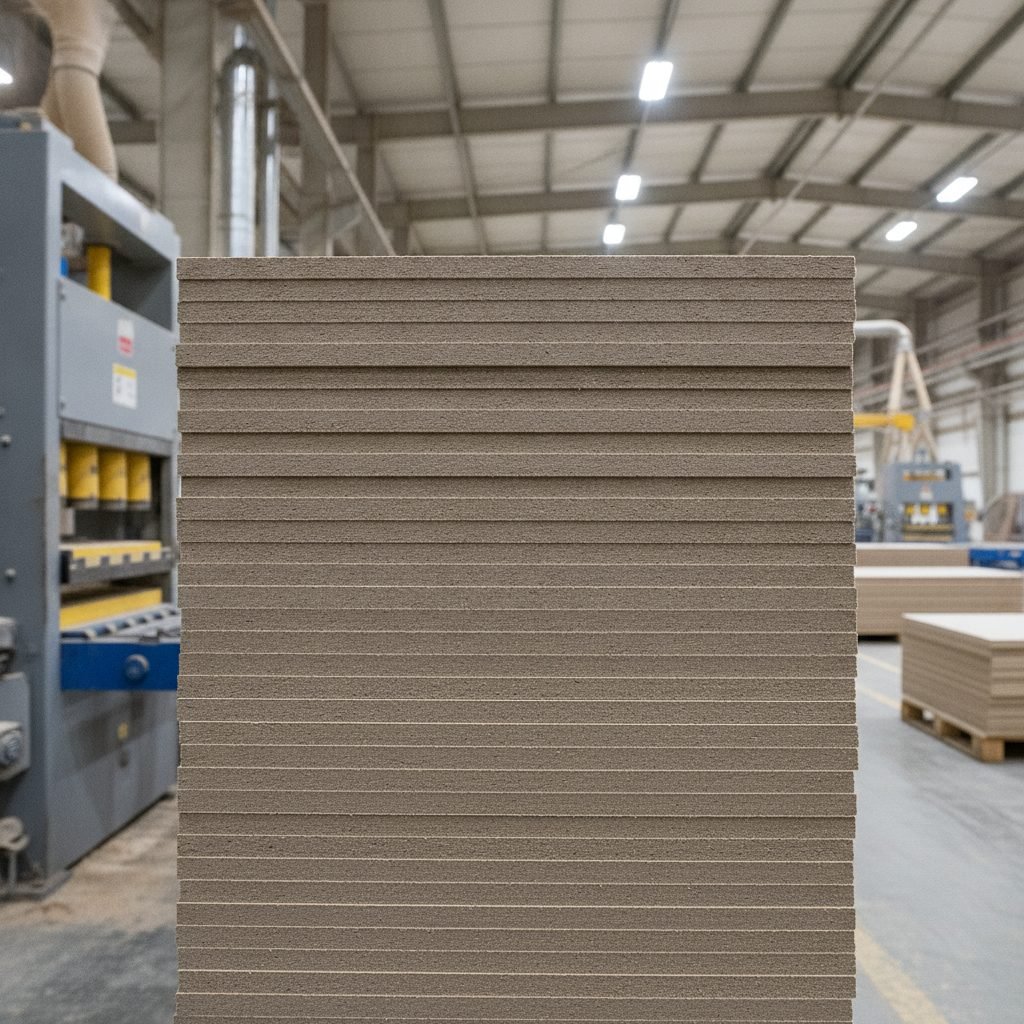


Updated July 13, 2026. Moisture-resistant MDF is an interior fibreboard formulated to perform better than standard MDF under intermittent humidity. It is not automatically waterproof, exterior-rated or suitable for direct water contact. Buyers must specify the product type, test standard, emissions compliance, thickness and finishing system rather than relying on a green colour or an “MR” label alone.
For adjacent guidance, see TimberInsider’s MDF price and conversion guide, MDF versus plywood comparison, formaldehyde standards guide and MDF product coverage.
What moisture-resistant MDF is
MR MDF uses a resin system and manufacturing controls intended to reduce moisture absorption and improve dimensional stability relative to standard interior MDF. The exact performance is defined by the cited standard and manufacturer declaration.
In Europe, products may be declared as an MDF.H type under EN 622-5 for humid interior conditions. In North America, ANSI A208.2 covers MDF for interior applications and specifies physical properties, dimensional tolerances, mechanical properties and formaldehyde limits. Do not assume the classifications are identical.
Moisture-resistant does not mean waterproof
MEDITE’s published guidance states that its MR panel is intended for humid interior environments such as kitchens and bathrooms, is not waterproof, and should not be used externally. The company distinguishes it from separately specified exterior MDF products.
This distinction applies to procurement generally: intermittent humidity, occasional splash risk, direct wetting, standing water and exterior weather are different exposure conditions. Select the product and assembly for the worst foreseeable condition.
Suitable applications
Documented MR MDF is commonly considered for kitchen and bathroom furniture, utility-room storage, interior wall panelling, mouldings, shopfitting and commercial joinery where humidity fluctuates. Suitability still depends on ventilation, edge details, coatings, fixings and distance from water sources.
It should not be specified generically for external cladding, unprotected wet rooms, shower enclosures, continuously damp substrates or below-grade conditions. Use an exterior-rated system where the exposure demands it.
Information required in a specification
- governing standard and declared board type;
- panel dimensions and thickness tolerance;
- density and relevant mechanical properties;
- thickness swelling or other moisture-performance value and test method;
- formaldehyde classification and jurisdictional compliance;
- surface condition, sanding and permitted coatings;
- chain-of-custody certification if required;
- manufacturer instructions for storage, machining, sealing and installation.
Verify data by thickness
Mechanical and swelling properties can change with thickness. A technical data sheet may present separate ranges for 6–9 mm, 9–12 mm, 12–19 mm and thicker panels. Do not transfer a value from one thickness range to another.
Ask for the current declaration of performance or technical data sheet associated with the actual manufacturing site and product code. Generic catalogue language is not a substitute for lot-appropriate documentation.
Edges, cut-outs and coatings
Machining exposes fresh fibre at edges, drill holes and routed profiles. These areas often need more preparation and coating than the factory face. Fully follow the coating manufacturer’s system, including primer, film build, curing and compatibility.
MEDITE advises fully sealing and coating its MR product in wet or humid interior environments. A finish reduces exposure but cannot correct an unsuitable substrate, leaking plumbing or poor ventilation.
Storage and acclimatization
Store panels flat, dry, supported and protected from ground moisture and weather. The Composite Panel Association notes that MDF changes dimensionally with relative humidity and recommends acclimatization for MDF mouldings. Project procedures should follow the panel manufacturer’s current instructions.
Record delivery condition and moisture damage before machining. Swollen or wetted panels should not be hidden behind a finish without technical assessment.
Formaldehyde compliance
Moisture resistance does not establish emissions compliance. In the United States, MDF and thin MDF are regulated under EPA TSCA Title VI. EPA lists limits of 0.11 ppm for MDF and 0.13 ppm for thin MDF and requires applicable testing, certification, labelling and records.
In the EU, Regulation (EU) 2023/1464 applies a 0.062 mg/m³ chamber concentration limit to furniture and wood-based articles placed on the market after August 6, 2026, subject to its conditions and exemptions. Confirm how the finished article, not only the raw board, meets applicable requirements.
MR MDF versus alternatives
MR MDF provides a smooth machinable substrate for humid interiors. Exterior MDF, plywood, compact laminate, cementitious board and other materials serve different conditions. Compare structural requirements, wetting, finish, fasteners, fire performance and service life before substitution.
Receiving inspection
- Match labels, product code and declared standard to the order.
- Check thickness, flatness, visible damage and pack moisture.
- Verify emissions and chain-of-custody documents.
- Keep batch and mill identification.
- Trial-machine and finish a sample before production.
- Quarantine material exposed to water or incorrect storage.
Frequently asked questions
Is MR MDF waterproof?
No. It is moisture resistant and typically intended for humid interiors unless a different exterior product is explicitly documented.
Can it be used in bathrooms?
It may be suitable for interior bathroom furniture or joinery when specified, sealed and kept from direct or prolonged wetting.
Does green colour prove performance?
No. Colour can be an identifier, but the standard, product mark and technical documentation establish performance.
Must cut edges be sealed?
Follow the manufacturer and coating-system instructions; cut edges and routed areas commonly require careful sealing.
Can standard MDF be substituted?
Only after confirming that the exposure, performance and project specification permit it.
Sources and methodology
- Composite Panel Association — MDF and ANSI A208.2
- Composite Panel Association — ANSI A208.2-2022
- MEDITE — MR product and documentation
- MEDITE — MR limitations and finishing guidance
- U.S. EPA — TSCA Title VI
- EUR-Lex — Regulation (EU) 2023/1464
Manufacturer examples illustrate documentation practice and are not universal performance claims. See TimberInsider’s sources and methodology policy.


