



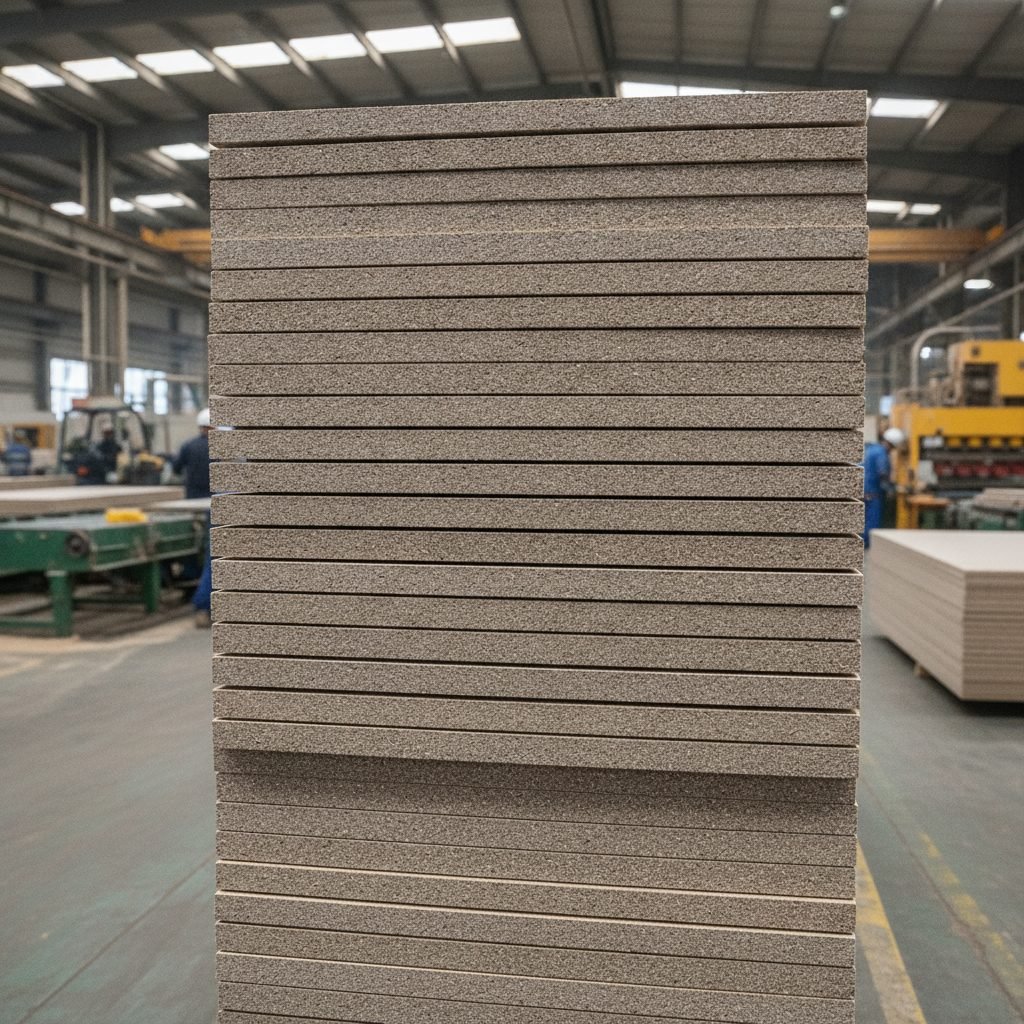


Formaldehyde emissions from wood panels remain a critical concern for furniture OEMs, residential builders, and regulatory bodies worldwide. The E0 and E1 standards define maximum allowable formaldehyde content in MDF, but their differences—and compliance costs—are often misunderstood. For procurement managers sourcing panels, the choice between E0 and E1 has direct implications for product positioning, market access, and total cost of ownership. This guide demystifies the standards, explains testing methods, and provides a practical framework for selecting the right certification level. Check the MDF price tracker for current E0 and E1 pricing across major regions.
Market Snapshot: E0 and E1 Formaldehyde Standards in 2025
Global MDF production reached 95 million m³ in 2024, with E0 representing approximately 18–22% of total output, up from 12% five years ago. Europe enforces EN 13986 building product regulations requiring E1 as a floor, while 16 member states (Germany, France, Netherlands) increasingly incentivize E0 for residential applications. China’s GB 18580-2017 mandates E0 for products intended for children under 14. Japan maintains the strictest regime: JAS F☆☆☆☆ (equivalent to E0) is required for all domestic-market panels, driving 45% of Japanese MDF to E0 or lower. North America has no federal E0/E1 mandate, yet premium furniture brands (Restoration Hardware, Herman Miller, Steelcase) contractually specify E0 for residential lines, pressuring their Chinese and Vietnamese suppliers to certify.
E0 MDF spot prices (ex-mill China, January 2025) range from $485–$520/m³ for standard 18 mm ‘A’ grade, compared to $410–$445/m³ for E1. In Europe, ex-works Central European mills, E0 18 mm panels trade €520–€590/m³; E1 equivalent, €460–€530/m³. Turkish producers generally price below Central European mills, with E0 at approximately €470–€510/m³. Third-party certification (TÜV, SGS, Eurofins) for E0 status costs $2,500–$6,000 per initial audit plus $1,200–$2,500 annually for surveillance testing. See panel market prices for weekly updates.
Understanding E0 and E1: Standards, Testing, and Regulatory Drivers
Formaldehyde Emission Limits and Certification Frameworks
E0 and E1 are tier ratings under the international EN 13986 standard (adopted by the EU) and equivalent national systems. The thresholds are measured via the perforator method (EN ISO 12460-5):
| Standard / Class | Formaldehyde Limit (mg/100g) | Test Method | Primary Markets | Certification Cost (Annual) |
|---|---|---|---|---|
| E0 (EU EN 13986) | ≤4.5 | EN ISO 12460-5 (perforator) | EU, Japan, China (children’s), premium residential | €1,500–€2,500 |
| E1 (EU EN 13986) | ≤9 | EN ISO 12460-5 (perforator) | EU, North America (voluntary), Asia-Pacific | €800–€1,500 |
| JAS F☆☆☆☆ (Japan) | ≤5 (JAS method) | Desiccator method | Japan domestic market; equivalent to E0 | ¥150,000–¥250,000 (~€1,000–€1,700) |
| GB 18580-2017 (China) | E0: ≤3 mg/L (chamber test); E1: ≤5 mg/L | Formaldehyde release (chamber method) | China, exported children’s products | ¥5,000–¥15,000 (~€650–€1,950) |
| NAF (North America Formaldehyde) | No federal standard; voluntary: ‘NAF’ ≤0.1 ppm | ANSI/APA PRG 320 (gas analysis) | North America (consumer brand specification) | $3,500–$6,000 |
E0 is approximately 50% stricter than E1. In practical terms, an MDF panel graded E1 might emit 7–8 mg/100g formaldehyde; an E0 panel from the same mill (if produced with low-formaldehyde adhesives and stricter controls) emits 3–4 mg/100g. This difference becomes significant in sealed interior spaces: a furnished bedroom with 20 m² of E1 MDF flooring can accumulate formaldehyde concentrations of 80–120 ppb; the same space with E0 stays below 50 ppb, below WHO guideline exposure limits.
Manufacturing Process: How Low-Formaldehyde Adhesives Drive Cost and Compliance
Standard MDF uses urea-formaldehyde (UF) or melamine-urea-formaldehyde (MUF) resins as binders. UF is cheap (~€400–€600/tonne) and delivers strong bonding, but hydrolyzes during production and storage, releasing formaldehyde gas. E1 mills use UF with formaldehyde scavengers (e.g., urea, melamine) to cap emissions; E0 mills avoid UF entirely.
E0 production typically relies on:
- Methylene diphenyl diisocyanate (MDI): A pre-polymer adhesive (~€1,200–€1,800/tonne) that binds wood fibers without releasing formaldehyde. MDI cures rapidly, requiring 2–3% by weight of wood fiber; UF needs 8–10%. MDI mills produce at 85–120 m³/hour vs. 140–180 m³/hour for UF mills, lowering throughput by ~30%.
- Phenol-formaldehyde (PF) resin: Lower formaldehyde monomer than UF (~€800–€1,100/tonne). PF is slower-curing (longer pressing times, higher energy costs) but acceptable for E0 when formaldehyde scavengers are used.
- Emerging bio-adhesives: Soy-based and tannin-based binders eliminate formaldehyde but cost 2–3× more and represent <5% of global E0 output due to performance variability.
The full cost stack for E0 production (vs. E1) includes: adhesive premium (+€80–€150/m³), slower production speeds (+€20–€40/m³), enhanced moisture control and testing (+€15–€30/m³), and third-party certification labor (+€10–€25/m³). Total premium: 12–18% above E1 cost base.
Regulatory Drivers and Market Shifts
Regulatory momentum is consolidating around E0 or equivalent. China’s mandatory E0 for children’s products (GB 18580-2017, enforced since 2018) has driven its major mills (Shandong Weihua, Shandong Shoufu, Guangdong Daya) to dual-certify E0 and E1 lines. The EU’s Construction Products Regulation (CPR 305/2011) now requires E1 minimum for all panels in construction; several member states (Germany, Austria, France) are piloting E0-mandatory procurement for public housing, indirectly pushing suppliers toward E0 capacity expansion. Japan’s JAS F☆☆☆☆ has been mandatory since 2003 and is accepted as equivalent to E0 globally.
North America remains fragmented. The Composite Wood Products Regulations (CWPR, Title VI, enforced 2018) set a federal limit of 0.13 ppm (parts per million) formaldehyde in composite wood, equivalent to approximately E1 or slightly stricter. However, no federal E0 mandate exists. Instead, consumer brands and residential developers (often responding to California’s Proposition 65 and consumer preferences) contractually specify E0 or NAF status, effectively creating a de facto premium market. Premium furniture OEMs report that 30–50% of new product lines target E0 certification to secure retail shelf placement and consumer trust.
Market Implications: Pricing, Supply, and Buyer Segments
Price Divergence by Region and Buyer Segment
Residential construction and flooring: E0 engineered flooring and laminate use MDF core boards. Flooring brands (Tarkett, Kronoflooring, Bauwerk) market E0 status as a health and durability feature, commanding 18–25% premiums over E1. A 2.5 mm engineered oak floor on E0 MDF core retails at €45–€65/m² vs. €38–€52/m² on E1. Residential builders in California, Scandinavia, and Germany now default to E0 for single-family homes targeting LEED, Cradle-to-Cradle, or EcoLabel certifications, which incentivize or require E0.
Panel distributors and merchants: Smaller distributors stock predominantly E1 due to cost and inventory turn. Larger distributors maintain separate E0 SKUs for captive OEM customers; these SKUs often carry minimum order quantities (full truck loads, 20–28 m³) and longer lead times (4–6 weeks). E0 inventory is perceived as higher-risk due to lower retail demand and price volatility.
Regional pricing patterns:
- Europe: E0 carries a €60–€100/m³ premium over E1 in Central Europe. Mills with established E0 capacity and certification infrastructure command the highest premiums.
- Asia-Pacific: China and Southeast Asia compete aggressively on E0 pricing due to lower labor and energy costs. Chinese E0 mills offer $50–$80/m³ discounts vs. European equivalents, capturing 35–40% of global E0 export volume.
- North America: Limited domestic E0 capacity; most E0 consumption is imported from China and Mexico. Retail pricing (E0 vs. E1) shows 20–25% premiums due to tariffs, logistics, and limited supply competition.
Emerging Trade Flows and Supply Chain Resilience
E0 certification is becoming a non-tariff trade barrier. Indian plywood and MDF makers are investing in E0 capacity to access EU and Japanese markets; certification timelines (3–6 months) create competitive lag. Mexican MDF producers are expanding low-formaldehyde capacity to serve North American residential and children’s furniture brands, partially displacing Chinese and Brazilian imports. Vietnamese furniture OEMs are shifting upstream to control formaldehyde risk: companies like Phu Hoa and Saigon Furniture now specify E0 directly from their resin suppliers and conduct in-house formaldehyde testing before panel acceptance.
Outlook and Buyer Recommendations: 3–6 Month Price Direction and Risk Scenarios
Price Direction: Q1–Q2 2025 Outlook
E0 MDF prices are expected to remain stable to slightly firm (+2–4%) through Q2 2025. The primary driver is adhesive cost: MDI resin prices (~$1,400–$1,500/tonne globally) are stable, with low downside risk given geopolitical tensions in Ukraine (disrupting UF feedstock) and steady downstream demand from residential and children’s furniture. E1 pricing may soften 3–5% due to lower-cost UF adhesive availability and seasonal demand softness in Q1. This widens the E0 premium to 15–20% from the current 12–15%, creating a window for strategic buyers to lock in forward contracts.
Risk Scenarios
Upside risk (E0 prices +6–10%): A major EU environmental directive (e.g., voluntary agreement to mandate E0 for all construction panels by 2026) or California legislation expanding formaldehyde limits would spur demand. Capacity constraints at MDI-capable mills and certification backlogs (3–4 month lead times at major labs like TÜV and SGS) could push E0 premiums to 22–25%. Adhesive cost shock (MDI spike to $1,800+/tonne) from supply-chain disruption would cascade rapidly.
Downside risk (E0 prices -5–8%): A glut of new E0 capacity from Chinese and Turkish mills, combined with weak residential construction in Europe (recession scenario), could compress margins to 10–12% premium over E1. Low-formaldehyde adhesive breakthroughs (bio-based resins achieving cost parity with UF by 2026) would accelerate E0 adoption but lower pricing. Chinese overcapacity in E0 (currently 15–18 million m³/year) may trigger export dumping pressure if domestic demand softens.
Five Buyer Recommendations
- Segment by end-use and regulatory requirement: Reserve E0 for products sold in Japan, EU, or China (children’s); specify E1 or NAF (ANSI/APA PRG 320) for North American residential and commercial if cost-sensitive. This avoids overspending on E0 for applications where E1 meets legal and brand requirements.
- Negotiate multi-quarter forward contracts with E0 mills at current premiums: Lock in Q2–Q3 2025 volume at E0 prices (€520–€560/m³ in Central Europe, $510–$550/m³ ex-China). Three-quarter forward commitments (typically minimum 200–500 m³/month) often yield 2–4% discounts vs. spot pricing and eliminate upside price shock risk.
- Verify third-party certification status and test reports: Request recent (within 12 months) perforator method test certificates from accredited labs (TÜV SÜD, SGS, Eurofins, CTBA). Avoid relying on self-certification or informal mill claims; non-certified panels may face retail rejection or market liability if formaldehyde content drifts above stated limits.
- Build regional dual-sourcing for E0 to mitigate supply disruption: Maintain qualified suppliers in two regions (e.g., Central Europe and China, or Turkey and Vietnam). E0 lead times are 4–8 weeks; single-source risk creates vulnerability. Diversification also captures regional price opportunities (Chinese E0 is typically 8–12% cheaper than Nordic).
- Plan for voluntary adoption of E0 even in non-mandated markets: If targeting premium retail or subscription-based customer segments (e.g., e-commerce, direct-to-consumer), adopt E0 as a brand differentiator and market in product descriptions. Health-conscious consumer segments will pay 15–20% premiums for certified low-formaldehyde products; cost recovery is realistic within 12–18 months.
Closing Perspective
E0 and E1 formaldehyde standards reflect a global shift toward healthier, regulated interior materials. The 50% stricter limit of E0 is not a marketing gimmick but a measurable compliance benchmark tied to regulatory requirements in major markets and consumer demand in premium segments. Pricing premiums (12–20%) are sustained by adhesive costs, production constraints, and certification infrastructure rather than market hype. For procurement managers, the choice between E0 and E1 is fundamentally a customer-location and product-positioning decision: specify E0 where regulation or brand strategy demands it; use E1 for cost-optimized segments where compliance margins are sufficient. Forward contracting at current E0 premiums (Q1 2025) is prudent given expected upside risks in Q2–Q3 from regulatory tightening and adhesive volatility. For live data and price benchmarks, visit our mdf tracker on TimberInsider.
Frequently Asked Questions
What is the difference between E0 and E1 MDF formaldehyde standards?
E0 MDF contains ≤4.5 mg/100g formaldehyde (EN ISO 12460-5 perforator method), while E1 allows up to 9 mg/100g. E0 is used for children’s furniture and sensitive applications; E1 is standard for general furniture and construction. E0 certification requires stricter manufacturing controls and lower-formaldehyde adhesives, making it 8–15% more expensive than E1.
Which countries or regions require E0 certification?
Japan (JAS F☆☆☆☆ equivalent to E0), China (mandatory for children’s products under GB 18580-2017), and the EU (E1 is minimum; E0 voluntary premium). North America has no federal E0/E1 requirement but increasingly demanded by consumer brands and residential buyers. Australia and New Zealand recognize E0 under AS/NZS 1859 standards.
How is formaldehyde content in MDF tested and verified?
The perforator method (EN ISO 12460-5) is the international gold standard: 1g of sanded MDF is soaked in toluene, then formaldehyde is extracted and measured via HPLC or gas chromatography. Gas analysis (EN ISO 12460-1) and desiccator methods are also used but less common. Third-party accredited labs (TÜV, SGS, Eurofins) certify compliance; manufacturers submit routine test reports quarterly or annually.
Does E0 MDF cost significantly more than E1?
Yes. E0 typically costs 12–18% more than E1 in Europe and Asia due to higher-cost low-formaldehyde resins (MDI, phenol-formaldehyde alternatives), stricter QC, and lower production speeds. For a €500/m³ E1 panel, expect €580–€610/m³ for E1 E0. Pricing varies by region: Turkish and Chinese E0 mills carry a smaller premium than north European mills.
What adhesives are used in low-formaldehyde MDF production?
E0 and low-E1 mills use methylene diphenyl diisocyanate (MDI), polymeric MDI (pMDI), and phenol-formaldehyde (PF) resins with minimal formaldehyde scavengers. Urea-formaldehyde (UF) and melamine-urea-formaldehyde (MUF) produce higher emissions and are phased out for E0. Soy-based and bio-adhesives are emerging but represent <5% of global production due to cost and performance trade-offs.
Update policy and background sources
This page was editorially reviewed on 13 July 2026. Dated prices and market shares are reference-period observations, not live quotations. Buyers should confirm specification, Incoterm, currency, tax, freight and quote validity before using a number commercially. Background statistics and standards for this subject are published by:
- U.S. EPA formaldehyde standards
- FSC certificate search and chain of custody
- PEFC certificate search
- European Commission EUDR guidance
TimberInsider separates observed data from estimates and does not treat a supplier list as certification or endorsement. See the editorial methodology, product guides and regional coverage for definitions and current context.


