



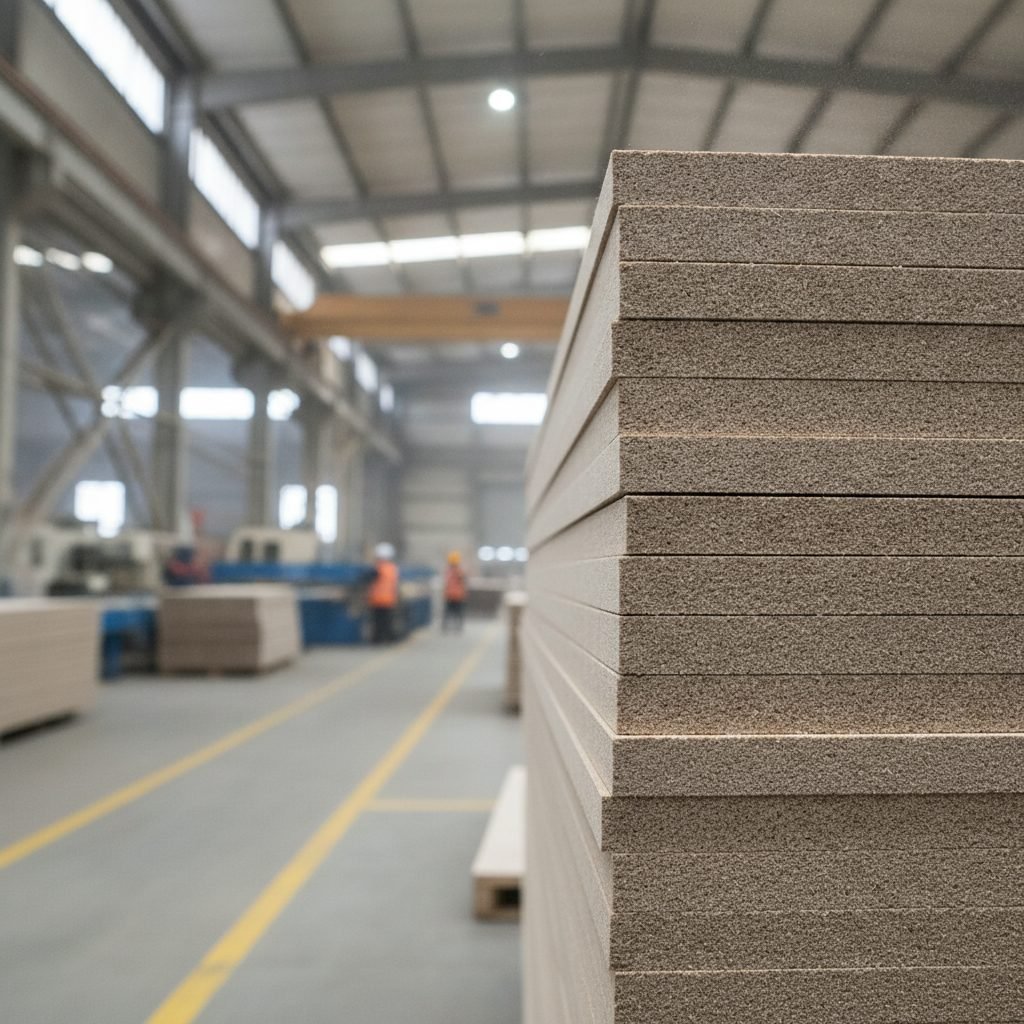


Updated July 13, 2026. MDF price per sheet cannot be represented by one reliable global number. A useful quote must specify dimensions, thickness, grade, surface, emissions compliance, quantity, currency, location and delivery terms. This guide shows how to normalize supplier quotes and calculate delivered cost without presenting hypothetical figures as live market data.
For related coverage, visit TimberInsider’s MDF prices hub, panel prices overview, Turkey MDF buyer guide and particleboard versus MDF comparison.
What determines MDF price per sheet?
Sheet prices vary first with panel volume: a thicker or larger sheet contains more fibre and resin. They also vary with density, moisture-resistant or fire-retardant formulation, surface quality, sanding tolerance, certification, order size and transport distance. Decorative overlays, priming and machining are separate value additions and should not be compared with an unfinished standard panel.
The Composite Panel Association explains that MDF is produced with different physical properties and dimensions. Its ANSI-sponsored voluntary standard classifies MDF by physical and mechanical properties, product grade, dimensional tolerance and formaldehyde emission limits. Buyers should therefore compare compliant specifications, not just the letters “MDF” on two offers.
Minimum information required on a quote
- length, width and actual or performance thickness;
- standard, grade, density range and intended application;
- standard, moisture-resistant, fire-retardant or other formulation;
- raw, sanded, primed, laminated or melamine-faced surface;
- emissions certification and supporting documents;
- sheet count, pack configuration and minimum order;
- currency, tax, rebates and payment terms;
- Incoterm or domestic delivery basis, origin and destination;
- quote date, validity period and expected delivery date.
Correct sheet-volume conversion
Many mill and export offers are quoted per cubic metre, while distributors sell per sheet. Convert every dimension to metres and use:
Sheet volume (m³) = length (m) × width (m) × thickness (m)
A 2440 × 1220 × 18 mm sheet contains approximately 0.05358 m³. A North American 4 × 8 ft sheet at 3/4 inch contains 2 cubic feet, or approximately 0.05663 m³. It does not contain 0.9 m³.
To convert a cubic-metre quote into a sheet equivalent:
Material cost per sheet = quoted cost per m³ × sheet volume
For illustration only, a hypothetical $350/m³ quote for a 4 × 8 ft × 3/4 in sheet equals about $19.82 per sheet before freight, duties, tax, handling and waste. This is a conversion example, not a TimberInsider price observation.
Price per square foot and square metre
A 4 × 8 ft sheet covers 32 square feet before cutting loss. Divide the sheet price by 32 to obtain price per square foot. A 2440 × 1220 mm panel covers about 2.9768 m²; divide the sheet price by 2.9768 to obtain price per square metre.
Area-based comparison is useful only when thickness, grade and surface treatment are identical. For panels of different thicknesses, compare both area cost and cubic-metre equivalent.
Calculate delivered MDF cost
The lowest ex-works price is not necessarily the lowest procurement cost. Use:
Delivered sheet cost = material + freight + handling + duties + non-recoverable tax + finance cost − rebates
Then account for damaged sheets, machining waste, rejects, storage and lead-time risk. A more consistent panel can justify a higher purchase price when it reduces sanding, tool wear, rework or rejected components.
Compliance affects comparability
In the United States, EPA’s TSCA Title VI rule covers MDF, thin MDF, particleboard and hardwood plywood. EPA lists formaldehyde emission limits of 0.11 ppm for MDF and 0.13 ppm for thin MDF, together with testing, third-party certification, labelling and recordkeeping requirements. A non-compliant offer is not a valid substitute for a compliant panel.
In the European Union, Regulation (EU) 2023/1464 restricts furniture and wood-based articles placed on the market after August 6, 2026 when formaldehyde released under the specified chamber conditions exceeds 0.062 mg/m³, subject to the regulation’s scope and exemptions. This article does not treat “E0” or “E1” marketing labels as universal substitutes for jurisdiction-specific evidence.
How to use market indicators
Wood fibre, resin, energy, labour, capacity utilization, furniture demand, construction and freight can influence MDF quotes. Broad statistical indicators help explain the environment but are not sheet-price benchmarks. Eurostat’s industrial producer price data cover manufacture of wood and wood products under NACE division 16, for example, but a headline industrial PPI movement must not be described as a specific MDF price change.
For a decision-grade benchmark, collect at least three supplier quotes with identical specifications and terms. Record the timestamp and preserve the original offer. Calculate a median only after normalizing currency, units and delivery basis.
Quote comparison template
| Field | Supplier A | Supplier B | Supplier C |
|---|---|---|---|
| Dimensions and thickness | Record | Record | Record |
| Grade and surface | Record | Record | Record |
| Compliance documents | Verify | Verify | Verify |
| Quantity and pack size | Record | Record | Record |
| Ex-works sheet equivalent | Calculate | Calculate | Calculate |
| Delivered sheet cost | Calculate | Calculate | Calculate |
| Quote date and validity | Record | Record | Record |
Buyer checklist for 2026
- Define the application and required standard before asking for prices.
- Request the same dimensions, grade, finish, quantity and delivery basis.
- Verify emissions and chain-of-custody documents where required.
- Convert every offer to sheet, area and volume equivalents.
- Compare delivered cost and expected yield, not headline price alone.
- Keep dated source documents and schedule quote refreshes.
Frequently asked questions
What is the average MDF price per sheet in 2026?
No global average is decision-grade without a dated specification and location. Obtain comparable local quotes and normalize them with the formulas above.
How many cubic metres are in a 4 × 8 ft × 3/4 in MDF sheet?
Approximately 0.05663 m³. Multiply a like-for-like price per cubic metre by this volume to calculate the material-only sheet equivalent.
Why can two 18 mm MDF sheets have different prices?
They may differ in dimensions, density, grade, moisture resistance, surface treatment, emissions compliance, tolerances, certification, quantity and delivery terms.
Should buyers choose the cheapest sheet?
Not automatically. Compare delivered cost, compliance, consistency, machining yield, waste, lead time and supplier reliability.
How often should MDF pricing be updated?
Refresh a published observation when its underlying quote expires or market conditions materially change. Every price must retain its date, specification, location and commercial basis.
Sources and methodology
- Composite Panel Association — Medium Density Fiberboard
- Composite Panel Association — Standards
- U.S. EPA — Formaldehyde Emission Standards for Composite Wood Products
- U.S. EPA — TSCA Title VI consumer questions
- EUR-Lex — Regulation (EU) 2023/1464
- Eurostat — Industrial producer price methodology
TimberInsider distinguishes sourced observations from calculations and editorial interpretation. See the full sources and methodology policy.


