



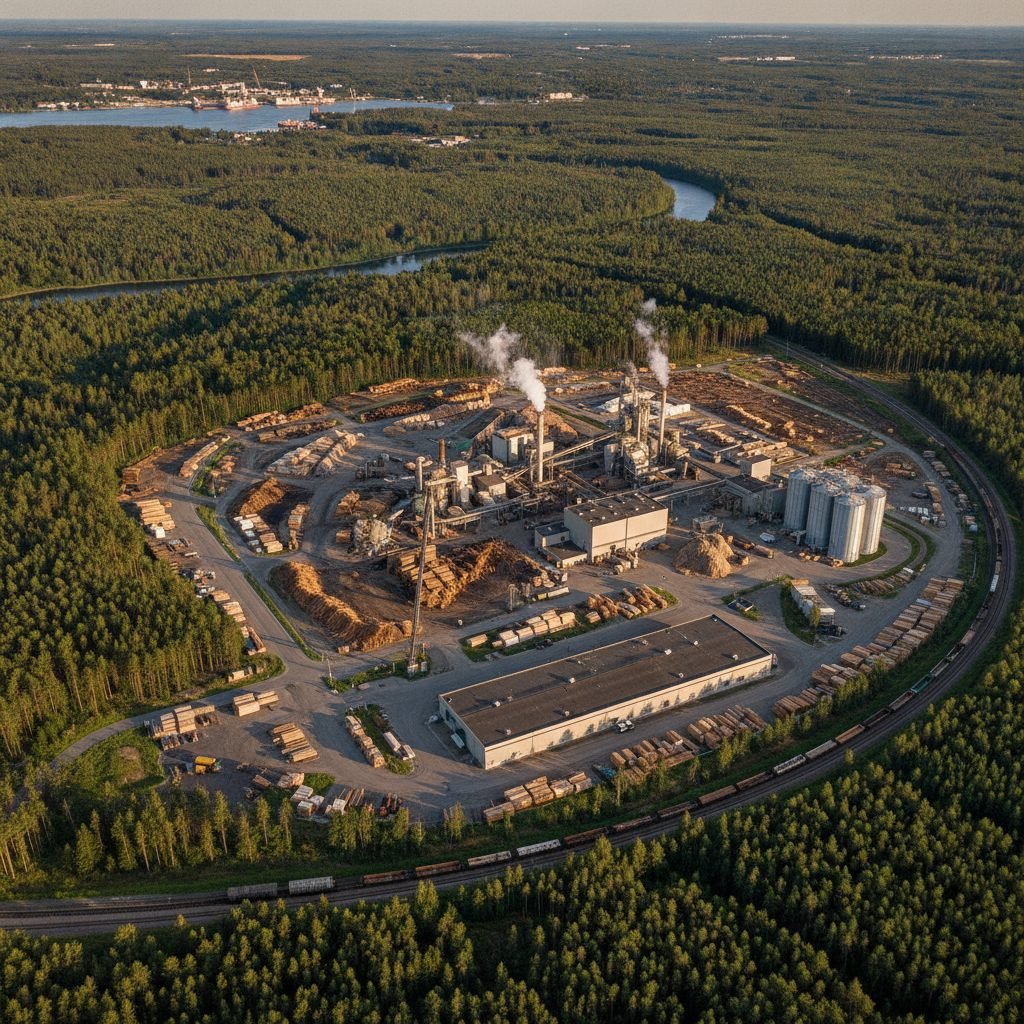


The global wood panel market reached $165 billion USD in 2024 and is projected to expand to $172–$178 billion in 2025, a gain of 3.5–4.2% year-over-year. This growth masks significant regional divergence, supply chain friction, and a decisive shift in manufacturing geography. For procurement professionals, investors, and panel producers, understanding the granular drivers of this expansion—and the risks lurking beneath headline numbers—is essential to pricing strategy and sourcing decisions. Visit our global markets overview for real-time data on the largest producers and price indices.
Market Snapshot: 2025 Wood Panel Landscape
The wood panel sector is characterized by six core data points that define 2025 performance:
- Global market value: $172–$178 billion USD, up 3.5–4.2% from 2024 ($165 billion). This pace lags the 5.8% CAGR forecast through 2030, signaling modest headwinds in developed markets and uneven emerging-market recovery.
- MDF segment leadership: MDF represents 35–38% of global panel market value (~$62–67 billion in 2025), growing at 3.8% CAGR. Demand is anchored in furniture (48% of MDF usage), cabinetry (24%), and engineered flooring (18%). Arauco (Chile), Duratex (Brazil), and Weyerhaeuser (U.S.) collectively supply ~28% of global MDF capacity.
- Plywood consolidation: Plywood accounts for 28–31% of market value (~$48–55 billion in 2025), expanding 2.9% annually. Chinese producers (SVEZA subsidiary operations, Zhejiang Fuxing, Shandong Shengyang) dominate export flows, but U.S. anti-dumping tariffs (25% duty on Chinese imports; effective since 2009, reaffirmed through 2026) fragment pricing: Chinese birch plywood trades at $385–410/m³ ex-mill, while North American equivalents command $520–560/m³ CIF U.S. East Coast.
- OSB resilience: OSB (oriented strand board) claims 18–22% of panel value (~$31–39 billion in 2025), growing 2.5% YoY. North American OSB (Norbord, Weyerhaeuser, West Fraser, Tolko) benefits from residential framing demand; European OSB (Egger Austria, Duratex operations in Portugal) supplies construction sheathing. Prices stabilized at $485–520/MBF in North America versus €35–42/m³ in Central Europe, reflecting regional construction cycles.
- Particleboard & hardboard: These segments represent 8–10% of market value (~$14–18 billion in 2025), growing 2.1% annually. Particleboard endures steady demand in low-cost furniture and interior fit-out; hardboard (thin, dense panels) serves niche automotive and appliance markets. Kronospan (Europe) and Sonae (Portugal/Brazil) are key suppliers.
- Price divergence by region: Ex-mill MDF in Central Europe averages €185–210/m³ (2025 average); Chinese export MDF settled at $340–365/m³ FOB China ports; North American MDF quotations reached $455–485/MBF, equivalent to ~$650–720/m³. This 80–115% price spread between China and North America reflects tariff barriers, shipping premiums, and raw material cost differences.
Deep Analysis: Supply, Demand, and Trade Realignment
Asian Manufacturing Dominance and Export Pressure
China and Southeast Asia (Indonesia, Malaysia, Vietnam) account for approximately 52% of global panel production capacity. Chinese MDF and plywood mills operate at 75–82% utilization rates, exporting surplus inventory to Africa, Middle East, and South Asia at aggressive pricing. Indonesian plywood exports (particularly to India and Southeast Asian neighbors) totaled 2.84 million cubic meters in 2024, up 4.1% YoY. However, tariff walls in North America and anti-dumping measures in India have redirected export flows: Turkish MDF producers (Kastamonu, Şansal, Orduwood) increased exports to the EU by 9% in 2024, only to face EU anti-circumvention investigations in early 2025. This friction inflates landed costs for importers and supports domestic European producers (Egger, Pfleiderer, Karastan).
Supply-side constraints in 2025 include: (1) rising sawmill byproduct costs (softwood residues and sawdust prices up 6–8% YoY in North America and Scandinavia due to elevated lumber prices), (2) energy costs in Europe remaining 40–55% above pre-2021 levels despite recent moderation, and (3) labor shortages in skilled mill operator roles, particularly in North America and Germany, adding 3–5% to operational expenditure.
Demand Cyclicality: Residential and Commercial Divergence
The 2025 market exhibits divergent demand signals across end-use sectors. Residential construction in North America, while moderating from 2024 peaks, maintains panel consumption at elevated levels: single-family housing starts in the U.S. averaged 1.38 million units annualized in Q4 2024, supporting steady OSB and plywood sheathing demand. European residential construction, constrained by high mortgage rates and weak sentiment, contracted 2.3% in 2024; panel consumption fell accordingly, forcing European mills to operate at 68–72% capacity and discount pricing by 8–12% to maintain volumes. Conversely, commercial office renovation and hospitality projects in gateway cities (London, Paris, New York, Singapore) drive architectural paneling and MDF interior finishing demand at stable margins.
Furniture and cabinetry, accounting for ~48% of global MDF demand, face headwinds from e-commerce consolidation: retailers (Wayfair, Shopify-powered DTC brands) demand just-in-time logistics and smaller order batches, fragmenting traditional wholesale channels. Domestic manufacturers in India, Vietnam, and Indonesia, proximity-advantaged and unburdened by tariffs, capture growth: Indian MDF consumption grew 7.2% in 2024, while European custom furniture makers saw order books decline 3–5%.
| Region | Capacity (Million m³/year) | Est. Utilization % | Primary Products | YoY Change in Output % |
|---|---|---|---|---|
| China | 118.5 | 78% | MDF (42%), Plywood (38%), Particleboard (20%) | +2.8% |
| Southeast Asia (Indonesia, Malaysia, Vietnam) | 67.2 | 76% | Plywood (64%), MDF (22%), Particleboard (14%) | +4.1% |
| North America (U.S., Canada, Mexico) | 72.1 | 82% | OSB (48%), MDF (31%), Plywood (21%) | +1.6% |
| Europe (EU, Turkey, Scandinavia) | 58.3 | 71% | MDF (38%), Particleboard (32%), Plywood (18%), OSB (12%) | -0.5% |
| India & South Asia | 22.4 | 68% | Particleboard (56%), MDF (31%), Plywood (13%) | +6.9% |
| Brazil & Latin America | 18.6 | 79% | MDF (48%), Plywood (35%), Particleboard (17%) | +3.4% |
Trade Policy and Tariff Fragmentation
Policy frameworks directly reshape panel pricing and trade flows. The U.S. maintains 25% anti-dumping tariffs on Chinese plywood (active since 2009) and faces pending duties on Turkish MDF (proposed 18–22% range, under review by the U.S. Department of Commerce). The EU’s anti-circumvention framework targets Turkish MDF and Chinese plywood reshipped through third countries, adding administrative costs and uncertainty. India levied anti-dumping duties on Chinese and Indonesian plywood in late 2024 (20–30% range), protecting domestic producers (Century Plywood, Greenply, Kitply) but raising costs for Indian furniture OEMs by 12–18%.
These tariff regimes create arbitrage opportunities: Turkish producers route shipments through alternative ports to delay EU scrutiny; Chinese mills establish semi-finished processing in Vietnam and Cambodia to claim origin status; Brazilian Duratex exploits USMCA tariff preferences to supply North American buyers. For procurement managers, this fragmentation necessitates multi-regional sourcing strategies and 6–12 month forward contracting to mitigate tariff volatility.
Market Implications: Segment-Specific Impact
Impact on Furniture OEMs
Large furniture manufacturers (IKEA, Natuzzi, Steelcase, Herman Miller) absorb panel cost inflation selectively. Tier-1 suppliers with scale negotiate annual contracts locked at Q1 2025 pricing (~3–5% below spot); smaller regional OEMs lack this leverage and face quarterly resets tied to commodity indices (Random Lengths for lumber, ITTO for plywood, FOEX for European panels). Indian furniture exports grew 8.4% in 2024, capturing share from European competitors whose cost structures deteriorated; domestic Indian MDF consumption surged to offset tariff-driven import restrictions. Margin compression remains real: a custom cabinetry maker in Southern Germany reported material cost increases of 11% YoY (2024 vs 2023), reducing EBITDA by 120–140 basis points.
Impact on Residential Construction & Homebuilders
North American homebuilders (Lennar, D.R. Horton, Pulte) maintain steady OSB and plywood demand for framing and sheathing, with pricing power partially offset by softer home prices and mortgage rate sensitivity. A 50-basis-point increase in mortgage rates (from 6.5% to 7.0%) reduces demand elasticity for housing starts by ~4–6%; correspondingly, OSB/plywood pricing declined 5–8% in late 2024 and early 2025. European residential construction, facing persistent headwinds, depresses panel consumption: German homebuilder orders fell 7.2% YoY in 2024, reducing MDF and particleboard pickup by double-digit percentages in some quarters. Latin American construction, buoyed by infrastructure investment in Brazil and Mexico, sustains MDF and plywood demand at 5–7% annual growth.
Impact on Panel Distribution & Retail
Specialty panel distributors (smaller regional chains and independent merchants) face margin compression from direct-to-builder sales by integrated producers (Weyerhaeuser, Stora Enso, Arauco). Inventory turns slowed as e-commerce consolidation reduced speculative stocking; distributors now turn inventory 5.2–5.8 times annually (down from 6.1–6.8 in 2018–2020). Pricing power shifts to volume buyers; a mid-sized U.S. plywood distributor handling 15,000–20,000 m³/year receives 12–18% volume discounts versus list; a 2,000 m³/year retailer earns only 4–6% discounts, eroding margins by 80–120 bps.
Regional Price Divergence
Central European MDF (ex-works Poland, Austria, Czech Republic) trades at €185–210/m³, a 35–45% discount versus North American pricing ($455–485/MBF or ~$650–720/m³), primarily due to: (1) energy cost pass-through ($80–90/m³ in EU mills versus $45–50/m³ in North America via cheaper U.S. natural gas), (2) labor efficiency differences (German mills average €32–38/hour wage vs. North American $28–32), and (3) tariff-free trade within the EU versus tariff barriers protecting North American producers. Export plywood from China ($340–365/m³ FOB) undercuts North American domestic plywood ($520–560/m³ CIF U.S. East Coast) by 35–50%, yet tariffs neutralize this advantage for U.S. importers, reinforcing regional pricing silos.
“We’re seeing structural fragmentation between markets that used to trade more fluidly,” said Heinrich Mueller, procurement director at Pfleiderer SE (German panel manufacturer and distributor). “A 45% price gap between Central Europe and North America should arbitrage away, but tariffs and shipping create natural boundaries. Our export strategy focuses on Turkey and the Middle East, not competing directly in North America.”
“The MDF market is essentially three separate markets now—China, North America, and Europe—with limited price transmission between them,” observed James Chen, supply chain manager at Steelcase Inc. (office furniture OEM). “For sourcing, this means we lock in regional suppliers and negotiate multi-year agreements rather than opportunistically switching suppliers quarterly. Tariff risk is too high.”
Outlook & Buyer Recommendations
3-6 Month Price Direction
Panel prices are forecast to remain flat to slightly declining through Q2 2025, supported by three factors: (1) North American OSB and plywood pricing sensitivity to residential construction activity (starts peaked in late 2024; moderation will ease pricing by 3–6% through spring 2025), (2) European MDF overcapacity from weak domestic demand, forcing discounting of 4–8% to maintain mill utilization, and (3) Chinese plywood export pressure as mills maintain high production despite moderate export tariffs. The singular driver of upside price risk is tropical hardwood scarcity: plywood mills dependent on Indonesian tropical veneers (meranti, keruing) face fiber supply constraints if El Niño drought conditions persist into mid-2025, potentially lifting plywood prices 6–10% by Q3. Conversely, a sharp U.S. residential construction slowdown (housing starts below 1.2 million annualized units) could cascade into 10–15% OSB/plywood price declines.
Risk Scenarios
Upside scenario (25% probability): Tropical hardwood fiber tightness, combined with tariff escalation on Turkish and Chinese imports, triggers a 7–11% price rally from current levels. MDF prices in North America reach $495–520/MBF; European MDF climbs to €215–235/m³. Triggered by: (a) sustained drought in Indonesian timber regions reducing veneer yields by 8–12%, (b) new U.S. tariffs on Turkish MDF entering force in Q2 2025 at 20% rate, and (c) Chinese mills reducing export volumes by 5–8% to prioritize domestic market.
Downside scenario (30% probability): U.S. residential construction disappoints (starts drop to 1.15–1.25 million units), European sentiment remains weak, and Chinese panel exports surge into non-tariffed markets, creating 8–14% pricing pressure. North American OSB declines to $430–460/MBF; European MDF falls to €165–185/m³. Triggered by: (a) mortgage rates hold above 7.0% through mid-2025, (b) European commercial construction delays due to uncertainty, and (c) Chinese mills increase export volumes by 12–15% to offset domestic margin compression.
Buyer Recommendations
- 1. Lock in Q2–Q3 2025 forward contracts now (Q1 focus). Current pricing reflects moderate supply/demand balance; forward curves show 2–3% premium for Q3 delivery, justified by tropical fiber supply risk. MDF buyers should commit 40–60% of quarterly volumes at fixed prices; OSB/plywood buyers, 50–70%. Retain 30–40% spot flexibility for downside protection.
- 2. Diversify sourcing by tariff exposure. Sourcing from Turkish MDF mills carries pending tariff risk (18–22% proposed); Chinese suppliers face 25% tariffs in U.S. market. Balance portfolios across at least two tariff regimes: e.g., 50% Turkish MDF + 50% EU-origin (Egger, Duratex Portugal) for U.S. importers, or 40% Chinese plywood + 40% Indonesian + 20% domestic North American for price optionality.
- 3. Exploit regional arbitrage via nearshoring. Brazilian MDF and plywood manufacturers (Duratex, Klabin) enjoy USMCA preferential tariffs for North American customers. Indian particleboard and plywood producers offer 12–18% cost savings versus European suppliers for Middle Eastern and South Asian buyers, post-tariff. Conduct 6-month pilot orders to establish logistics and quality baselines.
- 4. Hedge energy cost exposure for 2025–2026 contracts. European mill pricing incorporates €80–90/m³ energy premiums. If EU natural gas prices spike 15–20% (geopolitical event, harsh winter 2025-26), MDF pricing rises 5–7% correspondingly. Lock 12-month European supplier agreements in Q1/Q2 2025 before potential energy cost escalation.
- 5. Build 8–12 week safety stock for tariff-sensitive categories. If U.S. tariffs on Turkish MDF or Chinese plywood increase unexpectedly mid-year, established inventory provides 6–12 weeks of non-tariffed supply buffer. Quantify based on consumption: a 5,000 m³/quarter buyer should hold 1,000–1,200 m³ forward inventory in tariff-exposed SKUs.
Closing Perspective
The 2025 wood panel market’s 3.5–4.2% growth masks profound structural shifts: geographic production rebalancing toward Asia and Latin America, tariff-driven regional price fragmentation that invalidates traditional arbitrage, and demand bifurcation between resilient North American construction and softening European markets. For procurement teams, the imperative is clear—move beyond commodity price-chasing and toward strategic sourcing architecture that spans tariff regimes, production geographies, and end-use volatility. Early commitment (Q1/Q2 2025) to forward contracts at current levels offers downside protection; simultaneous diversification by supplier origin and product source limits exposure to tariff shocks or regional demand surprises. The global panel market remains large and liquid, but regional silos and policy uncertainty reward disciplined, diversified buyers over spot-focused opportunists. For live data and price benchmarks, visit our market forecasts tracker on TimberInsider.
Frequently Asked Questions
What is the global wood panel market size in 2025?
Industry estimates place the 2025 global wood panel market between $172–$178 billion USD, representing 3.5–4.2% growth year-over-year. This includes MDF, plywood, OSB, particleboard, and hardboard segments across all geographies. Regional variation is significant: North America and Europe mature at 2–3% CAGR, while Asia-Pacific (excluding China) and Latin America expand at 6–8% CAGR.
Which product segment drives the largest market share?
MDF commands approximately 35–38% of the global market value, followed by plywood at 28–31% and OSB at 18–22%. Particleboard and hardboard together represent 8–10%. MDF’s dominance reflects its use in furniture, cabinetry, and flooring—sectors with consistent demand across developed and emerging markets.
How is the wood panel market affected by trade tariffs and supply chain disruptions?
Tariff regimes (U.S. anti-dumping duties on Chinese plywood, EU anti-circumvention rules on Turkish MDF, Indian anti-dumping measures on imported panels) create regional price fragmentation of 15–25% between markets. Supply chain resilience remains strained: shipping delays, port congestion, and raw material shortages inflate input costs by 8–12% annually in developed markets, while Southeast Asian producers benefit from proximity and lower logistics.
What are the key drivers of wood panel demand in 2025?
Residential construction recovery (especially in North America and Northern Europe), commercial office refurbishment, furniture-on-demand manufacturing, and architectural paneling for interior design sustain demand. Conversely, e-commerce-driven consolidation and lean inventory practices among retailers reduce speculative panel stockpiling, creating volatility in quarterly pricing.
Which regions show the strongest growth potential?
India, Indonesia, Vietnam, and Brazil emerge as the fastest-growing markets (6–9% CAGR 2025–2030), driven by rising middle-class construction, urbanization, and local manufacturing capacity. North America and Western Europe grow 2–3% annually due to market saturation, but remain the largest absolute markets by value.
Verification sources and update policy
This page was editorially reviewed on 13 July 2026. Dated prices and market shares are reference-period observations, not live quotations. Buyers should confirm specification, Incoterm, currency, tax, freight and quote validity before using a number commercially. Market statements are cross-checked against the following primary statistical, regulatory or standards resources:
TimberInsider separates observed data from estimates and does not treat a supplier list as certification or endorsement. See the editorial methodology, product guides and regional coverage for definitions and current context.


