



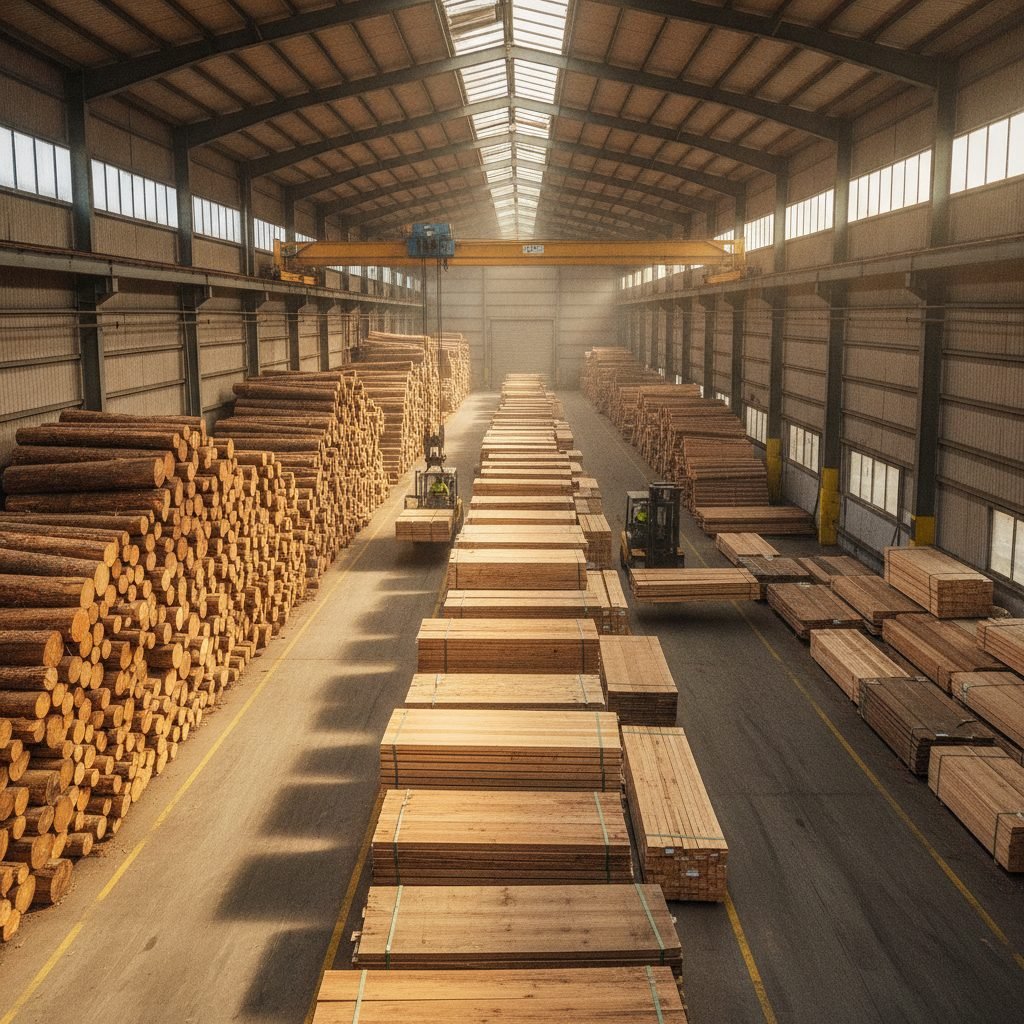


Asian wood panel demand is on track for a record year in 2025, powered by residential construction recovery in India and Southeast Asia, export-driven furniture production, and supply-chain diversification away from China. Yet price volatility and emerging tariff uncertainty are forcing buyers across the region to rethink procurement strategy. Here is what the data reveals.
Market Snapshot
Asia’s wood panel consumption reached 142.3 million cubic meters in the first half of 2025, up 8.3% year-over-year, according to preliminary UNECE Timber Bulletin data. This marks the strongest H1 performance since 2018. Within the region, demand patterns diverge sharply:
- India: Panel demand grew 12% YoY to 18.4 million m³ (H1 2025), with domestic MDF mills operating at 94% capacity and imports surging 23% from Southeast Asian mills. Ex-mill MDF pricing in Tamil Nadu climbed to ₹18,500–19,200 per m³ (USD 222–231/m³), up 8% from January 2025.
- Southeast Asia: Vietnam, Indonesia, and Thailand combined consumed 34.7 million m³, growing 8.5% YoY. Panel prices in Bangkok and Ho Chi Minh City averaged USD 285–320/m³ for export-grade MDF, a 10% premium to Indian domestic pricing due to logistics and quality certification costs.
- China: Domestic panel demand remained flat at 2–3% YoY growth, with consumption at 52 million m³ (H1 2025). Net exports of plywood rose 17% to 2.8 million m³, signaling oversupply pressure and aggressive export-focused pricing by mills like Huajian and Shenlin. FOB China MDF hit USD 265–285/m³, undercutting Southeast Asian producers and attracting Indian importers despite tariff headwinds.
- Japan & South Korea: Mature markets, both flat to −1% YoY; however, higher-end specialty plywood and engineered wood demand remains resilient, supporting premium pricing (+5–7% for birch-faced plywood).
- Bangladesh & Pakistan: Emerging demand centers. Bangladesh panel consumption grew 11% to 2.1 million m³, with 60% of supply sourced from Indian mills. Pakistan saw 9.5% growth to 1.3 million m³, primarily from Chinese imports.
- Regional Price Index: Global wood markets tracked a composite Asia panel price index (weighted by consumption) at 112.4 (2020 = 100) in June 2025, up 7.2% from January 2025 but still 3.1% below June 2024 due to Chinese export deflation.
Deep Analysis
India’s Construction Boom and Import Surge
India is the region’s demand engine in 2025. The construction sector’s 18% annual growth, driven by affordable housing policy, commercial real estate expansion, and Metro rail projects, has pulled panel consumption forward. Domestic MDF capacity—led by Greenpanel Industries, Century Ply, and Greenply Industries—stands at 2.85 million tons annually, but demand has outpaced supply by 6–8%, forcing importers to source from Indonesia (PT Kutai Timber, Daya Wood) and Vietnam (Anhui Xinyi Group, Lam Son). Import duties on MDF are 7.5%, but tariff arbitrage and quality reputation make Southeast Asian mills competitive even with landed costs of USD 250–270/m³. Plywood demand is even more acute: India imports 70–75% of its plywood demand (1.2 million m³ in H1 2025), heavily reliant on Thai, Indonesian, and Chinese producers. Russian birch plywood, previously 15–20% of India’s import mix, has collapsed due to sanctions, creating a structural supply gap worth 200,000–300,000 m³ annually.
“We are signing 18-month contracts with mills in Sumatra and Quang Ninh to lock in supply,” said Rajesh Khurana, procurement head at Century Ply’s OEM division. “Domestic capacity expansion takes 3–4 years, but import demand is pressing now. We are willing to pay 5–8% premiums for reliable quarterly shipments.”
Chinese Overcapacity and Export Redirection
China’s property sector contraction—new construction starts fell 22% YoY in H1 2025—has left domestic panel mills with 18–22% excess capacity. Producers like Huajian, Shenlin, and Wuhua have pivoted aggressively to exports, flooding Southeast Asia and South Asia with discounted MDF and particle board. Chinese particle board pricing has dropped to USD 240–260/m³ FOB, undercutting Thai and Malaysian mills by USD 15–25/m³. This has compressed margins across the region and forced higher-cost producers (Malaysia’s Pertama, Thailand’s Suksabai) to reduce output or exit. However, quality perception and logistics costs have insulated Indian domestic MDF pricing from the worst of Chinese pressure: Indian buyers pay a 10–15% premium for domestic mills due to shorter lead times (14–21 days vs. 35–45 days from China) and lower currency volatility risk. The dynamic has created a geographic price corridor: Chinese FOB < Southeast Asian ex-mill < Indian ex-mill, with arbitrage opportunities for traders and importers managing currency exposure.
Tariff Shock and Buyer Hedging Behavior
Looming US tariff frameworks—specifically the USTR’s consideration of 25% tariffs on Chinese panel exports (furniture panel components and finished boards)—are reshaping procurement decisions across Asia. Importers of Indian furniture (which uses approximately 40% panel inputs by weight) are pressuring their panel suppliers to offer forward pricing for Q4 2025 and Q1 2026 to hedge tariff pass-through risk. Vietnamese and Thai furniture exporters, already operating on thin margins (3–5% net) due to labor cost pressures, are absorbing panel price volatility rather than passing it fully to Western buyers, who themselves are managing higher landed costs from US tariff exposure. This has created a squeeze: panel producers in Southeast Asia are catching demand from Indian and Vietnamese OEMs locking in supply, but at risk of margin compression if tariff implementation is delayed or scaled back. Spot pricing has become highly sensitive to USTR headlines, with panel prices swinging 2–3% on tariff policy updates in late May and June 2025.
| Region/Country | H1 2025 Consumption (M m³) | YoY Growth (%) | Primary Product | Avg. Price (USD/m³) | Price Change YoY (%) | Key Demand Driver |
|---|---|---|---|---|---|---|
| India | 18.4 | +12.0 | MDF, Plywood | 218–231 | +8.5 | Construction, affordable housing |
| Vietnam | 12.1 | +9.5 | MDF, Plywood | 295–320 | +6.2 | Furniture export, appliance OEM |
| Indonesia | 10.3 | +8.2 | Plywood, Particle Board | 280–310 | +5.8 | Domestic construction, regional supply |
| Thailand | 8.1 | +7.1 | MDF, Particle Board | 275–305 | +4.9 | Furniture export, regional hub |
| China (Domestic) | 52.0 | +2.1 | MDF, Plywood (export-focused) | 265–285 (FOB) | −6.3 | Property slowdown; export strategy |
| Japan | 5.2 | −0.8 | Specialty plywood, engineered wood | 380–420 | +4.5 | Premium interior, renovation |
| South Korea | 3.8 | −1.2 | MDF, specialty plywood | 350–390 | +3.2 | Appliance, furniture OEM |
| Bangladesh | 2.1 | +11.0 | MDF, Plywood (imports from India) | 230–250 | +7.1 | Construction, retail expansion |
| Pakistan | 1.3 | +9.5 | MDF, Particle Board (Chinese imports) | 245–270 | −2.4 | Furniture, appliance sectors |
Market Implications
Impact on Buyer Segments
Residential Builders & Developers: Indian and Southeast Asian property developers are experiencing rapid panel cost inflation (+8–12% YoY in India). Builders with fixed-price contracts signed in 2024 are absorbing margin pressure. Those with forward-pricing clauses are passing increases to end buyers, pressuring residential affordability. In Vietnam and Thailand, where developer margins are tighter (4–6%), panel cost spikes are forcing design simplification (e.g., reducing engineered wood components in favor of solid wood or steel framing). Outlook: builders are shifting to domestic suppliers where available, creating structural demand for local capacity expansions.
Furniture OEMs & Export Manufacturers: Vietnamese, Thai, and Indian furniture exporters face a squeeze: panel costs are rising 6–11% YoY, while Western buyer resistance to price increases is stiff (average price increases capped at 3–4% in negotiated contracts). Net result: compressed margins pushing OEMs to consolidate, offshore higher-labor work, or exit low-margin segments (e.g., entry-level particleboard furniture). Tariff hedging is driving forward-contract activity, artificially supporting near-term panel demand but creating risk of pullback in Q4 if tariff implementation is delayed. “We are committing 50% of our Q4 panel requirements now to lock in pricing before any tariff shock,” said Linh Tran, supply chain director at a Hanoi-based office furniture manufacturer. “The alternative is to risk 15–20% cost swings that kill project profitability.”
Panel Distributors & Traders: Regional distributors are benefiting from geographic price arbitrage and supply tightness. Buy-sell spreads have widened from 4–5% (typical) to 7–9% in high-growth markets like India. However, inventory risk is rising: distributors caught with Chinese panel stock face price erosion if tariff headwinds ease, while those undersupplied miss margin opportunities. Successful traders are running lean just-in-time models and taking short-dated forward positions with mills rather than holding inventory.
Regional Price Divergence
Asia’s wood panel market is fragmenting into three pricing zones. Zone 1 (China): USD 265–285/m³ FOB for standard MDF, underselling all competitors. Zone 2 (Southeast Asia regional hub): USD 290–330/m³ ex-mill for Vietnamese and Thai MDF, supporting a 5–10% logistics and risk premium over Chinese pricing. Zone 3 (India): USD 220–235/m³ ex-mill for domestic MDF, lower than Southeast Asia due to lower input costs (eucalyptus fiber, energy) and weaker freight logistics, but supported by tariffs, lead-time preference, and currency risk aversion. Plywood pricing shows wider divergence: Thai and Indonesian plywood commands 15–25% premiums over MDF due to supply constraints (Russian birch scarcity) and quality reputation. Indian plywood imports from Southeast Asia run USD 240–280/m³ CIF, with domestic finished products retailing at USD 260–310/m³ depending on veneer quality and certification (FSC premiums of 5–8%).
Outlook & Buyer Recommendations
Asian wood panel demand is forecast to grow 7.5–9% for full-year 2025, with H2 growth moderating to 5–7% due to seasonal patterns and tariff uncertainty. The primary price driver for H2 will be US tariff implementation timing: a 25% tariff on Chinese panel exports (effective October 2025 or later) would pressure Chinese FOB pricing down 3–5% as mills flood Asian markets with diverted inventory, but would support Southeast Asian and Indian pricing by 4–8% as tariff-displaced demand redirects to higher-cost regional suppliers.
Upside Risk: Accelerated Indian construction and appliance sector demand, combined with delayed tariff implementation, could push panel prices 5–7% higher by year-end, particularly in MDF. Strong monsoon recovery and efficient port operations in India could further tighten supply.
Downside Risk: Rapid US tariff implementation (September 2025) triggers Chinese mills to flood Asian spot markets, pulling prices down 8–12% by October. Simultaneously, property sector instability in China deepens, further depressing domestic demand and freeing export capacity. A combined scenario could see Chinese MDF drop to USD 245–260/m³ FOB, pressuring higher-cost competitors across the region into margin compression or production cuts.
Buyer Recommendations:
- 1. Segment procurement by tariff sensitivity and geography: Commit 40–50% of Q3–Q4 panel needs to 90–120-day forward contracts with Southeast Asian and Indian mills at current pricing (approximately USD 290–320/m³ for Vietnamese MDF, USD 220–235/m³ for Indian domestic MDF). Lock this volume before any tariff shock widens pricing. Keep 20–30% allocated to spot purchasing with monthly review windows (e.g., September, November) to capitalize on potential Chinese export deflation if tariff timelines slip.
- 2. Diversify mill sourcing to hedge currency and supply-chain risk: Develop supplier relationships across at least three geographies: India (for lead-time efficiency and ₹ currency stability), Vietnam or Indonesia (for quality and regional logistics), and, if tariff-protected, selective Chinese sourcing for non-US-bound products. This prevents over-reliance on any single supply zone if tariff policy or monsoon logistics disrupt normal flows.
- 3. Negotiate tariff-adjustment clauses in Q4 and Q1 contracts: Forward contracts signed now should include provisions for tariff pass-through if US tariff rates exceed 20% and are implemented before contract delivery. This protects both buyer and mill from margin collapse while avoiding outright contract cancellations if tariff shock materializes.
- 4. Build 4-6 week safety stock for domestically-consumed products in India and Vietnam: Given monsoon disruption risk (June–September) and tariff policy volatility, carrying incremental inventory of 2–3 weeks of demand as insurance is cheaper than emergency sourcing or production shutdowns. This is especially critical for large OEMs (furniture, appliance) with thin margins.
- 5. Monitor Chinese export pricing and capacity utilization weekly: Set automated alerts for FOB China MDF pricing falling below USD 270/m³ or Chinese mill capacity utilization reports below 75%. Either signal indicates aggressive export pricing and potential for redirect flooding into Asian spot markets within 3–4 weeks—a window to delay or cancel less-committed spot purchases.
Asia’s wood panel market in 2025 reflects the region’s transformation into a polyglot supply-demand landscape: India driving import-hungry growth, Southeast Asia serving as a regional distribution hub and OEM supplier base, and China oscillating between export aggression and tariff uncertainty. Buyers who segment their procurement into hedged forward contracts, diversified sourcing, and disciplined spot buying will navigate H2 2025 with margin protection. Those relying on single-source or spot-only strategies face 8–15% cost volatility and margin compression. For live data and timber prices, visit our Asia tracker on TimberInsider.
Frequently Asked Questions
What is driving wood panel demand in Asia in 2025?
Three factors: (1) Residential construction acceleration in India and Southeast Asia post-pandemic recovery; (2) Furniture export rebound as Western retailers rebuild inventory; (3) Appliance manufacturers scaling production to offset China tariff exposure. India alone saw 12% YoY panel consumption growth through Q2 2025.
Which Asian countries are seeing the fastest panel demand growth?
India (12% YoY growth), Vietnam (9.5%), Indonesia (8.2%), and Thailand (7.1%) lead the region. China’s domestic panel demand remains flat at 2-3% YoY due to construction slowdown, making it a net exporter rather than demand driver in 2025.
Are panel prices rising or falling in Asia in 2025?
Mixed signals: MDF and plywood prices in Southeast Asia gained 6-11% from January to June 2025, driven by supply constraints and logistics costs. India saw more stability (+2-4%) due to local production capacity additions. Particle board softened slightly (-3%) as Chinese export pressure mounted.
What is the outlook for Asian panel demand in H2 2025?
Demand is forecast to grow 7.5-9% for the full year, with H2 slower than H1. Risk factors: (1) Rising US tariffs on Chinese goods may redirect cheap panel imports to Asia, depressing prices; (2) Monsoon logistics delays in India and Bangladesh; (3) Property sector uncertainty in China spreading caution among regional OEMs.
Should buyers lock in panel contracts now or wait for price declines?
Procurement teams should split strategy: (1) Secure 40-50% of Q3-Q4 needs in forward contracts at current levels to hedge tariff and monsoon risk; (2) Keep 20-30% spot-flexible for potential September price dips if US tariff implementation stalls; (3) Diversify sourcing between Indian domestic mills (longer lead times, stable pricing) and Indonesian/Vietnamese mills (faster delivery, higher volatility).
Verification sources and update policy
This page was editorially reviewed on 13 July 2026. Dated prices and market shares are reference-period observations, not live quotations. Buyers should confirm specification, Incoterm, currency, tax, freight and quote validity before using a number commercially. Market statements are cross-checked against the following primary statistical, regulatory or standards resources:
TimberInsider separates observed data from estimates and does not treat a supplier list as certification or endorsement. See the editorial methodology, product guides and regional coverage for definitions and current context.


