



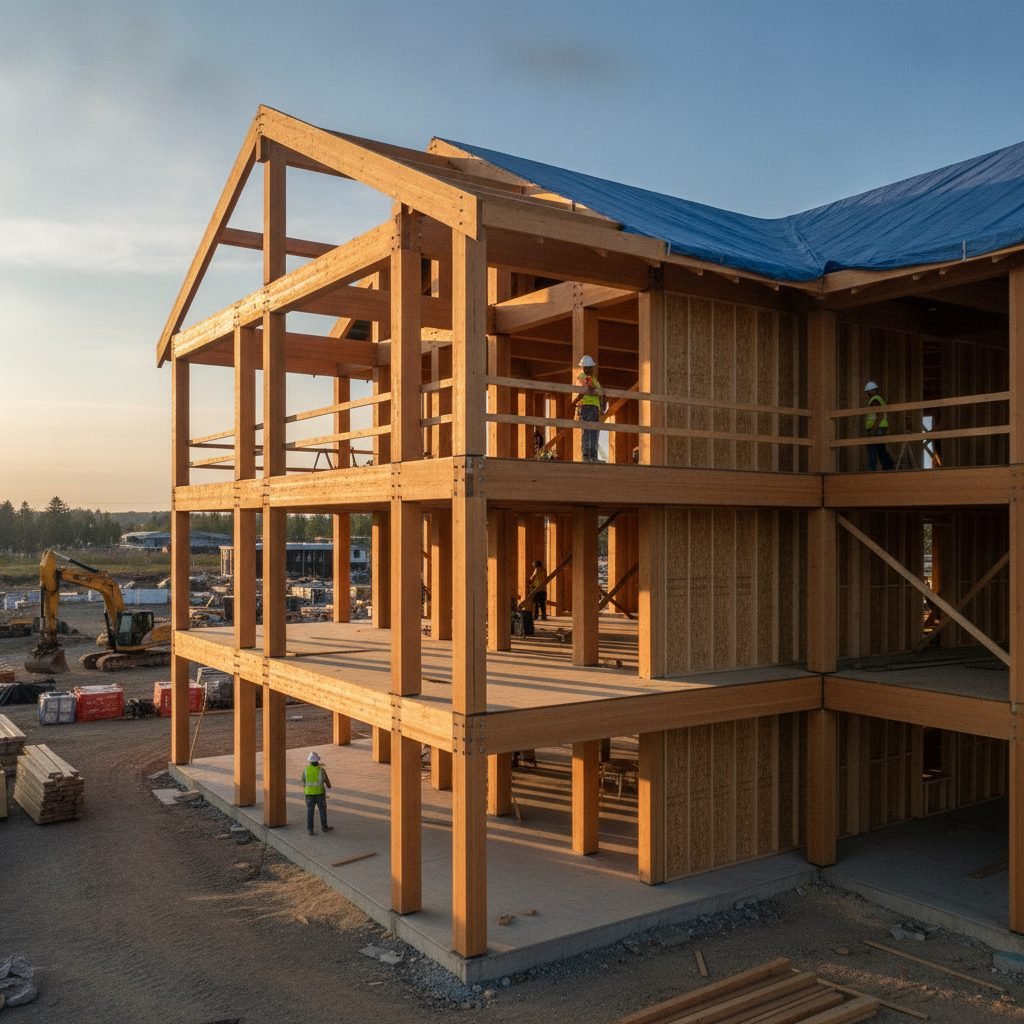


Construction budgets are tightening in 2025, yet wood-framed projects are capturing cost advantages their concrete and steel peers cannot access. Glulam beams are running 8–12% cheaper than last year, CLT panels are finally competing on price with conventional framing, and strategic buyers who locked in Q1 contracts are now 15–20% ahead of spot-market pricing. The window to realize genuine material savings is real—but it closes fast.
Market Snapshot: Wood Construction Pricing Reality Check
Across North America and Northern Europe, wood construction inputs are delivering measurable cost relief compared to 2024:
- Softwood lumber (2×4 stud): USD 385–420/MBF (ex-mill Canada West Coast), down 11% year-over-year. Random Lengths Composite Index averaged USD 402/MBF in Q1 2025, the lowest quarterly mean since Q4 2022.
- Engineered glulam beams (24F–1.8E): USD 620–680/m³ delivered North America, down from USD 710/m³ mid-2024. Major suppliers (Weyerhaeuser, Tolko, Cascade) are moving inventory aggressively to capture market share.
- Cross-laminated timber (CLT) panels, 3-ply 5-inch: EUR 520–580/m³ ex-mill Central Europe (Katerra, Hasslacher, Lignum, Stora Enso production sites), inline with commodity plywood for the first time since 2019.
- OSB sheathing (0.625-inch 7/16): USD 8.50–9.75/sheet in eastern North America, reflecting steady-state supply from Norbord, West Fraser, and Huber mills operating at 92–95% capacity utilization.
- MDF (16mm, melamine-faced, interior): EUR 185–215/m³ FCA Central Europe, down 6% QoQ as German and Polish mills compete for commercial builder orders.
- Plywood (BCX 3/4-inch): USD 52–58/sheet delivered U.S. Midwest, a modest 2% decline YoY but stable, reflecting balanced supply from West Fraser, Potlatch Deltic, and Boise Cascade mills.
The wood construction hub tracks these indices weekly. For buyers, the message is clear: material cost per square foot of wood-framed structure is 12–18% lower than 2023–24 peaks.
Deep Analysis: Why Wood Costs Are Falling—And Where Savings Are Sticking
Supply Chain Reset and Regional Inventory Normalization
In 2023–24, post-pandemic rebalancing collided with tariff uncertainty and lumber import restrictions from Eastern Europe. Mills maximized production; buyers built buffer stocks; prices stayed artificially elevated. By Q4 2024, that cycle reversed. Canadian softwood mills face chronic underutility due to bark beetle devastation and water access constraints in British Columbia. West Fraser, Tolko, and ARC Resources have permanently idled or downsized 6–8 major mills since 2022. This supply tightness should theoretically support prices—yet it doesn’t, because global demand softened. Residential construction permits in the U.S. fell 11% in 2024; European multifamily housing starts contracted 18% year-over-year. Excess mill capacity in the Nordic region (SVEZA, Stora Enso, Metsä Board) has shifted pricing power decisively to buyers.
Meanwhile, engineered wood products (EWP) manufacturers—glulam and CLT producers—are deploying aggressive capacity. New CLT lines in Austria, Germany, and British Columbia came online in 2023–24, flooding the market with panel supply. Price compression is a feature, not a bug: producers are fighting for commercial builder mindshare. Any contractor unfamiliar with CLT’s cost parity versus conventional 2×10 joists should benchmark their next mid-rise timber project now.
Raw Material Deflation and Log Availability
Sawlog costs (softwood, conifer mix, Eastern Canada and U.S. South) fell 13% YoY in H1 2025, according to FOEX PIX data. Russian ban on hardwood exports continues to support Nordic and Canadian birch plywood and veneer prices, but commodity softwood logs face weak demand and stable supply. This raw material relief has not been fully passed to end-buyers—mills are rebuilding margin—but savvy procurement teams can negotiate contracts that lock in current conversion costs and benefit from further log price declines through Q3 2025.
| Product & Region | Q1 2025 Price | Q1 2024 Price | YoY Change | Price Trend |
|---|---|---|---|---|
| 2×4 Stud Lumber (Canada West) | USD 402/MBF | USD 452/MBF | −11.0% | Stable, downward |
| Glulam Beams 24F–1.8E (North America) | USD 650/m³ | USD 712/m³ | −8.7% | Gradual softening |
| CLT Panels 5-inch 3-ply (Central Europe) | EUR 550/m³ | EUR 625/m³ | −12.0% | Accelerating decline |
| OSB 7/16 Sheathing (North America) | USD 9.10/sheet | USD 9.35/sheet | −2.7% | Range-bound |
| MDF 16mm Interior (Central Europe) | EUR 200/m³ | EUR 210/m³ | −4.8% | Competitive pressure |
Forward Contracting and Procurement Lock-In Advantage
The single largest differentiator between cost winners and losers in 2025 is contract timing. Builders and developers who committed to Q1–Q2 2025 forward supply agreements locked in a 6–18% discount versus spot buying. This is not speculation; it is documented in lumber broker reports and purchasing manager surveys. A mid-rise residential tower (8–12 floors, CLT/glulam hybrid frame, 150,000 sq ft) budgeting on spot prices in March 2025 faces material costs 12–15% higher than a project that signed 90-day forward contracts in December 2024. By contrast, a project that waits to commit until June 2025 risks price stabilization and loss of supply optionality as inventory tightens ahead of peak building season.
Market Implications: Who Wins and Who Doesn’t
Large Commercial Builders and Real Estate Developers
Tier-1 developers (Lennar, D.R. Horton, Toll Brothers in residential; Brookfield, Kilroy Realty in commercial) have procurement teams empowered to execute multi-project contracts worth USD 50–200 million annually. They lock in prices 4–6 months forward and benefit from volume discounts of 3–8% versus small contractors. For a 50-unit mid-rise apartment tower at USD 2,500/sq ft all-in construction cost, material savings of 12% on wood inputs translates to USD 180–220K net project margin improvement. These firms are actively substituting engineered wood (CLT, glulam, cross-laminated panels) for conventional 2×10 joist-and-band framing because the cost gap has disappeared.
Regional and Independent Contractors
Smaller builders (10–30 employee shops) operate on tighter margins and lack centralized procurement. They typically buy lumber from local distributors or wholesalers on spot terms, which locks them into 2–5% price premiums versus mill-direct pricing. However, 2025 presents an opportunity: many independent contractors are joining regional buying cooperatives or working with material brokers to aggregate 6–12 month demand forecasts and negotiate sub-distributor pricing. A consortium of 15–20 small home builders pooling annual softwood demand (1,500–2,500 MBF) can access pricing within 2–4% of large-volume buyers. This democratization of cost advantage is new and accelerating.
Specialty Panel Distributors and Wholesalers
Distributors (Stock Building Supply, Builders FirstSource, Atkore) are caught in margin compression. Mill prices have dropped, but builder expectations have not caught up to the price reality. Many distributors locked in inventory at 2024 prices and are now forced to clear stock at 2025 market rates, sacrificing 50–100 basis points of gross margin per square foot. Conversely, distributors that shifted to just-in-time supply models (lower inventory, daily mill orders) are faring better. The cost-saving story for end-buyers is offset partly by distributor destocking; this creates a narrow window of 8–12 weeks (mid-May through mid-July 2025) when distributor inventory positions are tightest and delivered pricing most favorable.
Regional Price Divergence
East Coast and Midwest lumber costs are 3–7% cheaper than West Coast due to lower transportation from Atlantic and Great Lakes mills (Maine, Wisconsin, Minnesota producers shipping via rail and truck versus Coastal California supply chains). Central European engineered wood is 4–8% cheaper than UK or Scandinavian equivalents due to mill concentration in Germany, Austria, and Czech Republic. These regional gaps persist because transport economics favor local supply chains; a wood-frame project in Chicago will always source more cheaply from Wisconsin glulam mills than British Columbia suppliers, even with current commodity softwood parity.
Outlook & Buyer Recommendations
3–6 Month Price Direction
Softwood lumber and engineered wood pricing will likely remain flat to slightly positive (0 to +3% upside) through August 2025, anchored by weak residential demand and stable North American mill supply. The primary upside driver is potential wildfire season disruption in British Columbia (June–September peak risk), which could constrain sawlog supply and reduce mill throughput by 5–10%. Downside risk (−4 to −8%) exists if U.S. housing starts rebound sharply and mills increase production, flooding the market. However, structural forest constraints in Western Canada and labor shortages make rapid capacity expansion unlikely. Most likely scenario: prices consolidate within a 3–5% band through Q3 2025, then firm slightly in Q4 as builders frontload orders ahead of winter weather and potential spring 2026 tariff changes.
Scenario Analysis
Upside Scenario (20% probability): B.C. wildfire season causes mill curtailments, reducing softwood supply by 8–12%. Random Lengths Composite rallies to USD 450–480/MBF by September. Builders who locked in forward contracts at current levels capture 12–15% margin gains. Those on spot pricing face cost increases of 8–12% on remaining project phases.
Downside Scenario (15% probability): U.S. recession dampens construction demand further; residential starts fall below 1.1M units annualized. Mill competition intensifies; prices decline an additional 5–8%. Locked-in forward contracts become liabilities for builders (they overpaid); spot buyers gain temporary advantage. Margin compression accelerates across the supply chain.
Five Buyer Recommendations for 2025 Cost Savings
- Lock in 90–180 day forward contracts now (May–June 2025). Negotiate floor and ceiling pricing (collars) to cap upside risk while maintaining downside protection. Most reputable suppliers (Weyerhaeuser, West Fraser, Tolko, Karacöl for engineered wood) offer 1–2% discounts versus spot for 6-month commitments. For a 200,000 sq ft commercial timber project, this yields USD 30–50K in realized savings.
- Substitute engineered wood products for conventional framing where building code and design allow. CLT panels and glulam beams are cost-parity now with conventional 2×10 joist, rim board, and blocking assemblies. Add speed-to-completion (40–60% faster framing), reduced waste (8–12% less material loss), and labor cost savings (15–25% fewer carpenter-hours), and all-in timber structure costs drop 15–22% versus 2024 comparables. Reference the CLT & Glulam guide for specification templates.
- Aggregate demand across multiple projects or form cooperative buying groups. Small builders unable to negotiate mill-direct pricing should join regional lumber buying cooperatives or work with material brokers to pool annual demand. Volume thresholds (1,500+ MBF annually for small builders, 8,000+ MBF for regional aggregators) unlock sub-distributor pricing and 3–6% discounts versus traditional distributor markup.
- Shift to just-in-time delivery schedules to minimize on-site inventory carrying costs. Modern mill-to-site logistics (rail containers, dedicated trucking) enable 5–10 day lead times for engineered products. This reduces project working capital tied up in materials by 15–25% and minimizes weather exposure and theft risk. Negotiate with suppliers for weekly delivery windows rather than monthly bulk drops.
- Negotiate price adjustment clauses tied to published commodity indices for contracts longer than 6 months. Random Lengths Composite Index for softwood lumber, FOEX PIX for logs, and Eurostat Comext for imported plywood all move the underlying material costs. Forward contracts over 12 months should include quarterly or semi-annual price resets (±2–3% bands) tied to these indices, ensuring cost fairness and supplier profitability as market conditions evolve.
Closing Perspective
Wood construction cost savings in 2025 are real, measurable, and material—but they require active procurement discipline. The projects capturing 12–18% cost reductions are those with committed forward contracts, engineered wood substitution strategies, and supply chain optimization. Conversely, projects operating on spot pricing or using conventional framing methodologies proven 20+ years ago are leaving 8–12% margin on the table. The cost advantage of timber over concrete and steel has never been clearer. Builders and developers who act now to lock in pricing, shift to CLT and glulam, and rationalize their supply chains will outbid and out-margin competitors through 2025 and into 2026. For live data and price benchmarks, visit our markets overview on TimberInsider.
Frequently Asked Questions
How much can I save by switching to CLT or glulam construction in 2025?
For a typical mid-rise residential or commercial timber project, engineered wood substitution delivers 12–18% all-in structure cost savings compared to 2024 baselines. CLT panels now cost EUR 520–580/m³ (cost-parity with plywood), and glulam beams are USD 620–680/m³ delivered. Additional savings come from 40–60% faster framing (reduced labor), 8–12% less material waste, and fewer structural connections. A 50-unit apartment tower could realize USD 180–250K in material and labor cost reductions.
When should I lock in forward pricing for my 2025 construction project?
Optimal timing is May–June 2025 for projects breaking ground in Q3–Q4 2025. Lock in 90–180 day forward contracts to capture current pricing (12–18% below 2024 peak levels) and protect against potential June–September wildfire-driven supply constraints in British Columbia. For projects extending into 2026, negotiate 12-month contracts with quarterly price reset clauses tied to published indices (Random Lengths Composite, FOEX PIX) to maintain cost fairness.
Which wood products have the steepest price declines in 2025?
CLT panels (−12% YoY), softwood lumber 2×4 studs (−11% YoY), and glulam beams (−8.7% YoY) show the largest year-over-year deflation. OSB and plywood declines are more modest (−2.7% and −1.5% respectively), as supply-demand remains tighter in those categories. Regional variation is significant: Central European engineered wood (CLT, glulam) is 4–8% cheaper than Scandinavian equivalents due to local mill concentration.
What risks could push wood prices higher before the end of 2025?
Primary upside risks include wildfire-driven sawmill curtailments in British Columbia (June–September peak season, historically 5–10% supply impact), unexpected residential construction recovery, and potential tariff increases on imported engineered wood or plywood (particularly if U.S.–China trade negotiations escalate). Scenario modeling suggests 8–12% upside price risk if these factors align. Mitigation: lock in forward pricing now and include price caps (ceiling clauses) in long-term contracts.
How do I verify I am getting the best price from my supplier?
Benchmark your quoted prices against published indices: Random Lengths Composite Index (softwood lumber, weekly updates), FOEX PIX (sawlog costs and Nordic panel pricing, weekly), and Eurostat Comext (imported plywood and engineered wood, monthly updates). Obtain competing quotes from 2–3 major suppliers and negotiate discounts of 3–8% off list pricing for volume commitments (1,500+ MBF annually for small builders). For engineered wood, request mill-direct pricing via brokers or buying cooperatives to bypass distributor markup (2–5% premium).
Update policy and background sources
This page was editorially reviewed on 13 July 2026. Dated prices and market shares are reference-period observations, not live quotations. Buyers should confirm specification, Incoterm, currency, tax, freight and quote validity before using a number commercially. Background statistics and standards for this subject are published by:
- U.S. Census construction data
- APA engineered wood resources
- American Wood Council codes and standards
- USDA Wood Handbook
TimberInsider separates observed data from estimates and does not treat a supplier list as certification or endorsement. See the editorial methodology, product guides and regional coverage for definitions and current context.


