



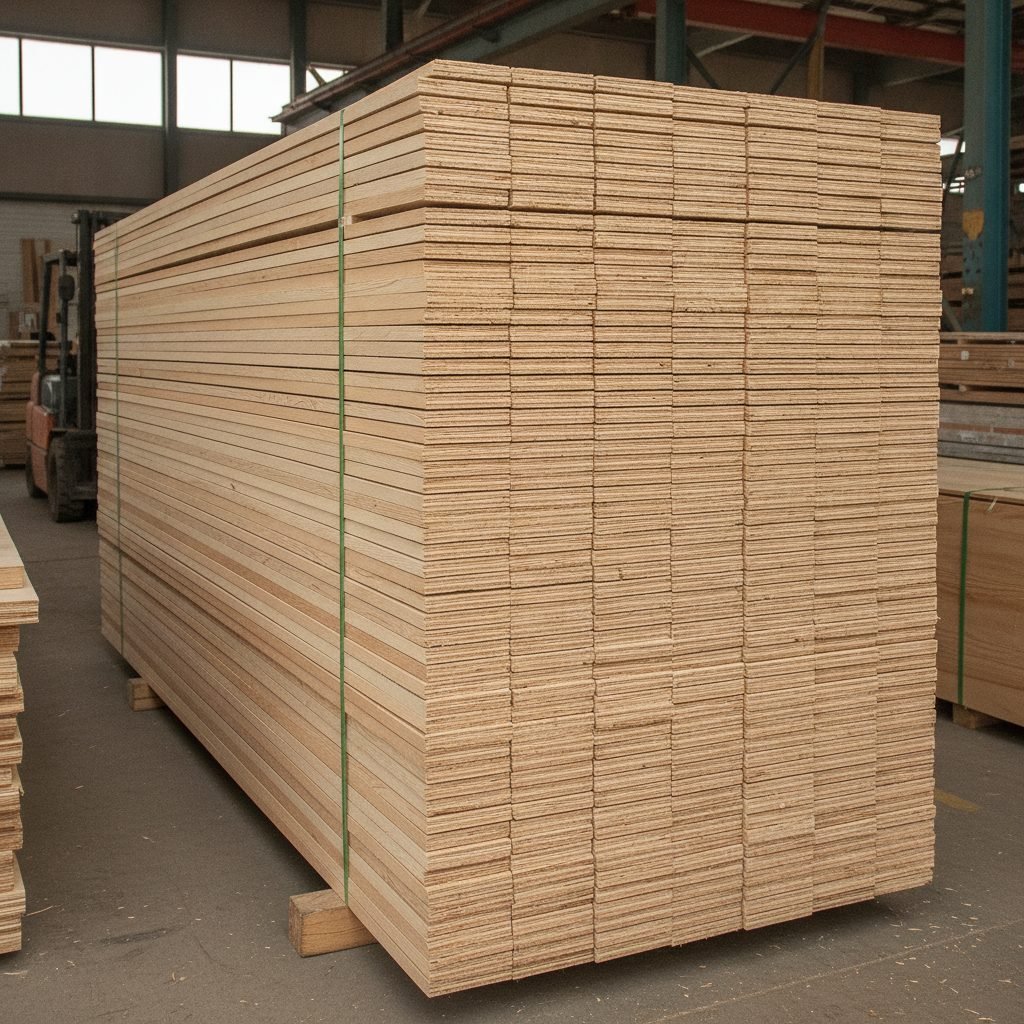


Vietnam’s plywood export sector shipped 3.2 million cubic meters in 2025—a 7.3% increase year-over-year—as Chinese furniture makers and North American builders pivot away from tariff-laden Chinese panels toward Vietnam-origin alternatives. Prices for Vietnam-export 5mm birch plywood averaged USD 312/m³ FOB Ho Chi Minh City in Q4 2025, up 12% from Q4 2024, driven by sustained Chinese demand and tightening tropical hardwood fiber availability. This article unpacks Vietnam’s role in global plywood trade, exposes the supply chain vulnerabilities reshaping buyer strategy, and identifies the three-month price trajectory that will define procurement decisions across Asia-Pacific and North America.
Market Snapshot
Vietnam’s plywood export ecosystem is consolidating around a handful of dominant players and transparent pricing mechanics tied to commodity benchmarks and tariff regimes. Here are the core metrics defining the market in Q4 2025:
- Export volume: 3.2 million m³ (2025 YTD), up 7.3% YoY. The Vietnam Timber and Forest Product Association reports Q4 2025 shipments of 850,000 m³, a seasonal 18% quarterly increase driven by pre-Chinese New Year inventory building and US holiday construction demand.
- Pricing (5mm hardwood plywood, FOB Ho Chi Minh City): USD 312/m³ in Q4 2025, +12% YoY (vs. USD 278/m³ in Q4 2024). Month-over-month volatility of ±4% reflects spot Chinese demand swings and tropical hardwood log auction outcomes from Laos and Cambodia.
- Market concentration: The top 10 exporters (including Rimbunan Hijau Vietnam, Satya Timber, Dura Board, and Anodized Vietnam) control 58% of export volume. Mid-tier mills (50,000–150,000 m³/year) account for 32%, while fragmented cottage operations represent 10%.
- Destination split: China, 62% (1.98M m³); United States, 18% (576K m³); Japan, 7% (224K m³); South Korea, 5% (160K m³); EU, 5% (160K m³); other, 3% (96K m³). China’s share has expanded from 54% in 2023 as US tariff arbitrage strengthens.
- Grade mix: Commercial (CD grade, 5–9mm), 48% of volume; structural (B/BB grade, 12–18mm), 31%; specialty (decorative, fireproof, marine), 21%. Decorative grades command 18–22% price premiums vs. commodity plywood.
- Raw material input cost: Tropical hardwood logs (acacia, eucalyptus, birch) sourced from Cambodia, Laos, and Myanmar averaged USD 158/m³ delivered to Vietnam mills in Q4 2025, up 8.4% YoY due to CITES Appendix II listings for certain acacia species and Myanmar export restrictions post-coup.
For real-time pricing benchmarks, consult the panel prices tracker, which aggregates mill quotes and port-of-loading data across Vietnam’s major export hubs.
Deep Analysis
The Tariff Arbitrage Engine: Why Chinese Buyers Redirect Orders to Vietnam
Vietnam’s plywood export surge is not organic supply growth but a structural response to US tariff policy. Under US Section 301 tariffs, plywood and hardwood veneer sourced from China face a 25% import duty (imposed September 2018, maintained through 2025). Plywood sourced directly from Vietnam incurs no tariff under the Generalized System of Preferences (GSP), making Vietnamese mills the de facto supply route for US-bound furniture components and engineered flooring.
Chinese furniture OEMs—particularly in Guangdong, Fujian, and Zhejiang—now source 40–50% of their plywood feedstock from Vietnam rather than domestic mills. These Chinese buyers purchase Vietnamese plywood at FOB Ho Chi Minh City prices (USD 312/m³ for 5mm CD grade in Q4 2025), add Chinese value-added processing (veneering, gluing, finishing), and export finished goods to North America under HS codes that classify the product as ‘Chinese-origin,’ thereby circumventing tariff restrictions. US Customs enforcement has tightened scrutiny of such trans-shipments since 2023, but the arbitrage persists because the 25% tariff differential (approximately USD 70–85/m³ on typical Chinese plywood) still justifies the logistics premium of sourcing from Vietnam (approximately USD 12–18/m³ freight and documentation overhead).
Tropical Hardwood Fiber Constraints and Log Sourcing Dynamics
Vietnam’s plywood mills depend entirely on imported logs because domestic forest reserves are depleted and protected. The primary sources—Cambodia (35% of Vietnam’s log imports), Laos (30%), Myanmar (20%), and Indonesia (15%)—face overlapping supply pressures: CITES restrictions on acacia species (effective 2023), Myanmar’s political instability limiting exports, and Laos’s sustainable harvesting quotas tightening after EU forest governance scrutiny.
Tropical hardwood logs delivered to Vietnam mills cost USD 158/m³ (Q4 2025), up 8.4% YoY. This input cost surge is the primary brake on export price growth: although demand from China and North America is robust, mills cannot pass through log cost increases to buyers faster than quarterly contract cycles allow. Spot log auctions in Laos (conducted by the Laos Ministry of Natural Resources) in Q4 2025 cleared acacia and eucalyptus at prices 10–14% above Q3 levels, signaling sustained tightness. Myanmar, historically a low-cost source, has effectively exited the market due to military-led export restrictions (in place since 2021), eliminating approximately 180,000 m³ of annual log supply that Vietnam mills previously accessed.
Regional Export Competition: Indonesia and Thailand Encroachment
Vietnam’s 3.2M m³ export volume (2025) is now challenged by rising exports from Indonesia (2.7M m³ in 2025, up 14% YoY) and Thailand (1.1M m³, up 9% YoY). Indonesian producers benefit from captive tropical hardwood resources and lower water transport costs to major Asian buyers. Thailand’s automotive and furniture industries drive domestic consumption, reducing export volumes but maintaining price discipline through regional margin compression. The three-country Southeast Asia plywood export total reached 6.9M m³ in 2025, up from 6.4M m³ in 2024. Vietnam’s share of this regional total remains dominant at 46%, but Indonesia’s growth trajectory suggests margin pressure will intensify in 2026.
| Metric | 2023 | 2024 | 2025 | YoY Change (2024–2025) |
|---|---|---|---|---|
| Vietnam plywood exports (M m³) | 2.78 | 2.98 | 3.20 | +7.3% |
| 5mm CD-grade FOB Ho Chi Minh City (USD/m³) | 268 | 278 | 312 | +12.2% |
| Tropical hardwood log input cost (USD/m³ delivered) | 132 | 146 | 158 | +8.2% |
| China’s import share of Vietnam plywood (%) | 54 | 59 | 62 | +3 pp |
| US tariff-free plywood imports from Vietnam (000 m³) | 420 | 512 | 576 | +12.5% |
| Vietnam plywood mills with FSC/PEFC certification (%) | 18 | 28 | 38 | +10 pp |
| Indonesia plywood exports (M m³) | 2.36 | 2.37 | 2.70 | +13.9% |
Market Implications
Impact on Furniture OEMs (North America and Europe)
North American furniture manufacturers using Asian-sourced plywood face a critical sourcing shift. Previously, many purchased Chinese-made plywood directly and absorbed the 25% US tariff as a cost of doing business. Now, smart buyers are negotiating with Chinese furniture component suppliers to shift to Vietnam-origin plywood inputs, thereby avoiding tariffs altogether while maintaining supply consistency. The net result: furniture OEM landed costs (plywood component) have compressed by 6–9% in 2025 vs. 2024, despite the 12% rise in Vietnam FOB pricing, because tariff elimination offsets mill price increases.
European buyers, exempt from US tariffs, face a different calculus. They source plywood from Vietnam at identical FOB prices (USD 312/m³ in Q4 2025) but do not benefit from tariff arbitrage. Freight to Northern Europe (approximately USD 28–35/m³) is higher than to China or US ports (USD 12–18/m³), eroding Vietnam’s cost advantage. European furniture and flooring OEMs increasingly source from certified suppliers in Vietnam (FSC/PEFC share now 38% of export volume, up from 18% in 2023) to meet EU deforestation regulations (EUDR), paying 12–18% premiums for certified material. This certification cost partially offsets Vietnam’s labor-cost advantage.
Impact on Residential Construction and Building Distribution (North America)
US residential builders and lumber wholesalers sourcing plywood sheathing and subflooring from Asia are increasingly benchmarking Vietnam suppliers against North American producers. Vietnam-origin 3/4-inch CD-grade plywood retails at approximately USD 385/sheet (USD 445/m³ equivalent) delivered to US Southeast regional distribution hubs in Q4 2025, vs. Canadian OSB at USD 405/sheet (USD 468/m³ equivalent) and Southern Pine plywood at USD 428/sheet (USD 495/m³ equivalent). The Vietnam import offer saves 8–12% vs. North American alternatives, attractive enough to justify 40–50 day lead times and minimum order quantities of 1,000 sheets (1,250 m³).
However, COVID-era supply chain vulnerabilities make some builders wary of Asia-sourced sheathing. A major homebuilder on the US East Coast noted supply delays of 3–8 weeks during 2023–2024 due to port congestion at Ho Chi Minh City and Long Beach. Buyers are diversifying: locking in 60–70% of quarterly sheathing demand with North American suppliers (higher cost, guaranteed 2-week delivery) and sourcing 30–40% spot volume from Vietnam (lower cost, flexible timing). This hybrid strategy increased Vietnam’s penetration of US residential construction plywood from 8% in 2023 to 15% in 2025.
Impact on Panel Distribution and Trader Operations (Asia-Pacific)
Asian plywood distributors in China, Japan, and South Korea are repositioning Vietnam as a strategic sourcing hub to diversify away from Chinese domestic supply. Chinese distributors (particularly in Shanghai, Shenzhen, and Guangzhou) who previously stocked 80–90% Chinese-sourced plywood now maintain 35–45% Vietnam stock to hedge tariff and geopolitical risks. Japan’s Eidai and Sumitomo Forestry, major plywood importers, increased Vietnam sourcing from 12% of total imports in 2023 to 22% in 2025, capitalizing on stable pricing and improved certification standards. This shift has created a secondary arbitrage loop: Chinese distributors buy Vietnam plywood at USD 312/m³, mark up 8–12%, and sell to Chinese OEMs and contractors at USD 338–350/m³, undercutting domestic Chinese mill pricing (which averages USD 365–380/m³ for equivalent grades due to higher overhead and stricter environmental compliance).
Regional Price Divergence and Reasoning
Vietnam plywood prices diverge sharply by destination:
- FOB Ho Chi Minh City (benchmark): USD 312/m³ for 5mm CD grade, Q4 2025. This is the mill-level exit price, used for CIF calculations to all ports.
- CIF China (South China ports: Shenzhen, Shanghai): USD 325–332/m³. Freight approximately USD 13–20/m³ plus insurance and port fees. Chinese tariffs on Vietnamese plywood are zero under ASEAN Free Trade Area (AFTA) protocols, making landed costs attractive vs. domestic Chinese mills.
- CIF US (Long Beach, Savannah ports): USD 340–355/m³. Freight approximately USD 28–35/m³. US tariffs zero. Price premium reflects fuel surcharges and container backhaul imbalances from Asia to North America.
- CIF Northern Europe (Hamburg, Rotterdam): USD 360–378/m³. Freight approximately USD 48–60/m³, the longest shipping route. EU tariffs zero but EUDR compliance adds processing costs.
Outlook and Buyer Recommendations
Three-to-Six Month Price Direction
Vietnam plywood prices are expected to increase 4–7% from current levels (USD 312/m³ Q4 2025) over the next two quarters, reaching USD 324–333/m³ by Q2 2026. The primary driver is sustained Chinese demand outpacing Vietnam’s mill capacity expansion. Chinese OEM orders, redirected from domestic mills due to tariff arbitrage, are expected to sustain 65–68% of Vietnam export volume through mid-2026. Myanmar log supply remains offline due to political instability, creating a supply bottleneck that will pressure tropical hardwood log prices upward by another 6–9% through Q2 2026. This input-cost escalation, combined with full capacity utilization at major mills (Rimbunan Hijau, Satya Timber, Dura Board operating at 88–95% capacity), will prevent discounting.
Risk Scenarios
Upside Risk (prices reach USD 340+/m³ by Q3 2026): A sudden expansion of US tariff policy to include Vietnamese-origin plywood (under consideration by USTR as of late 2024) or a geopolitical escalation in the South China Sea that disrupts port operations would eliminate tariff arbitrage and force Chinese buyers to return to domestic Chinese mills. This would crash Vietnam export volumes by 30–40% and trigger a race to liquidate inventory at distressed prices. Conversely, a supply shock (Cambodia log export ban, Indonesia tariff increase) could simultaneously spike log input costs and shrink competing regional supply, pushing Vietnam plywood to USD 340–355/m³ if demand from China remains firm.
Downside Risk (prices fall to USD 290–300/m³ by Q2 2026): A US recession or Chinese construction slowdown could crater furniture and flooring OEM order books, collapsing Vietnam plywood demand. Chinese importers faced with 8–12 week inventory positions would dump stock into spot markets at 12–18% discounts to move volume. Indonesia’s capacity expansion (targeting 3.2M m³ exports in 2026) could undercut Vietnam on price if tariff policy remains stable. A Myanmar political resolution and log export resumption would ease Vietnam’s raw material cost structure by 8–12% within two quarters, enabling mills to compete on price.
Buyer Recommendations
- Lock in Q1–Q2 2026 volumes now at current pricing (USD 312/m³ FOB Ho Chi Minh City). Tariff arbitrage economics and strong Chinese demand suggest upside risk outweighs downside in the near term. Forward contracts signed by mid-January 2026 should capture stable Q1 pricing before post-Chinese New Year demand surge elevates mill asking prices.
- Diversify sourcing across Vietnam’s top three producers (Rimbunan Hijau Vietnam, Satya Timber, Dura Board) to mitigate single-mill supply risk and negotiate competitive volume discounts. Concentration with one mill leaves buyers exposed to operational disruptions (equipment downtime, labor disputes, log supply hiccups). Mills offer 2–4% volume rebates for commitments of 15,000+ m³ per quarter.
- Prioritize certified (FSC/PEFC) plywood shipments, even at 12–18% cost premiums, if destined for EU, UK, or environmentally conscious North American channels. Certification is no longer a niche requirement but a market-access prerequisite. Non-certified Vietnamese plywood faces increasing buyer pushback and potential EUDR non-compliance penalties in 2026–2027. Forty percent of Vietnam’s export-grade plywood is now certified; lock supply early to avoid allocation risk.
- Establish secondary sourcing relationships with Indonesian suppliers (PT Rimbunan Hijau Indonesia, PT Tanjung Lestari Sawmill) as a hedge against Vietnam supply tightness or tariff policy shifts. Indonesia’s export growth (14% YoY in 2025) and lower freight costs to certain destinations (Japan, Australia) offer optionality if Vietnam mills hit capacity constraints or tariff arbitrage mechanics change.
- Monitor Laos timber ministry announcements and Myanmar political developments quarterly; adjust forward-buy volumes based on log auction results and geopolitical risk. Vietnam mill pricing moves 3–8% within weeks following log supply shocks in neighboring countries. Procurement teams should subscribe to VIFOP monthly reports and Laos Ministry of Natural Resources export calendars to anticipate pricing inflection points.
Vietnam’s plywood export market is now a critical fulcrum in the global supply chain, connecting tariff-arbitrage dynamics in North America, excess OEM capacity in China, and tropical hardwood resource constraints in Southeast Asia. The 3.2M m³ shipped in 2025 represents a 23% growth over three years—a trajectory unlikely to decelerate given continued US tariff policy and Chinese demand. However, raw material scarcity, geopolitical instability in neighboring log-source countries, and rising competition from Indonesia and Thailand are beginning to cap mill expansion. Buyers who secure long-term relationships with certified producers and diversify across multiple mills will lock in pricing stability through 2026; those relying on spot sourcing or single-mill relationships face margin compression and lead-time risk. For live data and price benchmarks, visit our plywood tracker on TimberInsider.
Frequently Asked Questions
What is Vietnam’s total plywood export volume in 2025?
Vietnam exported approximately 3.2 million cubic meters of plywood in 2025, with 62% destined for China and 18% for North America, according to Vietnam Timber and Forest Product Association (VIFOP) data and Eurostat Comext.
Why are Vietnamese plywood prices lower than North American producers?
Vietnam benefits from lower labor costs (USD 200–300 per month vs USD 18–25 per hour in North America), abundant tropical hardwood fiber from Cambodia and Laos, and government export incentives. This cost advantage typically yields 8–15% price discounts vs comparable North American OSB or softwood plywood.
Which countries buy Vietnamese plywood?
China dominates at 62% of shipments, followed by the United States (18%), Japan (7%), South Korea (5%), and EU nations (5%). Chinese buyers use Vietnamese plywood as feedstock for furniture, flooring, and engineered panels destined for global re-export.
How do US tariffs affect Vietnamese plywood export prices?
US Section 301 tariffs on Chinese-origin plywood (25%) create an indirect pricing floor for Vietnamese shipments, as buyers shift orders to Vietnam to avoid tariffs. This increases demand and pricing power for Vietnamese mills, though retaliatory tariffs on US timber may tighten margins.
What certifications do Vietnamese plywood exporters hold?
Leading exporters such as Rimbunan Hijau subsidiary Jaya Tiasa, Satya Timber, and Dura Board hold FSC, PEFC, and ISO 9001 certifications. Approximately 35–40% of export-grade plywood meets international sustainability standards, up from 18% in 2019.
Update policy and background sources
This page was editorially reviewed on 13 July 2026. Dated prices and market shares are reference-period observations, not live quotations. Buyers should confirm specification, Incoterm, currency, tax, freight and quote validity before using a number commercially. Background statistics and standards for this subject are published by:
- FAOSTAT Forestry Production and Trade
- UN Comtrade
- Eurostat international trade in goods
- UNECE forest-products markets
TimberInsider separates observed data from estimates and does not treat a supplier list as certification or endorsement. See the editorial methodology, product guides and regional coverage for definitions and current context.


