



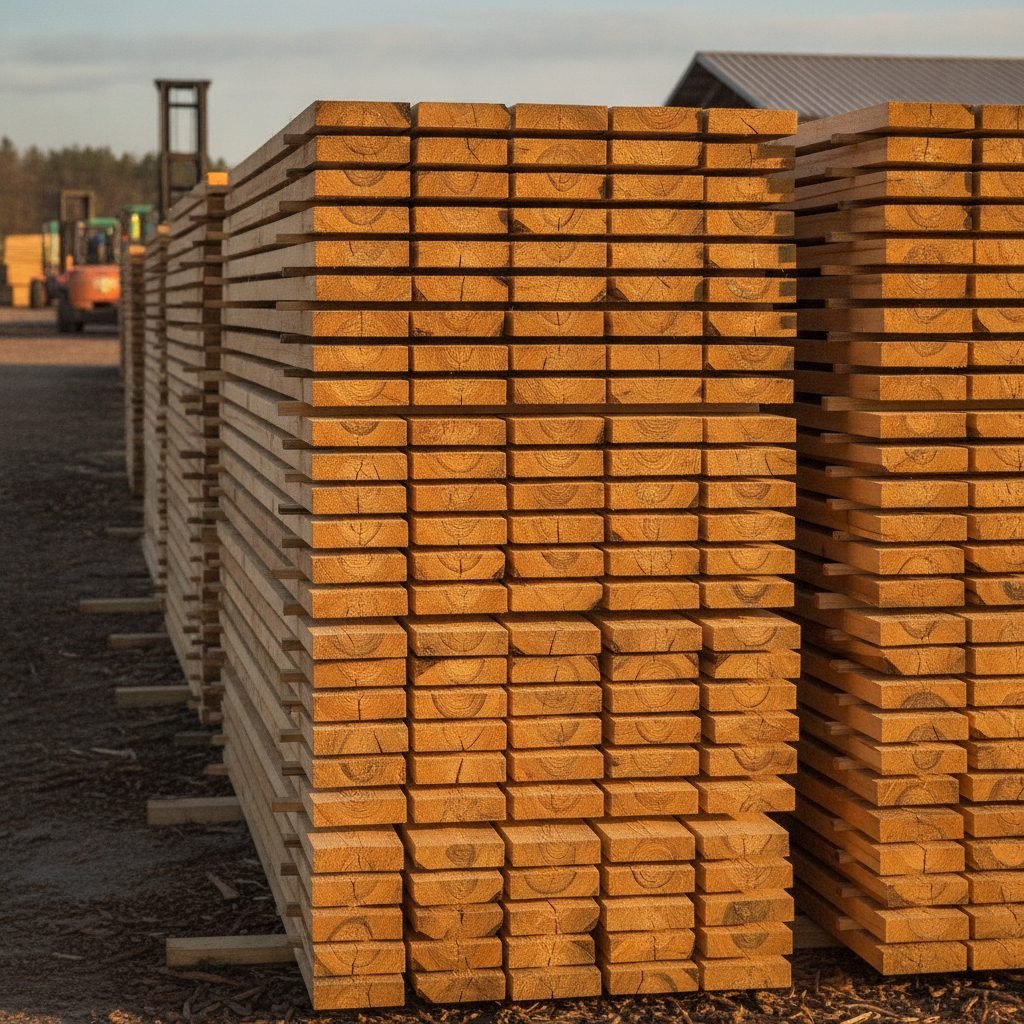


US pine lumber prices climbed into Q2 2025 despite sluggish housing starts, as Western mill curtailments and tariff jitters tightened supply. The Random Lengths Framing Lumber Composite index hit $424 USD/MBF in May — a 9% year-over-year gain and the highest Q2 level since 2022. But structural headwinds now suggest moderation ahead.
Market Snapshot
Pine lumber prices across the USA in Q2 2025 tell a regionally fragmented story:
- Western Pine: Ex-mill Pacific Northwest (Douglas-fir, ponderosa, lodgepole) averaged $410–$445 USD/MBF in May, up 7% from Q4 2024 but down 2% from the Q1 peak. Tolko Industries and Weyerhaeuser maintained reduced operating schedules through spring, citing chip availability constraints.
- Southern Yellow Pine: Georgia and Louisiana mill prices tracked $385–$425 USD/MBF, benefiting from steady residential construction demand in the Southeast. Sawlog prices at the stump rose 5% YoY, pressuring mill margins.
- Regional Delivered Prices: CIF prices to the Northeast (Baltimore, New Jersey ports) hit $510–$545 USD/MBF in May—a 14% premium over Western ex-mill rates. Shipping from West Coast to East Coast adds $100–$130 per MBF; Southern mills shave $30–$50 off Eastern delivered pricing.
- Grade and Dimension Spreads: 2×4 #2 KD (kiln-dried) lumber commanded a $35–$45 premium over commodity 2×4 #3 material. Longer lengths (16 ft, 20 ft) earned 8–12% premiums over 12 ft baseline in framing-heavy markets like Florida and Texas.
- Capacity Utilization: US softwood mills operated at 82% capacity in Q2 2025—down from 86% in Q1—suggesting modest output increases but insufficient to suppress price momentum. West Fraser and Arauco (with US operations) both signaled stable to higher Q3 guidance.
- Year-to-Date Trend: Random Lengths Framing Composite gained 9% YoY (Q2 2025 vs Q2 2024) and 6% QoQ (Q2 vs Q1 2025), reversing the deflationary trend that dominated 2024. Softwood Lumber Index (FOEX PIX) reflects similar strength in North American benchmark grades.
Deep Analysis
Western Mill Curtailments and Chip Scarcity
The dominant driver of pine lumber price support in early 2025 was deliberate production restraint in the US Pacific Northwest. Tolko Industries curtailed two mills (Idaho and British Columbia) for a combined 320 million board feet annually; Weyerhaeuser maintained lower operating rates at its Longview facility. Root cause: pulp mills competing aggressively for wood chips, the byproduct of dimension lumber mills, pushed chip prices to $120–$135 per green ton—near parity with the lumber revenue they could generate. Mills were forced to choose: run at lower utilization and preserve margin, or produce at full tilt and earn minimal profit. Most chose the former, capping supply and supporting the $410–$445 Western price band.
This dynamic is forecast to ease in Q3 2025. The Finnish pulp giant Stora Enso announced reduced chip demand due to seasonal maintenance at its Kajaani mill; simultaneously, Southern pine chip inventories swelled as spring logging accelerated. Relief should reduce friction by late summer, allowing incremental Western mill production and modest price moderation.
Southern Pine Demand Resilience and Sawlog Price Pressures
The Southeast housing market has remained surprisingly robust. Single-family housing starts in Florida, Georgia, and the Carolinas remained above 1.1 million units annualized through Q2 2025—above pre-pandemic norms. Builder demand for Southern yellow pine (SYP) framing lumber stayed consistent, keeping mills near 85% utilization. However, a darker trend lurks beneath: sawlog prices at the stump climbed 5–7% YoY across Georgia, Louisiana, and Arkansas. Foresters faced higher establishment costs (site prep, replanting) following the 2024 hurricane season, shifting supply curves upward. Mills absorbed some margin compression; pricing discipline preserved the rest. Southern pine mills maintained their $385–$425 USD/MBF range rather than cutting production, suggesting confidence in sustained demand through late 2025.
Tariff Uncertainty and Trade Flow Rebalancing
Canadian lumber imports to the USA have remained steady in Q2 2025 at roughly 2.2 billion board feet (annualized rate)—roughly 25% of US softwood lumber supply. However, trade policy chatter has unsettled buyers. The US International Trade Commission (ITC) conducted a Section 301 review of Canadian lumber in April 2025, considering whether existing countervailing duties (19.3%) should be adjusted. Uncertainty led some US distributors and builders to forward-buy domestic pine lumber as a hedge, supporting prices. If tariffs rise materially, US pine lumber prices could spike 8–15% as import volumes fall and mills maximize domestic pricing power. Conversely, a tariff hold or reduction would ease demand and support price declines into Q4 2025.
| Region & Mill Type | Grade | May 2025 Price | Q1 2025 Avg | Q2 2024 Avg | YoY Change % |
|---|---|---|---|---|---|
| Western Pine (Pacific NW, ex-mill) | 2×4 #2 KD | $428 | $432 | $392 | +9.2% |
| Western Pine (Pacific NW, ex-mill) | 2×4 #3 | $388 | $391 | $355 | +9.3% |
| Southern Yellow Pine (Georgia/LA, ex-mill) | 2×4 #2 KD | $412 | $408 | $378 | +9.0% |
| Southern Yellow Pine (Georgia/LA, ex-mill) | 2×4 #3 | $370 | $365 | $340 | +8.8% |
| Northeast (CIF Baltimore/NJ ports) | 2×4 #2 KD | $535 | $518 | $468 | +14.3% |
| Southeast (CIF Miami/Jacksonville) | 2×4 #2 KD | $445 | $441 | $405 | +9.9% |
| Midwest (CIF Chicago, truck delivered) | 2×4 #2 KD | $468 | $454 | $425 | +10.1% |
Market Implications
Residential Builders and Tract Home Developers
Single-family home builders with fixed-price contracts signed in late 2024 now face pinched margins. A 2,500-square-foot home requires roughly 15,000–18,000 board feet of framing lumber. At an average Q2 2025 price of $420 USD/MBF, that material cost has risen to $6,300–$7,560—up $450–$650 from Q2 2024 levels. Larger volume developers (e.g., Lennar, DR Horton subsidiaries) locked in forward contracts in Q1 to cap exposure; smaller regional builders absorbed spot price increases. Northeast builders, paying $535 USD/MBF delivered, face acute pressure and are rationing lumber for premium projects only. The consensus: builders will accept modest margin compression rather than raise home prices 2–3% further in a price-sensitive market.
Lumber Distribution and Retail (Home Depot, Lowe’s Supply Chain)
National home center chains and lumber wholesalers maintain strategic inventory ahead of the key remodeling season (spring 2025 through early fall 2025). Rising pine lumber costs force inventory writedowns on older stock and tighter turnover. Retail shelf prices for 2×4 #2 pine lumber have risen to $8.50–$9.50 per linear foot in major metros—roughly aligned with wholesale cost escalation. Regional lumber distribution hubs, especially in the Southeast and Florida, are fully stocked and facing margin pressure; Northeast distribution points show tighter inventory, supporting pricing discipline. Forward pricing is critical; distributors locking in Q3 supply now at $415–$425 USD/MBF will have a competitive edge if market prices dip to $390–$405 in Q4 2025.
Light Commercial and Multi-Family Contractors
Multifamily residential (apartment and condo construction) has moderated from 2024 peaks, with 600,000 units starts annualized in Q2 2025 versus 700,000 a year prior. However, mass timber (CLT, glulam) and structural engineered lumber products—which depend on softwood feedstock—are gaining traction. Contractors managing mixed-material projects (wood frame below, mass timber above) are locking in blended lumber forward contracts at $410–$435 USD/MBF to manage risk. Commercial builders in active markets (Austin, Denver, Raleigh) report that labor shortages are a bigger constraint than material cost; lumber pricing, while elevated, is a secondary concern versus schedule certainty.
Regional Price Divergence Drivers
The 14% Northeast premium (vs. Pacific NW ex-mill) reflects trucking logistics. Motor freight from Oregon/Washington to the Northeast costs $85–$110 per MBF; rail is marginally cheaper ($70–$85) but less flexible for small-volume orders. Southern mills enjoy a structural advantage for the Eastern Seaboard: a full truck of SYP lumber from Georgia to Baltimore costs $45–$65 per MBF—nearly 40% less than Western transport. This freight cost advantage explains why Southern SYP pricing ($385–$425) has proven stickier than Western rates and why regional builders increasingly buy locally. Conversely, West Coast prices remain lowest on an absolute basis, fueling continued interregional trade despite elevated freight costs.
Outlook & Buyer Recommendations
Three-to-Six-Month Price Direction: Pine lumber prices are forecast to decline 4–8% from current May 2025 levels through Q4 2025. The primary driver will be mill production normalization as chip scarcity eases and seasonal demand softens. Western mills are most vulnerable to downside; Southern mills will defend prices more effectively. By December 2025, expect the Random Lengths Framing Composite to settle in the $385–$410 USD/MBF range, down from the $424 Q2 peak but still 5–7% above year-ago levels.
Upside Risk Scenario: Tariffs escalate. If the US imposes additional countervailing duties on Canadian lumber (moving from 19.3% to 30%+), imports collapse and US mill pricing power surges. Domestic pine lumber could spike to $460–$490 USD/MBF by Q4 2025, driven by supply tightness and substitution demand from construction projects pivoting away from Canadian SPF (spruce-pine-fir). Probability: 25–30%.
Downside Risk Scenario: Housing demand disappoints. If mortgage rates rise sharply (above 7.5%) or recession concerns resurface, single-family housing starts could fall to 1.2–1.3 million units annualized (from current 1.35M). Builder demand softens, mill operating rates drift to 75–78%, and competitive pricing pressure cascades through the market. Pine lumber prices could sink to $365–$380 USD/MBF by year-end. Probability: 20–25%.
Buyer Recommendations for Q3-Q4 2025
- 1. Establish tiered forward contracts now. Lock in 40–50% of Q3–Q4 anticipated volume at current spot rates ($415–$425 USD/MBF Western, $400–$410 Southern), 30% at a midpoint hedge ($400–$410), and hold 20% uncontracted to capture potential Q4 dips. This avoids timing-the-market risk while preserving upside capture.
- 2. Prioritize Southern mills for delivery to Eastern/Southeastern job sites. Freight economics make Southern yellow pine 5–12% cheaper landed cost to the East Coast and South. If your projects are east of the Mississippi, shift supplier mix toward Georgia, Louisiana, and North Carolina mills; savings compound over large project portfolios.
- 3. Monitor tariff policy announcements weekly. Set up alerts for USTR statements and ITC rulings on the Section 301 Canadian lumber review. A tariff increase is your cue to front-load Q4 lumber purchases immediately; a tariff hold or reduction warrants waiting for Q4 moderation.
- 4. Diversify between grade and dimension specs. If project specifications allow, substitute #3 grade lumber for some #2 applications; the 4–6% savings is material across large frame-ups. Similarly, shift to 12-foot lengths where permissible to avoid 16-foot premiums.
- 5. Engage mills directly for volume discounts. Mid-size builders (5,000–20,000 MBF annual consumption) have negotiating power. Direct mill relationships (bypassing wholesalers) can yield 2–4% discounts on forward contracts and priority allocation in tight months.
Pine lumber prices in the USA remain elevated in Q2 2025 on the back of Western supply discipline and tariff uncertainty, but structural conditions—normalizing mill operating rates and seasonal demand softening—point to 4–8% price declines by year-end. Regional divergence, with the Northeast paying a 14% premium and the Southeast benefiting from freight-cost advantages, creates opportunities for buyers who shift sourcing strategically. Builders and distributors should lock in forward contracts on a tiered basis now, prioritize Southern suppliers for Eastern delivery, and maintain vigilant tariff monitoring to manage downside risk. Housing demand remains adequate but is no longer a growth driver; mills will need to compete on price as inventory normalizes. For live data and price benchmarks, visit our timber prices tracker on TimberInsider.
Frequently Asked Questions
What is the current price range for pine lumber in the USA in 2025?
As of Q2 2025, pine lumber spot prices range from $385–$450 USD/MBF (thousand board feet) depending on grade, region, and mill proximity. Western pine (ponderosa, lodgepole) trades at a premium versus Southern pine due to shipping. Prices have stabilized after Q1 volatility but remain 8–12% above year-ago levels. Check our timber price tracker for daily mill quotes.
Why did pine lumber prices rise in early 2025?
Three factors drove Q1 gains: (1) Western mill curtailments due to winter weather and chip supply tightness; (2) tariff uncertainty ahead of the spring construction season; (3) elevated mortgage rates extending demand from the remodeling segment. Southern pine mills ran at 87% capacity utilization in January–February, lifting prices 6% QoQ.
Which regions have the highest pine lumber prices?
Northeastern USA (Maine, New Hampshire) and Mid-Atlantic states pay 12–18% premiums over mill-gate pricing due to transportation costs and regional demand from residential construction. Pacific Northwest ex-mill prices are lowest, but CIF prices to the East Coast add $80–$120 per MBF. Southern pine prices (Mississippi, Georgia mills) sit in the mid-range but benefit from lower logistics to the Southeast and Mid-South.
What should builders and contractors expect for pine lumber prices in H2 2025?
Industry consensus points to a 3–7% price decline in Q3–Q4 2025 as mill operating rates normalize post-summer and seasonal demand softens. However, risks include sustained housing demand and potential tariff escalation on Canadian lumber imports, which would support USA pine prices. Lock in forward contracts now if pricing certainty is critical for your project pipeline.
How do pine lumber prices compare to plywood and OSB?
Pine lumber (structural framing) trades separately from engineered panels. In Q2 2025, pine 2×4 #2 lumber averaged $415 USD/MBF, while 3/4-inch plywood hovered at $52–$58 per sheet ($520–$580 per MSF basis). OSB was softer at $28–$32 per sheet ($560–$640 per MSF basis). Builders often blend all three materials; monitor each index independently for cost control.
Update policy and background sources
This page was editorially reviewed on 13 July 2026. Dated prices and market shares are reference-period observations, not live quotations. Buyers should confirm specification, Incoterm, currency, tax, freight and quote validity before using a number commercially. Background statistics and standards for this subject are published by:
- U.S. Bureau of Labor Statistics PPI
- Eurostat producer prices
- FAOSTAT Forestry Production and Trade
- UNECE forest-products markets
TimberInsider separates observed data from estimates and does not treat a supplier list as certification or endorsement. See the editorial methodology, product guides and regional coverage for definitions and current context.


