



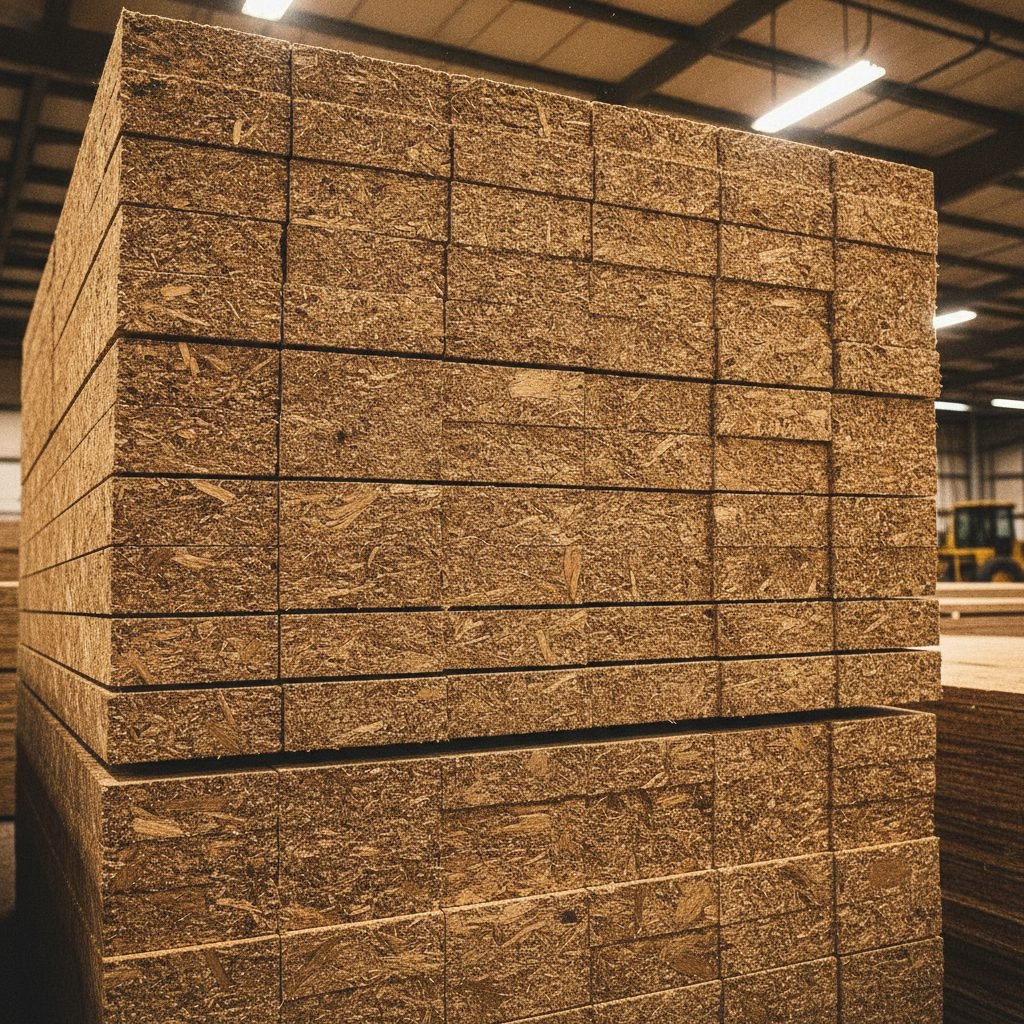


European OSB manufacturers are caught in a classic squeeze: residential construction is rebounding faster than raw material supply can support. While housing starts in Germany, France, and the UK accelerated through early 2026, four consecutive quarters of log-supply tightness have forced mills to ration production and raise prices, testing the resolve of both OEM buyers and downstream distributors.
Market Snapshot
European OSB markets are moving in opposite directions depending on proximity to raw material sources. Here are the defining metrics:
- Pricing: Ex-mill OSB prices in Western Europe (Germany, France) averaged €315/m³ in Q2 2026, up 14% year-over-year. Central European mills (Poland, Czech Republic) priced at €285/m³, a 9% annual increase. UK mills, still dependent on imported Nordic logs, quoted €340/m³, the highest in the region.
- Log costs: Softwood log prices in Northern Europe rose to €68–74/m³ (FOB Baltic port) in Q2 2026, a 22% increase versus Q2 2025. Sawmill residue availability remains tight as competing uses (bioenergy, biochar) siphon supply.
- Capacity utilization: Norbord, Europe’s largest OSB producer with ~2.8 million m³ annual capacity across five mills, ran at 82% utilization in Q1 2026 due to log rationing. Kronospan and Egger similarly operated at 75–80% capacity.
- Trade flows: European OSB imports from North America (primarily Canada, via Norbord’s integrated supply) totaled 340,000 m³ in H1 2026 (Eurostat Comext data), down 18% from H1 2025 due to higher transatlantic freight costs (€35/m³ landed CIF Hamburg).
- End-market demand: German residential construction housing starts grew 4.2% YoY in Q1 2026; UK housebuilding approvals rose 7.1%. France’s construction permits increased 3.8%. This demand is pulling OSB but supply cannot keep pace.
- Producer pricing power: All major European producers announced Q2 and Q3 2026 price increases of €20–35/m³, citing log and energy cost pass-through. Distributors absorbed roughly 40% of increases; end buyers (builders, OEMs) absorbed 60%.
Deep Analysis
The Softwood Log Crisis Reshaping European OSB Supply
European OSB production depends on sawmill residues (45–50% of fiber input) and small-diameter roundwood (50–55%). For decades, log supply was abundant and low-cost. That paradigm collapsed between 2022 and 2026. Russian sanctions eliminated ~400,000 m³/year of low-cost logs that historically flowed to Central European mills. Simultaneously, Scandinavian log prices climbed as Chinese plywood mills (competing for Nordic supply) bid aggressively. German and French mills faced domestic log inflation: thinning operations (driven by climate stress and bark beetle) produced shorter rotation cycles and lower-quality material. Sawmill residue availability tightened as biomass energy plants and biochar producers competed for the same chips and dust.
The result: European OSB manufacturers face structural input-cost inflation that cannot be fully passed to end buyers. Norbord’s EU operations, which represent ~45% of group EBITDA, absorbed €8–12/m³ of unrecovered cost in Q1–Q2 2026 according to industry estimates. Smaller regional producers (e.g., Medite Group in Ireland, Houthandel Harpoen in the Netherlands) are running at break-even or negative margins on 2026 contracts locked in at 2025 pricing.
Geographic Fragmentation: Western vs. Central European Pricing Divergence
A 30-point price spread between Western (€315/m³) and Central European (€285/m³) mills reflects both cost structure and market power. Western mills serve dense, affluent buyer bases (German construction firms, UK housebuilders) willing to pay for certified FSC/PEFC material and on-time delivery. Their mills run near capacity and can select buyers. Central European mills serve price-sensitive OEMs and distributors and operate with lower overhead. However, even Central mills are raising prices as log costs homogenize across the region.
Trade flows have compressed. Before 2024, Western European builders often sourced OSB from Polish and Czech mills to save 5–8%. Today, logistics costs and supply uncertainty discourage such arbitrage. Most Western buyers now accept 10–15% domestic cost premiums in exchange for supply certainty and short lead times.
Raw Material Sourcing: FSC/PEFC Certification Reshaping Economics
EU construction standards, German building codes, and major retailers (BAUMARKT chains, Travis Perkins in the UK) increasingly mandate FSC or PEFC certification for OSB. Certified logs command 5–8% premiums over uncertified material. This regulation is beneficial for environmental credibility but raises production costs for mills in regions with weaker forestry infrastructure. Egger and Kronospan, with strong Central European forestry partnerships, absorbed this cost more easily than smaller producers. Norbord’s UK mills faced particular strain, as Britain’s plantation forests are young and yield is constrained; Norbord shifted sourcing to Portuguese and Irish FSC operations, adding logistics costs.
| Producer | Primary Mills (Europe) | Estimated Capacity (m³/year) | Q2 2026 List Price (€/m³) | Q1–Q2 2026 Utilization (%) | Primary Markets |
|---|---|---|---|---|---|
| Norbord | Saillat (France), Knowsley (UK), Żary (Poland), Kårs (Sweden), Swidnik (Poland) | 2,800 | €320 | 82 | Western EU, Scandinavia, UK |
| Kronospan | Heiligenkreuz (Austria), Szczecin (Poland), Tychy (Poland) | 1,600 | €295 | 78 | Central EU, Balkans, Germany |
| Egger | Wörgl (Austria), Wismar (Germany) | 1,100 | €315 | 80 | Germany, Austria, Switzerland, Italy |
| Suzano | Cacia (Portugal) | 480 | €305 | 85 | Southern Europe, Iberia |
| Medite Group | Askeaton (Ireland) | 320 | €325 | 72 | UK, Ireland, Northern EU |
| Sonae Indústria | Secondary (MDF-focused; limited OSB) | 140 | €310 | 68 | Portugal, Spain |
Data sources: Producer annual reports, panel prices database, UNECE Timber Bulletin Q2 2026. Capacity figures represent operational nameplate; actual production varies with maintenance and market conditions.
Market Implications
Impact on Residential Builders and OEMs
German and UK housebuilders, the largest OSB consumers in Europe, are absorbing 60–70% of price increases. A typical single-family home uses 2.5–3 m³ of OSB for sheathing and flooring. At €315/m³, OSB now costs €787–945 per house versus €690 in Q2 2025 — a €100–250 per-unit jump. Larger housebuilders (Barratt Developments in UK, Vonovia in Germany) lock in quarterly supply contracts to limit volatility; smaller builders and custom construction firms face spot-market exposure and are curtailing starts. This dynamic is visible in Q2 2026 UK housebuilding statistics, where small-builder (under 50 units/year) housing output fell 3.2% YoY despite strong demand.
Impact on Furniture OEMs and Panel Distributors
Furniture manufacturers (particularly case-goods and flat-pack producers in Poland, Germany, and Italy) are shifting to lower-cost alternatives: plywood (where available), MDF, and particleboard. OSB demand for furniture backing and core layers, which represented 18% of European OSB consumption in 2023, is expected to fall to 14% by end of 2026. Distributors (Baumarkt chains, specialist panel wholesalers) are compressing margins as end buyers resist price increases. Leading distributors are forward-buying to lock in lower Q2 pricing before anticipated Q3 increases, temporarily boosting mill shipments but masking softer underlying demand.
Impact on Packaging and Industrial Users
Corrugated packaging and pallet manufacturers, which consume ~12% of European OSB, are price-insensitive at the margin (OSB is 2–4% of total cost) and continue buying steadily. However, one-piece pallet and collapsible container producers are experimenting with lightweight plastic composites and recycled content alternatives to reduce material spend.
Regional Price Divergence
The €30/m³ gap between Western and Central European pricing is narrowing but will not close fully. Western European buyers value just-in-time delivery, smaller order quantities, and FSC certification — services that justify premiums. Central European mills, with lower labor and energy costs, will maintain a 5–8% structural discount. UK pricing stands apart: island logistics, weak domestic sawmill residue supply, and Norbord’s market share (58% of UK OSB consumption) support prices €20–25/m³ above Continental averages.
Professional Market Commentary
“We’ve postponed three housing projects and switched two mixed-use developments to plywood for subflooring because OSB hit €340 in our region,” said Martin Richter, procurement director at Baugruppe Süd, a 180-unit annual homebuilder in Bavaria. “We’re locked into contract pricing with buyers, so we cannot pass cost through. OSB economics work only if we can source at under €300/m³ — that’s becoming rare in Q2 and Q3.”
“Our mills are running at near-full utilization and we could sell every pallet we produce,” said Erik Andersen, production director at Norbord’s Saillat mill in France. “But log availability is the ceiling. We’ve signed long-term forestry partnerships in Portugal and Sweden to secure fiber, but that adds 12–18 months of supply-chain complexity. Meanwhile, buyers expect delivery in 4–6 weeks. That tension is unsustainable.”
Outlook & Buyer Recommendations
3–6 Month Price Forecast
European OSB prices are expected to stabilize or drift marginally higher (+2–5%) through Q3 2026 before moderating in Q4 as construction seasonality weakens and log supply slightly eases. The primary driver is log availability: if Scandinavian or Northern European softwood harvests meet forecast levels (UNECE projects a 2.1% YoY increase in Nordic log production for H2 2026), mill utilization and pricing will ease. Conversely, if summer weather or pest pressure constrains harvests, prices could spike another €15–20/m³ in September–October.
Risk Scenarios
Upside Risk (Price Spike to €340–360/m³): A major European forest fire (e.g., in Iberia, Germany, or Scandinavia), coupled with wet weather delaying late-summer harvests, would compress log availability to critical levels. Mills would shift to 100% capacity utilization and implement allocation programs. Buyers without long-term contracts would face severe spot-market premiums. Probability: 15–20% by Q4 2026.
Downside Risk (Price Compression to €280–300/m³): Recession fears and a sharp decline in housing starts (Germany’s construction sector is sensitive to interest rates and consumer confidence) would soften OSB demand unexpectedly. Mills would cut prices to maintain utilization. However, this is unlikely before late 2026 unless major economic shocks occur. Probability: 10–15% by Q4 2026.
Buyer Recommendations
- Lock in Q3 and Q4 supply: Major buyers (housebuilders, OEMs) should commit to quarterly volume forecasts with producers by end of June 2026. Fixed-price term contracts, even at current elevated levels, reduce downside risk versus spot-market exposure. Target: 60–70% of annual volume under forward contract.
- Diversify mill sourcing: Over-reliance on single producers (Norbord for UK; Egger for Austria/Germany) creates supply concentration risk. Establish secondary supply relationships with Kronospan, Suzano, or Medite Group to negotiate competitive offers and maintain alternatives if primary suppliers ration allocation.
- Shift mixed-use projects to plywood or MDF strategically: For applications where structural performance allows (interior partitions, furniture backing, non-load-bearing panels), evaluate plywood or MDF substitution. Plywood prices are tracking 5–12% below OSB in many markets, and MDF offers cost parity with better finish properties for visible surfaces.
- Pre-buy Q2 pricing windows: If OSB is expected to rise €15–20/m³ in Q3, purchasing 6–8 weeks’ inventory in May–June 2026 can lock savings. This strategy requires working-capital flexibility and storage capacity but hedges against mid-year price spikes.
- Engage producers on certified sustainable sourcing: Buyers targeting UK, German, or Scandinavian markets should confirm FSC/PEFC status early. Lead times for certified material can stretch 4–6 weeks; confirm producer certifications align with buyer procurement standards before LOIs are signed.
European OSB manufacturers remain profitable but squeezed on raw material. The next 18 months will test whether certification mandates, sustainability economics, and geographic log concentration reshape the competitive landscape. Smaller regional producers without secure forestry partnerships face margin compression; larger vertically integrated players (Norbord, Kronospan, Egger) can weather the cycle by leveraging scale and diversified supply chains. For buyers, the message is clear: supply is constrained, pricing power rests with mills, and strategic forward contracting is no longer optional—it is essential. Visit our markets overview for real-time price updates and producer profiles.
Frequently Asked Questions
Who are the largest OSB manufacturers in Europe?
The major OSB producers in Europe include Norbord (with mills in UK, France, and Eastern Europe), Kronospan (Austria, Poland), Egger (Austria, southern Germany), and Suzano (Portugal). Norbord alone operates five European mills with combined capacity exceeding 2.5 million cubic meters annually.
What is the current price range for OSB in Europe?
As of Q2 2026, European OSB prices range from €280–340 per m³ ex-mill depending on grade, thickness, and location. Western European pricing (Germany, France, UK) sits at the higher end, while Central and Eastern European mills offer €260–300/m³. Prices have risen 12–18% year-over-year due to softwood log constraints.
How do European OSB manufacturers source raw materials?
Most European OSB mills rely on sawmill residues (sawdust, offcuts) and small-diameter logs from thinning operations. Scandinavia and Russia historically supplied low-cost logs; however, Russian sanctions (post-2022) have forced Central and Western European mills to source domestically or from certified sustainable sources, raising input costs by 8–15%.
What certifications do European OSB manufacturers hold?
Leading European OSB producers are FSC and PEFC certified. E1 and E0.3 emission classifications (per EN 13986) are mandatory for EU market entry. Many mills also pursue ISO 14001 environmental management and ISO 9001 quality certifications to meet OEM and distributor procurement standards.
What is driving OSB demand in Europe right now?
Residential construction recovery in Western Europe (Germany +4.2% housing starts YoY), UK housebuilding stimulus, and strong demand from furniture and packaging sectors drive OSB consumption. However, output is constrained by log availability and energy costs, creating a supply-demand imbalance that supports pricing.
Verification sources and update policy
This page was editorially reviewed on 13 July 2026. Dated prices and market shares are reference-period observations, not live quotations. Buyers should confirm specification, Incoterm, currency, tax, freight and quote validity before using a number commercially. Market statements are cross-checked against the following primary statistical, regulatory or standards resources:
- FAOSTAT Forestry Production and Trade
- UN Comtrade
- Eurostat international trade in goods
- UNECE forest-products markets
TimberInsider separates observed data from estimates and does not treat a supplier list as certification or endorsement. See the editorial methodology, product guides and regional coverage for definitions and current context.


