



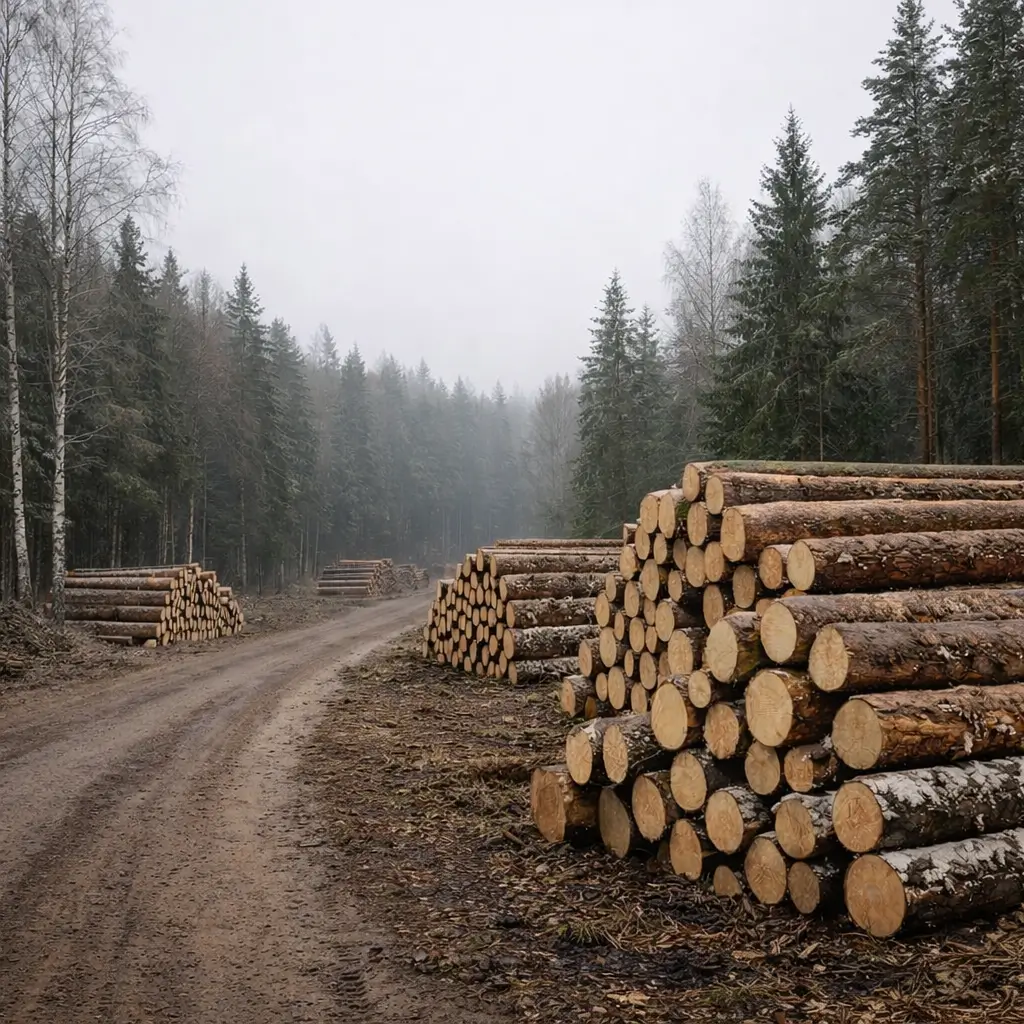


Updated July 13, 2026. Finnish industrial roundwood prices continued to fall in December 2025 after peaking around June. Official data from the Natural Resources Institute Finland (Luke) show that the picture changed again during spring 2026: sawlog prices recovered, while pulpwood remained substantially below the 2025 annual average.
Finnish roundwood prices in December 2025
| Standing-sale assortment | December price | Monthly real change |
|---|---|---|
| Pine sawlogs | €74.28/m³ | −1% |
| Spruce sawlogs | €77.78/m³ | −1% |
| Birch sawlogs | €59.07/m³ | −6% |
| Pine pulpwood | €23.99/m³ | −5% |
| Spruce pulpwood | €26.12/m³ | −6% |
| Birch pulpwood | €23.76/m³ | −6% |
The prices are the amounts recorded in wood-trade agreements. Luke’s narrative percentage changes are real changes adjusted with the cost-of-living index; the euro values are recorded at the nominal prices valid at the time.
The decline from the June peak
By December, average pine and birch sawlog prices had fallen about €10/m³ from their June highs, while spruce sawlogs were down about €8/m³. The adjustment was sharper for pulpwood: nationwide standing-sale averages fell by more than €10/m³ in six months.
Luke estimated declines of more than 30% for pine and birch pulpwood and 28% for spruce pulpwood from June to December. This confirms that the late-2025 correction was not evenly distributed across assortments.
May 2026 data show a split market
| Standing-sale assortment | May 2026 | Change from April | Versus 2025 average |
|---|---|---|---|
| Pine sawlogs | €77.28/m³ | +1% | −5% |
| Spruce sawlogs | €82.86/m³ | +1% | −1% |
| Birch sawlogs | €63.19/m³ | +2% | −5% |
| Pine pulpwood | €22.71/m³ | −1% | −28% |
| Spruce pulpwood | €24.67/m³ | −1% | −26% |
| Birch pulpwood | €23.36/m³ | +1% | −26% |
Compared with December, all three sawlog averages had recovered by May. Pulpwood remained weak, with pine and spruce prices below their December levels and birch only slightly lower. The original headline therefore describes December correctly but not the entire first half of 2026.
Trade volumes stayed unusually low
Industrial roundwood purchases from private forests were 28% lower year over year in December and 27% below the preceding five-year average. Preliminary full-year 2025 trade volume was 19% below 2024.
Weak trade continued into 2026. Luke reported May purchase volume 30% lower than one year earlier, while cumulative January–May volume was 28% lower year over year and 18% below the five-year average. A price increase alongside low volume can signal selective buying rather than a broad demand recovery.
Standing sales and delivery sales are different
In standing sales, the buyer purchases the right to harvest timber and the published price is commonly described as a stumpage price. Delivery sales involve wood delivered by the seller, so the price includes a different allocation of harvesting and transport responsibility.
December delivery-sale pulpwood prices were €43.10/m³ for pine, €45.75 for spruce and €43.41 for birch—well above standing-sale levels. The difference should not be interpreted as a free premium because the seller bears additional work and costs.
Why sawlogs recovered faster than pulpwood
Sawlogs and pulpwood feed different industries and require different tree dimensions and quality. Sawlogs serve lumber and plywood production, while pulpwood is used by pulp, paper, board and energy-related operations. Mill demand, inventories and species needs can therefore create separate price cycles.
Spring 2026 sawlog gains suggest firmer demand for selected industrial logs, especially spruce, but the trade-volume data remain cautious. TimberInsider follows these distinctions through its timber-price hub, sawmilling coverage and plywood analysis.
High annual earnings can coexist with a late-year decline
Luke reported record stumpage earnings of €3.7 billion for 2025, up 3% in real terms. This is not inconsistent with falling December prices. Trade was active and prices were high during the first half, while felling volumes were slightly above usual levels.
Annual income aggregates the whole year; a monthly price shows a much narrower period. Analysts should not use the record earnings figure to dismiss the late-year correction, or use December alone to characterise all of 2025.
Coverage and statistical limitations
Luke receives data from the largest wood buyers and forest-management associations. Published volumes represent about 90% of purchases by forest industries from non-industrial private forests and are not grossed up to the total market.
Prices exclude separate increments and services related to the transaction. Regional prices can differ from national averages, and contract timing may not match the month of harvesting or mill consumption. TimberInsider’s methodology guide explains why product, sales type, period and unit must remain visible.
What to monitor next
- June release: Luke scheduled the next monthly roundwood report for July 24, 2026.
- Sawlog momentum: determine whether the spring recovery persists across pine, spruce and birch.
- Pulpwood floor: watch for stabilisation after the steep decline from June 2025.
- Trade volume: low purchasing may affect future harvesting and raw-material availability.
- Regional spreads: national averages can conceal mill-specific competition.
For broader comparison, consult TimberInsider’s regional market hub and wood-market overview.
Bottom line
Finnish log and pulpwood prices did decline in December 2025, with pulpwood recording the larger fall from its June peak. By May 2026, sawlog prices had partially recovered while pulpwood remained depressed and trade volumes stayed unusually low. The market should be read by species, assortment and sales type rather than through one headline average.
Sources and methodology
December prices and volumes come from Luke’s December 2025 official release. Current comparisons use its May 2026 release. The annual earnings context comes from Luke’s 2025 stumpage earnings statistics, and harvest volume was checked against the December commercial fellings report. No currency conversion or estimate of uncovered market volume is applied.
Update note: subsequent price comparisons should use the same assortment, region and delivery basis.


