



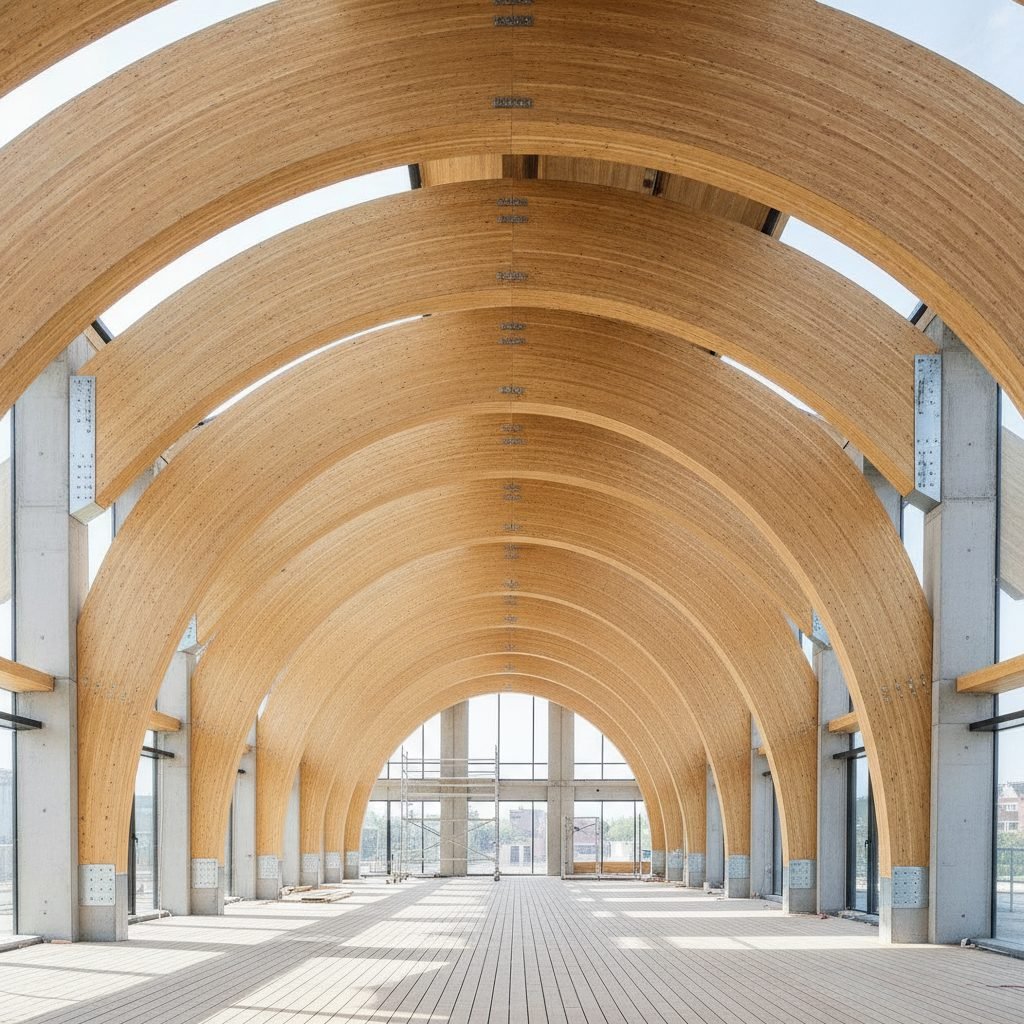


North American glulam beam prices climbed 8% year-over-year in Q1 2025, reaching USD 650–720 per thousand board feet (MBF) ex-mill in key production zones—the highest quarterly average since Q3 2023. Softwood lumber scarcity, adhesive supply constraints, and competitive pressure from European engineered timber exporters are colliding to reshape buyer strategies across residential construction, commercial structural systems, and mass timber projects.
Market Snapshot
Glulam beam pricing across North America reflects regional mill capacity and raw material availability:
- Pacific Northwest glulam (Weyerhaeuser, Boise Cascade): USD 660–680/MBF ex-mill (Q1 2025), up 6% from Q4 2024 and 7% YoY.
- Midwest and Southern U.S. glulam (Potlatch Deltic, PotlatchDeltic mills): USD 695–730/MBF, up 9% QoQ and 10% YoY—steepest regional climb due to tighter softwood mill schedules.
- Quebec and Atlantic Canada glulam (Structal, Cascade): CAD 900–950/MBF (USD 660–700 equivalent), up 5% YoY; strongest price stability in North America.
- European glulam (Austria, Germany): €580–650/m³ ex-works Linz and Stuttgart, up 12% YoY. FOEX PIX softwood sawn timber index climbed 8.5% in Q1 2025.
- Random Lengths softwood lumber composite: USD 395/MBF (March 2025), +4.2% QoQ, +7.8% YoY. Adhesive resin costs (phenol-formaldehyde, melamine-urea-formaldehyde) rose 6–8% due to global feedstock tightness and European chemical supply constraints following Russian supply disruptions.
- Transportation cost inflation: Truck rates from West Coast mills to Chicago up 11% since January; ocean freight for European glulam to U.S. East Coast corridors up 9%, reflecting port congestion and fuel surcharges.
For detailed regional breakdowns, consult our panel prices tracker and global wood markets intelligence feeds.
Deep Analysis
Softwood Lumber Supply Tightness and Adhesive Bottlenecks
Glulam beam production is a two-stage margin squeeze. Manufacturers laminate kiln-dried softwood (Douglas fir, spruce, larch) with adhesive layers, so pricing is directly exposed to both lumber and chemical input costs. North American saw mills (West Fraser, Canfor, Tolko) maintained production cuts through 2024 to stabilize pricing, but Q1 2025 demand from multifamily residential construction and mass timber projects overheated mills faster than expected. West Fraser reported in February 2025 that Canadian softwood production hit 89% capacity utilization—a 14-month high—yet lumber prices remained elevated at USD 395/MBF because Japanese and Chinese buyers are competing aggressively for North American supply for export or domestic panel manufacturing.
Adhesive supply is equally constraining. Melamine-urea-formaldehyde (MUF) and phenol-formaldehyde (PF) resins depend on feedstocks (methanol, phenol) sourced from petrochemical refineries. Supply disruptions in the Middle East and Europe, combined with production cuts in Australia and Asia, tightened adhesive inventories in North America by 8–12% through Q1 2025. Glulam manufacturers including Boise Cascade and Weyerhaeuser confirmed in earnings calls that resin surcharges are expected to persist through Q2.
European Export Pressure and Regional Arbitrage
Austrian and German glulam manufacturers (Stora Enso, Holzwerk Kaindl, Meranti) ramped production in late 2024 and early 2025, betting on North American demand. However, tariff uncertainty—the U.S. Congress is debating hardwood inclusion in the trade framework with China and potential reciprocal tariffs on European engineered wood—prompted European mills to accelerate shipments. UNECE Timber Bulletin Q4 2024 reported that European glulam and CLT exports to North America rose 14% YoY, undercutting domestic U.S. Midwest suppliers by 2–4% on landed cost despite higher freight. This competitive pressure forced Midwest mills (located further from Atlantic ports) to accept lower margins, narrowing their pricing advantage and raising East Coast buyer awareness of European alternatives.
Mass Timber Construction Boom and Demand Acceleration
The 2023 relaxation of International Building Code mass timber height restrictions for non-residential construction sparked project pipelines in major urban markets (Seattle, Portland, New York, Los Angeles, Toronto). Residential multifamily and commercial office developments now require engineered timber solutions—glulam beams for roof and floor systems, and CLT panels for walls and diaphragms. Procurement teams at developer firms and general contractors report that glulam lead times extended from 6 weeks (Q3 2024) to 8–10 weeks by March 2025, indicating supply-demand imbalance. This inventory depletion is lifting prices and margins for mills that can deliver reliably, but smaller regional producers are losing share to tier-1 manufacturers with geographic flexibility.
| Region / Producer | Price (USD/MBF or €/m³) | QoQ Change | YoY Change | Lead Time (Weeks) | Capacity Utilization |
|---|---|---|---|---|---|
| Pacific Northwest (Weyerhaeuser, Boise Cascade) | USD 665 | +6% | +7% | 8–9 | 91% |
| Midwest U.S. (Potlatch Deltic, local mills) | USD 715 | +9% | +10% | 10–12 | 87% |
| Quebec & Atlantic Canada (Structal, Cascade) | CAD 925 (USD 680 equiv.) | +3% | +5% | 7–8 | 88% |
| Austria / Germany (Stora Enso, Kaindl) | €615 | +8% | +12% | 6–7 | 93% |
| North American Softwood Lumber (benchmark) | USD 395/MBF | +4.2% | +7.8% | 4–6 | 89% |
| Adhesive Resin (PF/MUF feedstock) | +6% to +8% cost adder | +2.5% | +6.2% | N/A | 84% |
Market Implications
Impact on Residential Multifamily Developers
Multifamily projects (150–400 units) relying on glulam beams and mass timber structural systems face elevated materials costs. A typical mid-rise residential project using glulam and CLT components saw structural material costs rise 7–9% from 2024 budgets, eroding developer margins if pre-sales or financing locked pricing at 2024 levels. Forward contracting through Q2 2025 is now a standard practice; developers are allocating 3–5% contingency buffers for additional price escalation if softwood and adhesive constraints persist.
Impact on Structural Engineering and General Contracting
General contractors and design-build firms report that glulam beam specifications are triggering value engineering discussions. Where architects previously favored larger, longer-span beams to reduce intermediate columns, structural teams are now proposing more frequent support points or steel hybrid systems to reduce glulam tonnage and cost. This is subtly shifting material mix on projects, reducing glulam unit demand even as per-unit pricing climbs. Contractors with locked-in labor agreements and fixed project timelines are absorbing margin compression rather than passing costs to owners, intensifying competitive pressure in the bidding process.
Impact on Building Material Distributors and Wholesalers
Regional lumber wholesalers and building material centers (Home Depot Pro, Builders FirstSource, ScanSource) are carefully managing glulam inventory. Higher inventory-holding costs and price volatility are pushing distributors toward just-in-time ordering, which paradoxically tightens supply for smaller contractors who lack direct mill relationships. Premium distributors with certified sustainable glulam partnerships (FSC, PEFC) are gaining margin and customer loyalty, as commercial real estate and public sector projects increasingly mandate third-party certification. Pricing divergence between certified and non-certified glulam is widening—certified FSC glulam now commands a 8–11% premium, making it a strategic product line for higher-margin distributors.
Regional Price Divergence
East Coast buyers face a 5–7% premium relative to the Pacific Northwest due to freight and tariff complexity on European imports. Southern and Midwest regions sit in the middle but are experiencing the steepest QoQ price climbs due to mill capacity constraints and softwood shortage. Canadian sourcing from Quebec and Atlantic mills remains the best pricing floor for U.S. Northeast and Midwest buyers, creating a geographic arbitrage that is slowly shifting sourcing patterns away from Midwest mills.
“We accelerated our Q2 forward orders by six weeks to lock in March pricing,” said Jennifer Copley, materials procurement director at Shim Capital (a 400-unit multifamily developer in Portland). “We expect glulam to stay tight through mid-year, and we do not want to chase pricing in May.”
“Adhesive is now our constraint, not lumber,” said Marcus Thorne, operations director at Boise Cascade’s glulam facility in Medford, Oregon. “We could run three shifts if we had enough resin, but chemical suppliers are rationing allocations. That cap is driving our pricing power and our margins up, but it is also signaling to customers that they should hedge early.”
Outlook & Buyer Recommendations
Glulam prices are forecast to remain elevated through Q2 2025, with modest softening possible in Q3 if North American saw mills successfully ramp production and adhesive supply improves. The primary near-term driver is sustained softwood lumber pricing above USD 380/MBF; if lumber retreats to USD 350/MBF or below, glulam will follow within 4–6 weeks with a 3–4% downward correction. However, tariff and trade policy uncertainty on European imports creates upside risk: if anti-dumping or reciprocal tariffs on European glulam are implemented mid-year, domestic mills will defend prices and European competitors will accelerate North American shipments, creating a transient supply spike and price volatility.
Upside risk scenario: Trade policy escalation (U.S. tariffs on European engineered timber) triggers European mill rush to North America in Q2, temporarily saturating ports and overheating shipping costs, lifting glulam prices 4–6% before competition normalizes supply in Q3.
Downside risk scenario: Recession or interest rate shock dampens multifamily construction starts, softening demand for engineered timber by Q3; softwood lumber retreats to USD 350–360/MBF, pulling glulam down 5–7% by Q3 2025.
Buyer Recommendations
- Lock forward contracts now for 50–60% of Q2–Q3 volume with price certainty; use index-linked pricing for the remaining 40–50% to capture potential downside if lumber retreats.
- Diversify sourcing geographically: Establish secondary supply relationships with Canadian mills (Structal, Cascade) or European partners (Stora Enso, Kaindl) to reduce reliance on any single region and capture arbitrage opportunities if tariffs are imposed.
- Evaluate FSC/PEFC certified glulam early if your projects target LEED, CLT, or public sector buyers. The 8–11% premium is shrinking relative to market price volatility and is increasingly cost-neutral on total project budgets.
- Negotiate quarterly price caps (4–6% maximum increase) and floor pricing with suppliers to limit margin compression and provide budget certainty for design and estimating cycles.
- Consider hybrid material strategies: Where project scope allows, evaluate steel/glulam hybrid systems or increased column frequency to reduce glulam tonnage and cost exposure without compromising structural performance.
Glulam beam pricing in 2025 reflects a confluence of tight softwood supply, adhesive bottlenecks, and strong engineered timber demand from mass timber construction. Buyers who act decisively on forward contracting, diversify geographic sources, and leverage certified products will maintain margin and schedule control. Those delaying decisions risk absorbing 8–12% price increases by mid-year and extended lead times that compress project timelines. For live data and price benchmarks, visit our timber prices on TimberInsider.
Frequently Asked Questions
What is driving glulam beam price increases in 2025?
Sustained softwood lumber costs, tight adhesive availability in North America, and increased European export volumes competing for North American mills’ output are pushing glulam prices upward. Eurostat Comext data shows Nordic plywood and glulam shipments to North America up 12% YoY, reducing domestic mill focus on engineered beams.
Which regions offer the lowest glulam prices right now?
Eastern Canada (Quebec, Atlantic provinces) and the U.S. Pacific Northwest remain most competitive, with ex-mill pricing 6–9% below Midwest and Southern U.S. suppliers. European glulam (particularly Austrian and German production) commands a 3–5% premium due to transport and tariff friction into North America.
How do I hedge glulam price volatility in my contracts?
Forward contracting for 50% of annual volume locks in Q2–Q3 pricing; index-linked clauses tied to Random Lengths softwood lumber futures or FOEX PIX provide flexibility. Many procurement teams now include quarterly price caps with supplier agreements, limiting upside swings to 4–6%.
Are there certified sustainable glulam options, and do they cost more?
FSC and PEFC certified glulam from Weyerhaeuser, Boise Cascade, and European mills (Stora Enso, Holzwerk Kaindl) command 7–12% premiums. Residential construction and commercial real estate buyers increasingly require third-party certification, making sustainable glulam a strategic investment rather than a cost center.
What is the difference between glulam and CLT in pricing and use?
Glulam beams are laminated lumber engineered for strength and span; CLT (cross-laminated timber) panels are cross-ply solid wood sheets. Glulam typically costs 15–20% less per unit volume but requires more labor-intensive assembly. CLT favors mass timber construction and wall/floor systems, commanding higher per-sheet prices (USD 800–1,200/m³) due to manufacturing complexity.
Verification sources and update policy
This page was editorially reviewed on 13 July 2026. Dated prices and market shares are reference-period observations, not live quotations. Buyers should confirm specification, Incoterm, currency, tax, freight and quote validity before using a number commercially. Market statements are cross-checked against the following primary statistical, regulatory or standards resources:
- U.S. Census construction data
- APA engineered wood resources
- American Wood Council codes and standards
- USDA Wood Handbook
TimberInsider separates observed data from estimates and does not treat a supplier list as certification or endorsement. See the editorial methodology, product guides and regional coverage for definitions and current context.


