



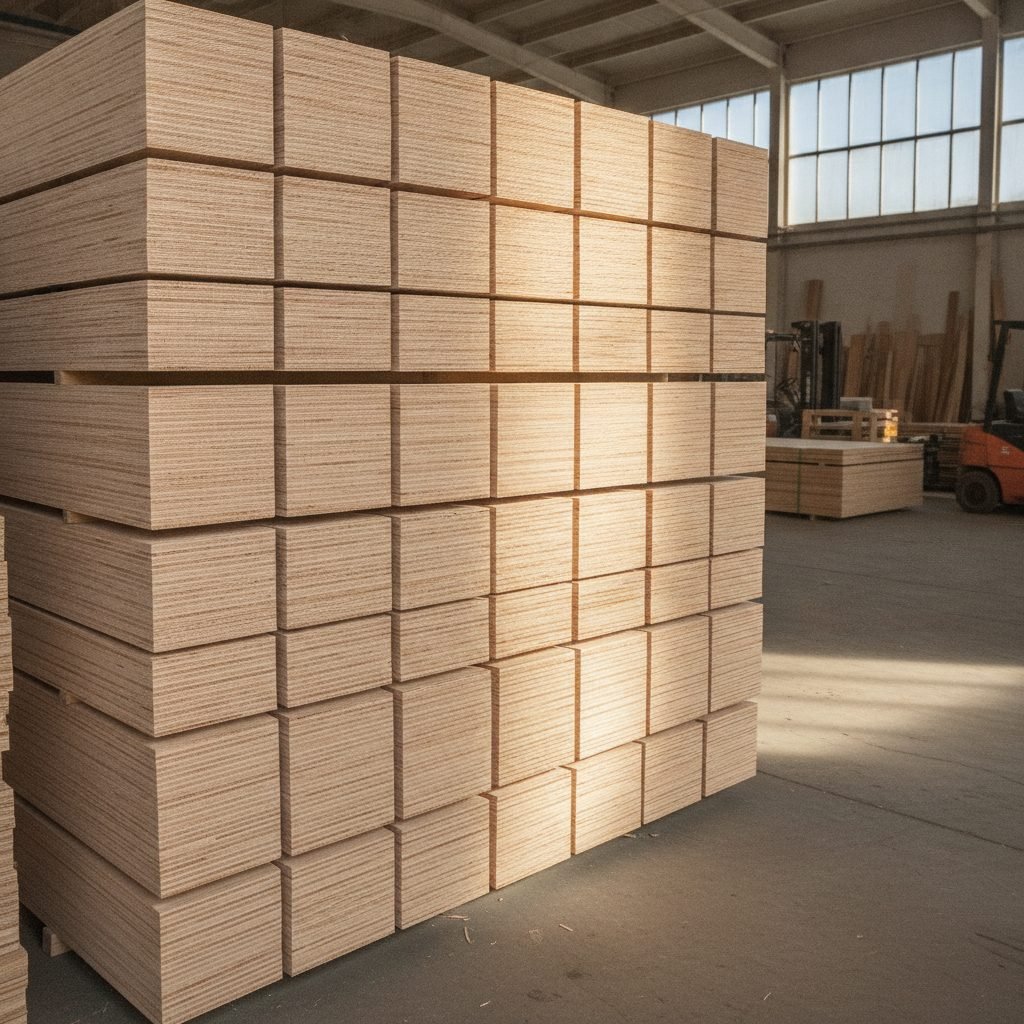


Russian plywood vanished from European supply chains overnight in March 2022, creating a 1.2-million-cubic-meter annual void that no single supplier could fill. Buyers accustomed to cheap Arkhangelsk birch suddenly competed for limited Nordic and imported Asian stock. Eighteen months later, the market has adapted—but at a structural cost that persists into 2026.
Market Snapshot: Post-Ban European Plywood Realities
The European plywood market absorbed one of the most rapid supply shocks in modern timber history. Key metrics reveal the scale of disruption:
- Price displacement: Birch plywood at the ex-works Czech Republic rose from €385/m³ in February 2022 to €510/m³ by September 2022—a 32% spike in seven months. By Q4 2024, prices stabilized at €445–€465/m³, representing an 18% structural premium versus pre-sanction baseline.
- Russian market share loss: Moscow supplied 34% of EU plywood imports (1.2M m³/year). Within 12 months, this fell to zero. By volume, substitution was incomplete: total European plywood availability dropped 8–12% through 2023, recovering only partially by 2024.
- Finnish / Swedish ramp-up: UPM-Kymmene and Stora Enso increased birch plywood output by 120,000 m³ annually—insufficient to fill the gap. Unit costs rose due to fiber scarcity and mill overcapacity elsewhere in their portfolios.
- Chinese import surge: Radiata pine plywood imports to the EU jumped from 180,000 m³ (2021) to 420,000 m³ (2023), then moderated to 350,000 m³ (2024) as buyers pushed back on non-birch substitutes. FOB Shanghai prices fell 12% (Q2 2024 vs. Q2 2023), yet landed costs in Hamburg remained elevated due to freight premiums.
- Brazilian eucalyptus entry: Arauco and Klabin exported 65,000 m³ of eucalyptus plywood to the EU in 2023–2024, capturing niche markets in furniture (softer density) and packaging. Ex-mill prices ranged €420–€480/m³, competitive versus Nordic birch.
- Certification friction: Chinese producers lack FSC certification at scale; Brazilian suppliers hold FSC but limited availability. European OEMs faced a trade-off: accept non-certified Asian plywood or pay 12–18% premiums for certified Nordics and Brazilian.
Deep Analysis: Supply Fracture and Structural Rebalancing
The Arkhangelsk Void and Nordic Capacity Limits
SVEZA and Segezha Group—Russia’s two largest plywood exporters to Europe—collectively shipped 850,000 m³ annually to the EU, primarily high-grade birch for furniture and construction. The northern Russian mills operated near-optimal utilization: raw material (birch logs from Karelia and Arkhangelsk) was abundant and cheap, transportation to European ports was established, and customer relationships spanned three decades.
When EU sanctions took effect, European buyers looked north to Scandinavia. Finland’s UPM-Kymmene and Sweden’s Stora Enso operated three birch plywood mills combined, with aggregate capacity of ~400,000 m³/year. Both mills ran at 85–95% utilization before 2022. Expansion was logistically difficult: birch pulpwood scarcity in Nordic countries meant competing with tissue and packaging mills for fiber. New mill construction would require 3–5 years and €150–200 million capital per facility—economics unviable when sanction duration remained uncertain.
Result: Nordic birch plywood availability increased by only 120,000 m³ (roughly 14% of the Russian loss) through 2024, achieved via reduced exports to non-EU markets and modest debottlenecking. The remaining void forced European buyers to source from unlikely origins.
China’s Opportunistic Pivot and Quality Trade-Offs
Chinese plywood mills, concentrated in Shandong and Jiangsu provinces, shifted production toward radiata pine and hardwood (eucalyptus, meranti) grades as Russian sanctions materialized. Chinese radiata plywood offers cost advantages (labor, energy, log sourcing from Australia and New Zealand), but structural properties and dimensional stability lag hardwood birch. Furniture OEMs requiring precise veneers or structural panels faced dimensional tolerance headaches.
Chinese producers increased EU-bound shipments from 180,000 m³ (2021) to 420,000 m³ (2023), capturing price-sensitive segments (mass-market furniture, packaging, construction sheathing). However, acceptance rates plateaued at ~350,000 m³ annually by 2024: European buyers proved unwilling to substitute low-grade Chinese radiata for premium birch at scale, despite price incentives of 15–20%.
Certification emerged as a secondary friction. Chinese mills achieved ISO 9001 and CE marking but lacked Forest Stewardship Council (FSC) credentials at volume. Scandinavian and Brazilian competitors, holding FSC A-grade certifications, commanded 10–18% premiums in the EU furniture sector, where IKEA, Natuzzi, and Herman Miller enforced sustainable sourcing mandates.
Turkish and Eastern European Adjacency Plays
Turkish mills (primarily Batı Anadolu and Marmara regions) increased birch and mixed hardwood plywood output. By 2024, Turkish exports to the EU reached ~95,000 m³ annually—modest but meaningful. Prices ranged €410–€460/m³ ex-mill Izmir, competitive versus Nordic birch due to regional fiber access and lower labor costs. However, Turkish production remained constrained by birch log supply; most Turkish plywood pivoted to softwood species, limiting direct substitution.
Eastern European mills (Poland, Romania, Lithuania) increased output modestly, but these regions faced identical fiber scarcity and competing domestic demand. Lithuania’s Kaunas Plywood doubled exports to 28,000 m³ annually, yet remained a rounding error against the Russian loss.
| Origin | 2021 Volume | 2024 Volume | % Change | Primary Grade | 2024 Price Range (€/m³) |
|---|---|---|---|---|---|
| Russia (SVEZA, Segezha, others) | 1.20 | 0.00 | −100% | Birch, softwood | N/A (banned) |
| Finland / Sweden (UPM, Stora) | 0.28 | 0.40 | +43% | Birch premium | 445–480 |
| China (radiata, hardwood) | 0.18 | 0.35 | +94% | Radiata, mixed HW | 320–380 |
| Brazil (Arauco, Klabin eucalyptus) | 0.05 | 0.07 | +40% | Eucalyptus | 420–475 |
| Turkey (hardwood, softwood) | 0.04 | 0.10 | +150% | Mixed HW/SW | 410–465 |
| Other EU/EFTA (Lithuania, Poland, Romania) | 0.08 | 0.12 | +50% | Mixed | 400–450 |
The table reveals incomplete market substitution: 2024 total EU/EFTA plywood imports (~1.04M m³) fell short of 2021 levels (~1.83M m³) by 43%. Buyers absorbed supply scarcity through demand destruction—particularly in price-sensitive construction and mass-market furniture.
Market Implications: Segmented Impact and Regional Divergence
Furniture Manufacturers: Cost Absorption vs. Margin Compression
European furniture OEMs—Natuzzi (Italy), Ekornes (Norway), Steelcase (Belgium), IKEA (Sweden)—faced acute sourcing pressure. Birch plywood, essential for cabinet substrates, drawer bottoms, and backings, represents 8–15% of material costs in traditional upholstered furniture. A 30% price spike translated to 2.5–4.5% overall cost increases, difficult to pass through to retail.
“We initially absorbed the Russian plywood premium to maintain customer relationships and production continuity,” said Giuseppe Marchetti, procurement director at Poltrona Frau (premium Italian furniture maker). “By Q4 2022, we had no choice but to source Chinese radiata as a secondary component, accepting quality compromises in non-visible applications. Margin pressure persisted through 2023.”
Mass-market producers pivoted faster. IKEA, with global sourcing power, negotiated long-term agreements with Brazilian and Turkish suppliers, locking in volumes at €430–€450/m³ through 2025. Smaller regional OEMs lacked such leverage, absorbing 18–22% cost increases and losing 5–8% margin on furniture lines using plywood.
Packaging Converters: Pass-Through and Demand Destruction
Plywood-based packaging (export crates, pallets, boxes) uses lower-grade, non-birch plywood—making substitution theoretically easier. However, Russian softwood plywood offered cost and reliability advantages for high-volume crating. European packaging firms initially absorbed costs, then passed through to customers via 12–18% price increases. Food and beverage exporters, facing margin compression, reduced crate orders and shifted to plastic alternatives.
Packaging demand for plywood fell ~15% in 2022–2023 versus trend, recovering only partially by 2024 as prices stabilized. This demand destruction was permanent: plastic crates and reusable alternatives captured market share that plywood did not regain.
Construction and Residential: Regional Divergence
Plywood in European construction (sheathing, roofing, subflooring) absorbed price increases unevenly. Nordic countries (Norway, Sweden, Finland) with established birch supply largely absorbed shocks internally. Central Europe (Germany, Poland, Czech Republic) faced acute scarcity and 25–32% price increases, suppressing residential construction starts by 8–12% in 2022–2023.
Southern Europe (Spain, Italy, France) relied more heavily on Russian plywood imports; price spikes of 30–35% triggered demand destruction in lower-income residential segments. Multifamily housing starts fell 10–15% in these markets during 2022–2023, recovering slowly.
“Spanish builders had to choose between absorbing plywood cost inflation or postponing projects,” noted Carlos Rodríguez, senior analyst at ANFCC (Spanish Construction Federation). “Most postponed. Housing starts haven’t recovered because construction labor costs rose simultaneously.”
Outlook and Buyer Recommendations: 2026 Trajectory
Price Outlook: Modest Stability with Persistent Premiums
Birch plywood prices in Central Europe are forecast to remain €435–€475/m³ through Q2 2026, reflecting stabilized supply (Nordic + Brazilian + Turkish + Chinese) at lower-than-pre-sanction volumes. The 18–22% structural premium versus 2020 baseline is likely permanent: no major new Nordic birch capacity is planned, and Russian re-entry remains geopolitically implausible within a 24-month horizon.
The primary price driver will be Chinese radiata plywood. If Chinese exports moderate to 300,000 m³ annually (due to U.S. tariff exposure or oversupply), European buyers will face tighter supply and upward pressure on alternatives (+3–5%). Conversely, if Brazilian eucalyptus production scales to 120,000 m³ annually, mild price relief (−2–3%) could emerge in 2025–2026.
Risk Scenarios
Upside risk (prices +5–8%): U.S. tariffs on Chinese plywood divert supply flows, reducing EU access to low-cost radiata. Simultaneously, Nordic capacity remains constrained by fiber scarcity and competing pulp/paper demand. European OEMs accept non-certified substitutes at volume, pushing prices upward across all origins.
Downside risk (prices −4–6%): Chinese overproduction in softwood plywood floods EU markets at aggressive pricing (FOB Shanghai drops to $300/m³). Simultaneously, Amazon and mass-market retailers reduce furniture plywood specifications, accepting lower-grade alternatives. Aggregate demand falls 8–12%, pressuring all suppliers toward margin defense via volume growth and price cuts.
Buyer Recommendations
- Diversify sourcing geographically. Commit 40–45% of plywood volume to Nordic / FSC-certified suppliers (Stora Enso, UPM, Klabin); 30–35% to Turkish and Eastern European alternatives; 20–25% to Chinese radiata for non-critical applications. Avoid single-source dependency on any origin.
- Lock in 12–18 month forward contracts now. Current prices (€445–€465/m³ for birch, €330–€370/m³ for radiata) offer negotiating opportunity. Spot buying exposes buyers to Q3–Q4 2025 potential spikes if Nordic supply tightens or Chinese export diversion occurs.
- Invest in certification homogenization. Require all suppliers to achieve FSC or PEFC certification. This eliminates a 10–18% price premium and reduces retail/brand compliance risk. Pressure Chinese suppliers to complete third-party audits; accept delayed delivery for certified grades.
- Redesign non-critical applications. For packaging, crating, and non-visible construction uses, specify lower-grade or mixed-wood plywood explicitly. Savings of 8–15% are available versus premium birch; customer acceptance is high when specifications are transparent.
- Monitor geopolitical risk windows. If Russian sanctions ease (unlikely before 2026 but not zero probability), plywood supply could shift dramatically within 6 months. Maintain supplier relationships with secondary Nordic mills and Turkish alternatives to ensure rapid pivots if primary sources falter.
The Russian plywood ban has permanently altered European supply architecture. The 1.2-million-cubic-meter void proved impossible to fill via a single origin; instead, buyers adapted to a diversified, higher-cost portfolio spanning China, Brazil, Turkey, and the Nordic region. Structural price premiums of 18–22% above pre-sanction baselines appear durable through 2026, but supply has stabilized and demand destruction has run its course. Buyers who lock in diversified contracts now, invest in certification, and redesign non-critical applications will navigate 2025–2026 with minimal disruption. For live data and price benchmarks, visit our markets tracker on TimberInsider.
Frequently Asked Questions
When did the Russian plywood ban take effect in Europe?
The EU ban on Russian plywood imports came into force in March 2022 as part of broader sanctions following Russia’s invasion of Ukraine. This eliminated Russia’s €2.1 billion annual plywood export market to Europe overnight, with birch plywood the most heavily impacted grade.
Which countries supplied most of Russia’s banned plywood to Europe?
Russian plywood predominantly originated from mills in Arkhangelsk and Vyatka regions. SVEZA, Metsa, and Segezha Group were the largest producers. These mills had exported approximately 1.2 million m³ annually to the EU before sanctions.
What alternatives have European buyers found to replace Russian birch plywood?
European importers have shifted to Finnish, Swedish, and Estonian birch plywood (limited capacity), Chinese radiata pine plywood (rising volumes), and Brazilian eucalyptus plywood. Turkish manufacturers also increased output, though quality and certification gaps persist.
How much have European plywood prices risen due to the Russian ban?
Birch plywood prices in Central Europe rose 28–35% in the 12 months following the ban. Premium grades command a 40% premium over pre-sanction levels. Price stabilization occurred in Q4 2023, but remains 18–22% above 2020 baseline.
Which industries faced the steepest plywood cost pressure in Europe?
Furniture manufacturers, packaging OEMs, and construction firms felt acute pressure. Furniture makers absorbed costs initially; packaging converters increased consumer prices. Construction demand for plywood softened due to cost pass-through challenges and declining housing starts.
Verification sources and update policy
This page was editorially reviewed on 13 July 2026. Dated prices and market shares are reference-period observations, not live quotations. Buyers should confirm specification, Incoterm, currency, tax, freight and quote validity before using a number commercially. Market statements are cross-checked against the following primary statistical, regulatory or standards resources:
- U.S. Department of Commerce trade remedies
- U.S. International Trade Commission
- Canada international trade
- UN Comtrade
TimberInsider separates observed data from estimates and does not treat a supplier list as certification or endorsement. See the editorial methodology, product guides and regional coverage for definitions and current context.


