



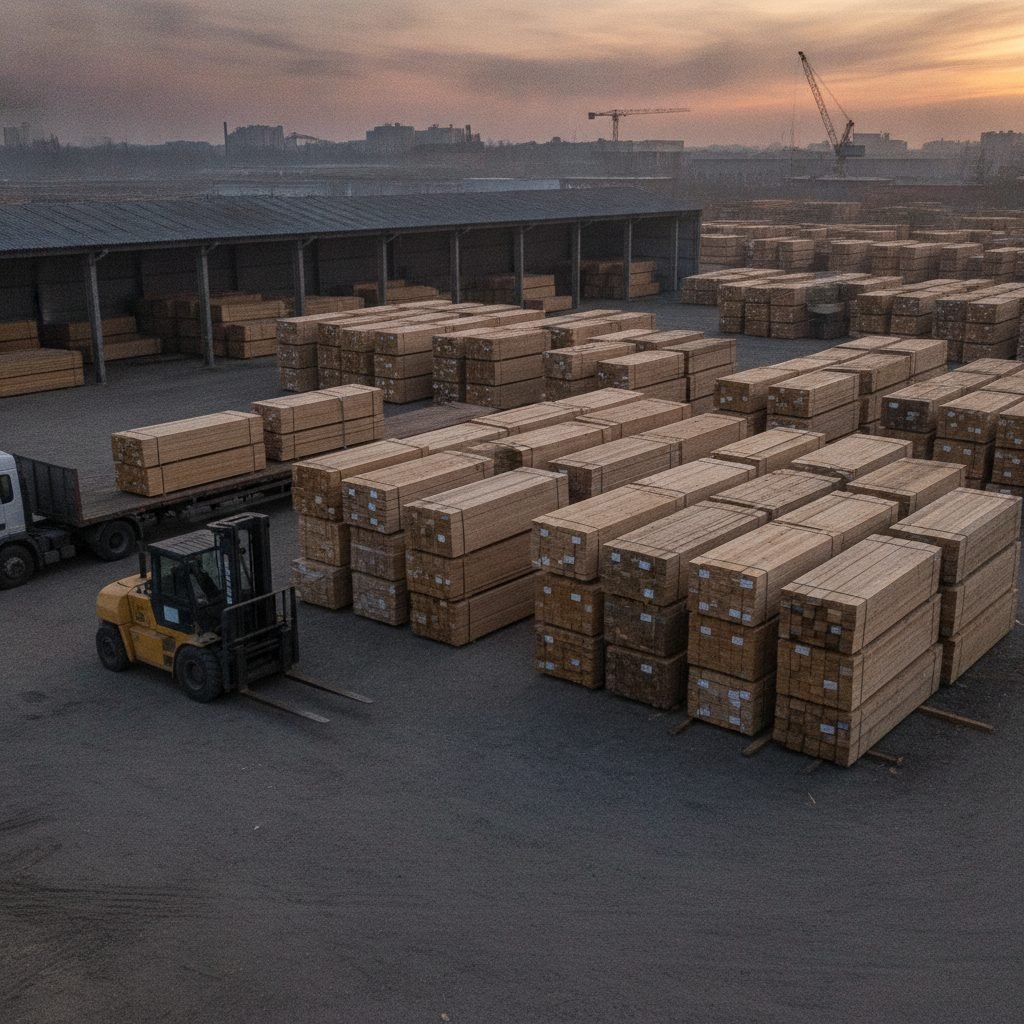


Canadian softwood lumber prices declined 12% in Q1 2025 versus the prior quarter, yet remain 7% above year-ago levels—a signal that supply discipline among major mills continues to support floors even as North American construction demand weakens. The Random Lengths 2×4 SPF benchmark fell from USD 425/MBF in December 2024 to USD 385/MBF by late January, stabilizing near USD 405/MBF through March. This whipsaw reflects competing pressures: mill capacity cuts designed to prevent margin erosion, sliding U.S. residential construction starts, and mounting uncertainty over tariff policy as lawmakers debate whether to include softwood lumber in broader trade negotiations with China.
Market Snapshot
Canadian softwood lumber pricing entered 2025 under structural headwinds. The Random Lengths 2×4 SPF index fell 8.5% QoQ but remains USD 27/MBF (7.1%) above Q1 2024 levels, reflecting persistent mill discipline even amid modest demand softening. Regional ex-mill pricing tells a more nuanced story:
- British Columbia (West Fraser, Canfor, Tolko): 2×4 SPF averaged USD 408/MBF ex-mill in Q1 2025, down 10% from Q4 2024 but up 6% YoY. Higher realized prices reflect constrained capacity: West Fraser idled one mill in southeastern BC for six weeks in January; Canfor reduced Valemount and Prince George production by 15% to balance inventory levels.
- Eastern Canada (Quebec, Maritimes): Acadian Timber and Mercer mills posted 2×4 SPF pricing near USD 372/MBF ex-mill, a 9% discount to BC due to longer haul distances to high-demand U.S. Southeast markets and lower local pulpwood premiums.
- U.S. housing starts declined 8.2% YoY to 1.26 million annualized units in February 2025, compared to 1.37 million in February 2024. This slowdown compressed demand for Canadian lumber across residential framing and repair segments.
- Canadian mill operating rates: Industry average capacity utilization fell to 78% in Q1 2025 from 84% in Q4 2024, with West Fraser, Canfor, and Tolko all implementing planned maintenance windows and/or production curtailments to prevent inventory gluts.
- USD/CAD currency movement: The loonie weakened to 1.33 against the U.S. dollar in March 2025, down from 1.28 in January, providing modest export pricing support for Canadian mills selling in USD-denominated markets.
- Tariff uncertainty premium: Buyers reported a 3–5% price premium embedded in forward contracts through Q2 2025, reflecting hedging costs tied to potential U.S. duties on softwood lumber if USMCA renegotiations introduce new restrictions.
Deep Analysis
U.S. Housing Weakness and Cross-Border Trade Flows
The primary headwind for Canadian lumber prices in 2025 is collapsing U.S. residential construction demand. Housing starts fell 8.2% YoY and single-family permits declined 11%, signaling that elevated mortgage rates (averaging 6.8% in February 2025) continue to suppress homebuyer activity across the Sun Belt and Midwest—traditionally heavy consumers of Canadian softwood lumber for framing.
Canadian mills export 60% of production to the U.S., making them acutely sensitive to this demand shift. Notably, the U.S. Northeast and Mid-Atlantic regions—which consume 35% of Canadian lumber imports—have seen the steepest permit declines, forcing BC mills to redirect inventory toward secondary markets (Mexico, Japan, offshore construction projects) at lower pricing or accept temporary production cuts.
West Fraser, Canada’s largest producer with 31% market share and mills across BC and Alberta, has responded by selectively curtailing output. In January 2025, the company idled its Slave Lake, Alberta mill for four weeks, citing “planned maintenance and market optimization.” This move, replicated across smaller rivals, has prevented a price collapse but also limited sales volumes—a classic supply-side stabilization tactic.
Mill Capacity Discipline and Margin Protection
Unlike prior downturns (2008–09, 2015–16), Canadian mills are not racing to the bottom. Canfor and Tolko have adopted a deliberate strategy of maintaining higher prices at lower volumes rather than undercutting to gain share. This reflects improved balance sheets, higher debt servicing costs, and board-level pressure to protect return on assets.
The trade-off is evident in operating rates: Canadian softwood mills ran at 78% capacity utilization in Q1 2025 versus a historical average of 82–84%. Inventory levels remain controlled, with major mills reporting 3–4 weeks of finished goods on hand—manageable but not abundant.
Tariff Policy as a Hidden Multiplier
A third dynamic is the tariff uncertainty premium. The USTR’s ongoing global markets overview framework negotiations with China have lawmakers asking whether softwood lumber should be included as a retaliatory item—a move that could impose 25% duties on Canadian imports. Buyers are hedging this risk by locking forward contracts at 3–5% premiums, which effectively bid up spot pricing even though underlying demand is weak.
| Metric | Q1 2024 | Q4 2024 | Q1 2025 | QoQ Change | YoY Change |
|---|---|---|---|---|---|
| Random Lengths 2×4 SPF Index (USD/MBF) | 378 | 425 | 405 | −4.7% | +7.1% |
| BC Mills 2×4 SPF Ex-Mill (USD/MBF) | 385 | 453 | 408 | −9.9% | +6.0% |
| Eastern Canada 2×4 SPF Ex-Mill (USD/MBF) | 361 | 415 | 372 | −10.4% | +3.0% |
| Canadian Mill Capacity Utilization (%) | 81 | 84 | 78 | −7.1% | −3.7% |
| U.S. Housing Starts (millions annualized) | 1.37 | 1.32 | 1.26 | −4.5% | −8.2% |
| USD/CAD Exchange Rate | 1.34 | 1.28 | 1.33 | +3.9% | −0.7% |
| Tariff Risk Premium (estimated % on spot price) | 0% | 1–2% | 3–5% | +150–250 bps | N/A |
Market Implications
Impact on Key Buyer Segments
Residential Builders and Framing Contractors: U.S. homebuilders (Lennar, D.R. Horton, Pulte) are shifting focus to higher-margin, smaller projects and renovation work. They are negotiating longer payment terms with lumber suppliers and requesting 90-day forward price locks to hedge budget uncertainty. A 8% decline in starts directly translates to 12–15% lower stud and joist demand. Builders report that Canadian lumber now represents 22% of material costs versus 18% a year ago, prompting specification changes toward engineered lumber and composite alternatives.
Panel and Truss Manufacturers: OEMs producing roof and floor trusses depend on steady Canadian stud supply. Margin compression is acute: a truss maker buying 2×4 SPF at USD 408/MBF versus USD 385/MBF last year cannot easily pass the USD 23/MBF delta to builders already under pricing pressure. Firms are exploring reclaimed lumber and smaller-dimension alternatives, reducing their Canadian softwood exposure by 5–8%.
Lumber Distributors and Building Material Retailers: The Home Depot, Lowe’s, and regional chains are managing inventory tightly. Slower turnover and margin pressure from price-conscious consumers force distributors to negotiate tighter terms with mills. However, distributor margins on Canadian lumber have actually expanded slightly due to reduced competition from stalled construction reducing speculative buying.
Regional Price Divergence
British Columbia mills command a USD 36/MBF premium (9.7%) over Eastern Canadian mills for identical 2×4 SPF. Three factors drive this:
- Transportation cost advantage: BC mills are 400–600 miles closer to high-demand U.S. Pacific and Mountain West regions, saving USD 15–20/MBF in freight.
- Scale and efficiency: West Fraser’s Prince George mill and Canfor’s Fort St. James facility are among North America’s lowest-cost producers, allowing them to maintain pricing discipline even in downturns.
- Market concentration: Eastern mills face higher local pulp competition for logs, raising input costs and limiting pricing power in weak demand periods.
This divergence is expected to persist through Q2 2025 unless U.S. demand rebounds sharply or Eastern mills coordinate production cuts more aggressively.
Industry Voices
“We locked in Q3 forward contracts early at current levels to avoid tariff surprises, but frankly, demand is weaker than we modeled in our budget,” said Jennifer Corbett, vice president of procurement at Toll Brothers Inc., a major Philadelphia-based homebuilder. “We are reducing lumber specs where code allows and exploring truss alternatives to offset higher material costs.”
“Our mills are operating at 78% capacity, which is sustainable but not ideal. If housing starts don’t recover by late Q2, we will implement more aggressive curtailments to protect margins,” said Michael Chen, operations director at Canfor Corporation’s BC Division. “Pricing discipline is holding, but volume is the real challenge right now.”
Outlook & Buyer Recommendations
Canadian lumber prices are forecast to drift sideways through Q2 2025 (USD 395–415/MBF for 2×4 SPF) before stabilizing or modestly declining in Q3 if U.S. housing permits remain flat. The primary price driver will be mill discipline: as long as West Fraser, Canfor, and Tolko maintain production cuts, a supply floor near USD 385/MBF is likely. However, two risk scenarios loom:
Upside Risk (Prices to USD 440+/MBF): If U.S. mortgage rates fall sharply below 6% and housing starts rebound 15%+ by Q3, demand could outpace mill capacity, triggering a rapid price spike. This is a 25% probability scenario dependent on Fed policy shifts.
Downside Risk (Prices to USD 355/MBF): If USTR imposes 25% tariffs on Canadian softwood lumber and U.S. housing starts fall another 10%, buyers could pivot aggressively to domestic U.S. mill supply or engineered alternatives, forcing Canadian mills to cut prices sharply to maintain volume. This is a 15% probability scenario contingent on trade policy escalation.
Buyer Recommendations:
- 1. Secure Q2 forward contracts now at current levels (USD 405–410/MBF for 2×4 SPF). Tariff uncertainty will likely keep a 3–5% premium embedded through June; waiting risks overpayment if policy shifts.
- 2. Negotiate multi-month volume commitments with BC mills (West Fraser, Canfor) in exchange for 2–3% discounts. These mills are capacity-constrained and value predictable offtake, especially in weak demand periods.
- 3. Diversify sourcing between BC and Eastern mills to hedge regional supply risk. An 8–10% cost savings on Eastern mill supply can partially offset BC price premiums if logistics is optimized.
- 4. Monitor the USTR tariff framework weekly and establish a contingency budget for a 15–20% price shock if duties are imposed. This is not a base case but warrants planning.
- 5. Pilot specification changes toward engineered lumber and composite alternatives to reduce softwood lumber exposure by 5–10%. This hedges both tariff and demand risk while future-proofing your supply chain.
Canadian lumber prices in 2025 reflect a structural shift toward mill discipline and margin protection over volume warfare. Buyers must adapt by locking supply early, diversifying regionally, and preparing for tariff volatility. The log prices underlying Canadian mill costs remain stable, supporting pricing floors even as housing demand softens. For live data and price benchmarks, visit our timber prices tracker on TimberInsider.
Frequently Asked Questions
What are current Canadian lumber prices in 2025?
As of Q1 2025, Canadian softwood lumber averaged USD 385–420 per MBF for 2×4 SPF (Spruce-Pine-Fir) ex-mill British Columbia, representing a 12% decline from Q4 2024 but a 7% premium versus Q1 2024. Prices vary by grade, species, and regional mill capacity utilization.
Why are Canadian lumber prices fluctuating in 2025?
Volatility stems from four factors: U.S. housing starts declining 8% YoY, mill production cuts by West Fraser and Canfor to stabilize margins, elevated mortgage rates limiting residential construction demand, and tariff uncertainty tied to ongoing USMCA renegotiations affecting cross-border trade.
How do British Columbia and Eastern Canadian lumber prices differ?
BC mills (West Fraser, Canfor, Tolko) sell at ex-mill pricing averaging USD 410/MBF for 2×4 SPF; Eastern mills (Acadian, Mercer) average USD 375/MBF due to higher logistics costs to major U.S. markets. Transportation and regional demand drive the 9% spread.
Which Canadian mills control market pricing in 2025?
West Fraser (31% market share), Canfor (18%), and Tolko Industries (12%) collectively control 61% of Canadian softwood output. Their production decisions, maintenance schedules, and export quotas directly influence Random Lengths benchmark pricing.
What should Canadian lumber buyers do in Q2 2025?
Lock in forward contracts for Q3 delivery to hedge currency and tariff risks; negotiate volume commitments with mills to secure supply as U.S. demand rebounds post-spring; monitor USTR announcements weekly; diversify sourcing between BC and Eastern mills to mitigate regional supply shocks.
Verification sources and update policy
This page was editorially reviewed on 13 July 2026. Dated prices and market shares are reference-period observations, not live quotations. Buyers should confirm specification, Incoterm, currency, tax, freight and quote validity before using a number commercially. Market statements are cross-checked against the following primary statistical, regulatory or standards resources:
- U.S. Bureau of Labor Statistics PPI
- Eurostat producer prices
- FAOSTAT Forestry Production and Trade
- UNECE forest-products markets
TimberInsider separates observed data from estimates and does not treat a supplier list as certification or endorsement. See the editorial methodology, product guides and regional coverage for definitions and current context.


