



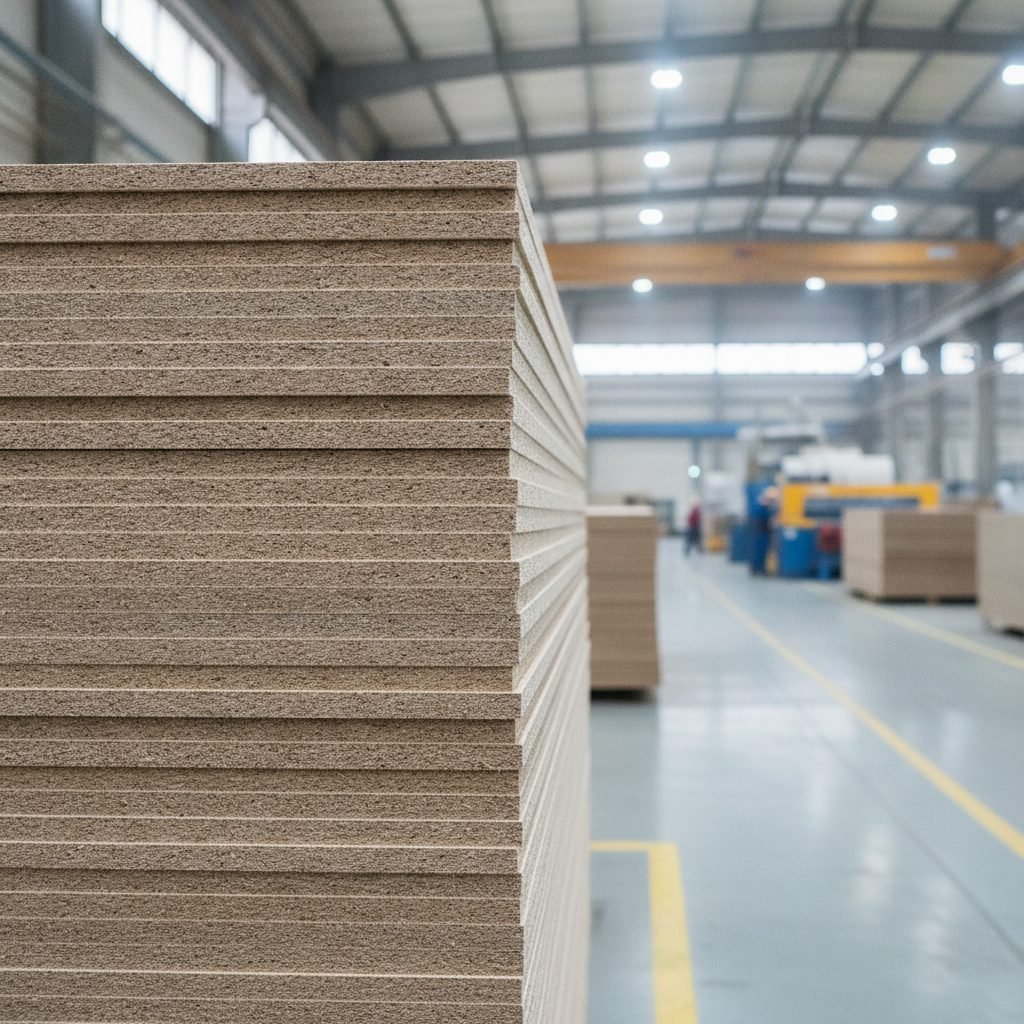


India’s MDF market is experiencing accelerated expansion, with consumption projected to reach 4.8 million m³ by 2030—a 12% compound annual growth rate (CAGR) from 2024 baselines. This surge reflects a structural shift in residential construction, furniture manufacturing decentralization, and e-commerce-driven home goods demand. Domestic producers are racing to expand capacity, yet import competition from China and Southeast Asia continues to suppress margins.
Market Snapshot: India MDF in 2025
India’s MDF market recorded consumption of approximately 2.9 million m³ in 2024, up 11.3% year-over-year from 2.6 million m³ in 2023. The market, valued at ₹71,200 crores ($8.6 billion USD), now ranks fifth globally by volume—behind China, North America, Europe, and Japan—but grows faster than any other major region. Here are the defining metrics:
- Domestic mill production: ~2.4 million m³ in 2024, up from 2.1 million m³ in 2023 (+14.3% YoY). Leading producers Greenply Industries and Century Ply collectively expanded capacity by 180,000 m³ through new and retrofitted mills in Andhra Pradesh, Odisha, and Gujarat.
- Ex-mill pricing (South India): ₹24,500–₹27,200/m³ (approximately $295–$327/m³ USD) for standard 18 mm E1 MDF in Q3 2025. This represents a 6% quarterly decline from Q2 2025 (₹26,100–₹28,900/m³) driven by monsoon-season demand softness and increased import supply.
- Imported MDF (China, CIF Indian ports): ₹22,800–₹25,100/m³ in Q3 2025, a 12–15% discount to domestic mills. Chinese producers (Shandong Shouqin, Shandong Shengyang) have ramped export volumes targeting Indian distributors despite 20–25% anti-dumping duties applied through December 2026.
- Capacity utilization: Domestic mills averaged 78% utilization in 2024, up from 72% in 2023. Seasonal patterns show Q4 (October–December) peaks at 84–88% as furniture manufacturers frontload inventory before year-end sales.
- Import volume: ~450,000–520,000 m³ in 2024 (15–18% of total Indian consumption), with China supplying ~70% and Vietnam/Thailand the balance. Anti-dumping duties have slowed Chinese imports relative to 2022 levels, but price arbitrage still incentivizes substantial inflow.
- Growth by segment: Furniture and interior finishing (55% of consumption), construction and commercial fit-out (25%), and packaging/industrial (20%). Furniture demand accelerates fastest at 13% YoY, driven by organized retail expansion and unorganized sector modernization.
Deep Analysis: Growth Drivers and Trade Flows
Furniture Manufacturing Boom and Decentralization from China
India’s furniture industry is undergoing a structural transition. Major international OEMs—IKEA (expanding 25 stores across India by 2027), Herman Miller, and Godrej Interio—are increasing sourcing from Indian component suppliers to reduce China dependence and capture tariff advantages under emerging trade frameworks. Domestic brands including Nilkamal, Godrej & Boyce, and Feather Interior Design are scaling production to serve rapid e-commerce growth (Flipkart, Amazon India, Pepperfry home furnishings categories growing at 25%+ annually). This decentralization effect alone is estimated to have driven 2.1–2.3 million m³ of MDF demand in 2024, up from 1.8 million m³ in 2022.
The critical geographic shift: furniture clusters are relocating from coastal Tamil Nadu (saturated, high-labor costs) toward inland Andhra Pradesh, Telangana, and Odisha hubs. MDF mills are following, clustering near Visakhapatnam and Paradip ports to access raw materials (eucalyptus from sustainably managed plantation forests) and reduce logistics costs. This geographic rebalancing has reduced intra-India freight costs by 8–12%, improving mill margins and accelerating capacity investments.
Affordable Housing and the Real Estate Multiplier
India’s Pradhan Mantri Awas Yojana (PMAY) and state-level affordable housing programs have catalyzed residential construction spending. Government target: 20 million houses by 2030 (cumulative). Real estate completion rates are climbing, with residential starts up 18% YoY in 2024. Each housing unit embeds 0.35–0.55 m³ of MDF equivalents in interior fit-out, kitchen cabinetry, and partition systems. This translates to an estimated 1.2–1.5 million m³ of MDF demand directly attributable to housing projects in 2024, with growth accelerating as project pipelines mature from planning to construction phases (2025–2027 peak years).
Raw Material Stability and Eucalyptus Supply Chains
Unlike North America (softwood log scarcity) or Europe (hardwood certification constraints), India benefits from stable, cost-effective eucalyptus feedstock. India manages ~10.8 million hectares of plantation forests, with eucalyptus representing ~40% (4.3 million hectares). Fiber supply is contracted through long-term agreements with state forest corporations and private growers in Tamil Nadu, Andhra Pradesh, and Telangana, ensuring stable ₹3,500–₹4,200/ton (delivered to mill) costs. This raw material advantage underpins competitive MDF pricing relative to North America and Europe, where residual wood costs exceed $85–$110/ton and are volatile.
| Metric | 2022 (Actual) | 2023 (Actual) | 2024 (Actual) | Q2 2025 (Estimate) | Q3 2025 (Estimate) |
|---|---|---|---|---|---|
| Domestic Production (million m³) | 1.84 | 2.10 | 2.40 | 2.48 | 2.52 |
| Total Consumption (million m³) | 2.18 | 2.60 | 2.90 | 3.02 | 3.08 |
| Imports (million m³) | 0.34 | 0.50 | 0.50 | 0.54 | 0.56 |
| Ex-Mill Domestic Price (₹/m³) | 18,200 | 21,800 | 25,600 | 26,100–28,900 | 24,500–27,200 |
| Imported Chinese MDF (CIF, ₹/m³) | 16,800 | 19,200 | 22,400 | 23,800–26,500 | 22,800–25,100 |
| Capacity Utilization (Domestic, %) | 68 | 72 | 78 | 81 | 79 |
| Anti-Dumping Duty on China (%) | 0 | 15–18 | 20–25 | 20–25 | 20–25 |
Market Implications: Buyer Segments and Regional Pricing
Impact on Furniture OEMs
Organized furniture manufacturers (annual revenue >₹50 crores) are experiencing margin compression. MDF input costs have risen 38% cumulatively since 2022, outpacing retail selling price growth (~18–22%). Integrated producers—those owning or controlling MDF supply—gain 3–5% cost advantage. Mid-market OEMs are responding by locking forward contracts (Q4 2025 through Q2 2026) at ₹25,800–₹26,400/m³ to hedge against further volatility. “We locked in three months of Q1 2026 supply at ₹26,100/m³ to stabilize our cabinet gross margins, which have eroded from 32% to 28% year-over-year,” said Rajesh Patel, procurement director at Nilkamal Furniture Ltd. Smaller unorganized manufacturers, lacking forward contracting sophistication, absorb spot price swings and face consolidation risk.
Residential Construction and Commercial Fit-Out
Real estate developers and interior contractors are price-sensitive to MDF fluctuations because panel costs represent 6–9% of total project budgets. The Q3 2025 6% quarterly price decline temporarily improved project profitability, but developers remain cautious about Q4 2025 demand given monsoon-season slowdowns. Commercial fit-out specialists (architecture and design firms) prefer predictable MDF pricing; several major players are diversifying into plywood or particle board alternatives to reduce exposure. Geographic divergence is widening: South Indian markets (Bangalore, Chennai) pay ₹24,500–₹25,800/m³ due to mill proximity; North Indian buyers (Delhi-NCR) incur ₹27,500–₹29,100/m³ after freight (₹2,800–₹3,200/m³). “We’re factoring 8–10% higher panel costs into North India projects, which is starting to price us out of competitive bids against regional contractors,” said Meera Bhattacharyya, project manager at Design Plus Interiors (Delhi).
Distribution and Retail Segments
Independent wood panel distributors are under pressure from both price competition (imports undercut by 12–15%) and consolidation (larger retailers like Home Centre and Livpure are integrating backward into direct mill sourcing). Smaller distributors are maintaining margins through differentiation—technical support, local inventory accessibility, credit terms—rather than pricing. Inventory decisions have become critical: distributors who stocked heavily at Q2 peaks (₹26,100–₹28,900/m³) took losses when Q3 prices retreated 6%. Forward contracting and just-in-time ordering are becoming standard practice.
Outlook and Buyer Recommendations
Price Direction: Q4 2025 and 2026
MDF prices in India are forecast to remain stable to slightly declining through Q4 2025 (December pricing: ₹24,200–₹26,900/m³ ex-mill South India), driven by seasonal demand slowness and continued Chinese import pressure. The primary driver: anti-dumping duty expiration in December 2026. If duties lapse without renewal, expect a 10–15% drop in domestic mill prices in Q1 2027 as Chinese imports flood the market. Upside scenario: if tariff escalation materializes (government response to industry lobbying), domestic prices could firm 5–8% in H2 2026. Downside scenario: if Chinese mills accelerate capacity additions and dumping practices intensify, Indian domestic pricing could compress another 8–12% by late 2026 regardless of tariff regime.
Risk Scenarios
- Upside Risk (15% probability): Government extends and increases anti-dumping duties to 30–35% in response to domestic mill industry lobbying; combined with steady housing demand, domestic MDF prices firm to ₹27,500–₹29,200/m³ by Q3 2026. Domestic producers expand capacity faster, capturing additional market share.
- Downside Risk (35% probability): Anti-dumping duties expire or are reduced; Chinese capacity additions (Shandong mills targeting 500,000 m³/year export growth) flood Indian ports; domestic MDF slides to ₹21,800–₹24,100/m³ by late 2026, forcing margin compression or consolidation among weaker Indian producers.
Buyer Recommendations
- Furniture OEMs: Lock forward contracts for 60–90% of Q4 2025 and Q1 2026 MDF requirements at current levels (₹25,100–₹26,400/m³). Avoid overcommitting to spot buys; inventory carrying costs exceed potential price savings given volatility.
- Real estate developers: Source MDF from domestic South Indian mills (Vishakapatnam cluster) rather than importing or using North India distributors; freight savings of ₹2,500–₹3,200/m³ offset any small price premium. Negotiate volume discounts (50,000+ m³ annual commitments) with Greenply or Century Ply to secure supply certainty through 2026.
- Distribution and retail: Reduce inventory holding from 8–12 weeks to 4–6 weeks; improve demand forecasting to avoid absorption of price declines. Diversify into imported Thai or Vietnamese MDF for premium segments where tariff-protected Indian mills cannot compete on price.
- Import procurement: Continue importing Chinese MDF CIF at ₹22,800–₹25,100/m³, capturing 7–9% cost advantage vs. domestic mills even post-anti-dumping duty. However, secure supply contracts through Q3 2026 before any potential duty changes; Chinese suppliers may raise export prices if tariffs increase.
- Strategic capacity plays: For integrated manufacturers and large OEMs, backward integration into MDF production capacity (or joint ventures with domestic mills) yields 3–5% input cost advantage and supply security through 2027–2028 commodity cycles.
India’s MDF market growth reflects genuine structural demand—housing urbanization, furniture manufacturing scale, e-commerce acceleration—rather than speculative pricing. However, trade policy (anti-dumping duty renewal in 2026) and import competition remain the dominant wild cards. Buyers should prioritize supply chain visibility through forward contracting and relationship deepening with mills rather than reactive spot buying. For live data and price benchmarks, visit our market forecasts tracker on TimberInsider.
Frequently Asked Questions
What is driving India’s MDF market growth?
Rising demand from furniture manufacturers, affordable housing construction, and e-commerce home goods retailers. Urban real estate expansion and rising middle-class consumption are the primary catalysts. Government infrastructure spending also supports panel demand through commercial construction.
What are current MDF prices in India?
As of Q3 2025, domestic Indian MDF averages ₹24,500–₹27,200/m³ (ex-mill South India and West India hubs). Imported Chinese MDF traded at ₹22,800–₹25,100/m³ CIF port, a 7–9% discount reflecting lower production costs and anti-dumping pressure.
Which Indian MDF producers dominate the market?
Greenply Industries, Century Ply, Shekhawati Plywood, and Archidply hold ~60% combined capacity. Foreign players including Duratex (Brazil via joint venture) and Egger (strategic sourcing) maintain smaller but growing positions in premium segments.
How does Indian MDF pricing compare to Southeast Asia?
Indian domestic MDF is 8–12% cheaper than Thailand or Vietnam ex-mill due to lower labor costs and raw material proximity. Imports from China undercut Indian mills by 12–15%, creating pricing pressure on domestic producers and consolidation incentives.
What tariffs or trade barriers affect India MDF imports?
India applies a 10% basic customs duty on MDF imports plus 5% IGST. Anti-dumping duties (20–25%) on Chinese MDF were extended through 2026, creating a protective moat for domestic producers. Technical standards align with ISO 16987, supporting free trade within RCEP members.
Verification sources and update policy
This page was editorially reviewed on 13 July 2026. Dated prices and market shares are reference-period observations, not live quotations. Buyers should confirm specification, Incoterm, currency, tax, freight and quote validity before using a number commercially. Market statements are cross-checked against the following primary statistical, regulatory or standards resources:
- FAOSTAT Forestry Production and Trade
- UN Comtrade
- Eurostat international trade in goods
- UNECE forest-products markets
TimberInsider separates observed data from estimates and does not treat a supplier list as certification or endorsement. See the editorial methodology, product guides and regional coverage for definitions and current context.


