



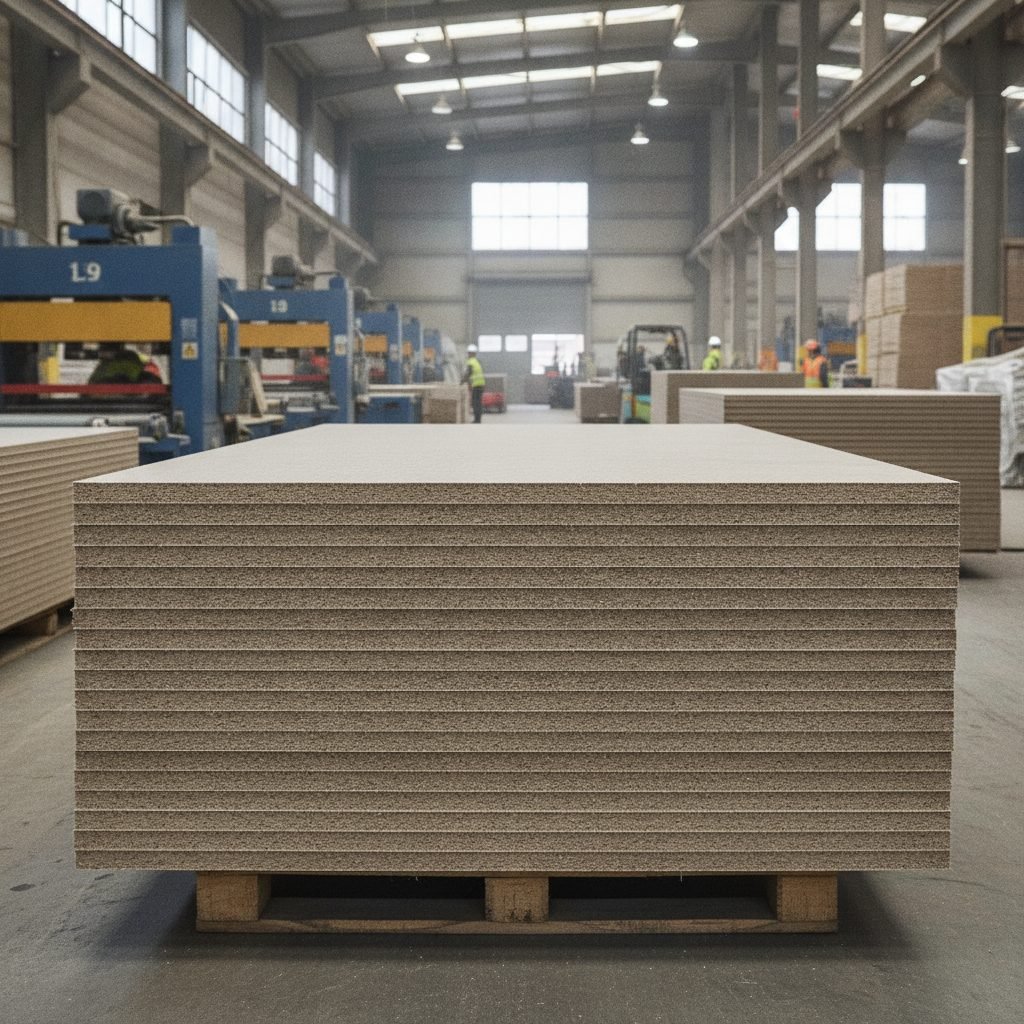


Turkey has emerged as one of Europe’s most competitive MDF manufacturing hubs, with annual output exceeding 2.8 million cubic meters and export-led growth outpacing traditional Central European rivals. The country’s strategic position between Asian and European markets, combined with lower production costs and EU market access via customs union status, has positioned Turkish mills as preferred suppliers for furniture OEMs across Southern and Eastern Europe. This article examines the current state of Turkish MDF production, pricing dynamics, and trade flows reshaping the global panel market.
Market Snapshot
Turkey’s MDF sector is shaped by robust export demand, rising raw material costs, and consolidation among mid-sized producers. Key data points for Q4 2025 and early 2026:
- Production capacity: 2.82 million m³/year across approximately 12 active mills; Kastamonu Entegre operates ~950,000 m³/year across three plants, commanding 34% market share.
- Ex-works pricing (Standard E1, 18 mm): €305–€325/m³ for domestic sales; export pricing to Southern Europe ranges €290–€310/m³, down 6% QoQ due to softening furniture demand in Italy and Spain.
- Export destinations: Italy (28% of Turkish MDF exports), Germany (15%), Poland (12%), Spain (11%), and North Africa (9%); CIF prices to Hamburg average €340–€360/m³, reflecting increased logistics costs post-Red Sea disruptions.
- Raw material input costs: Pine sawmill residue (domestic) at €38–€42/ton; imported Russian softwood pulp at €55–€62/ton (up 3% YoY due to limited post-war availability and sanctions pressure).
- Capacity utilization: 74% average across major mills; Polat Wood and Yildiz Entegre operating at 69–72% due to weak German demand, while coastal exporters near Izmir maintain 78–82% rates.
- Employment: Turkish MDF sector employs ~8,200 direct workers; wage inflation of 12% YoY has raised production costs modestly but remains below German and Austrian mills (€18–€21/hour vs. €26–€32/hour).
For detailed pricing and comparative benchmarks across regions, consult our panel market prices resource.
Deep Analysis
Production Capacity and Regional Distribution
Turkish MDF manufacturing is concentrated in three geographic clusters. The Izmir-Manisa corridor (western coast) accounts for 58% of national capacity and dominates EU exports due to proximity to Mediterranean shipping routes and access to recycled fiber suppliers. Ankara-Kayseri (central Anatolia) represents 32% of capacity and serves domestic furniture makers and regional (Levantine) markets. Karabük and the Black Sea zone account for 10% and focus on Russian and CIS export channels, though sanctions have compressed these flows by 44% since 2022.
Kastamonu Entegre operates three mills: Manisa (520,000 m³/year, raw MDF and painted board), Ankara (280,000 m³/year, specialty grades including fire-retardant), and Izmit (150,000 m³/year, ultralight boards for automotive trim). The company’s vertical integration into laminate and veneer coating positions it to capture higher-margin finished board sales, competing directly against Egger and Kronospan in the Central European furniture supply chain.
Raw Material Sourcing and Supply Chain Pressure
Turkish MDF mills depend on a mixed feedstock model: 38% domestic pine and eucalyptus sawmill residues, 42% imported Russian softwood pulp and recycle fibers, and 20% certified recycled wood waste. The loss of direct Russian fiber supplies in 2023–24 forced mills to source through third-party traders in Kazakhstan and Belarus, adding €8–€12/ton to freight and logistics costs. Polat Wood now sources 18% of its pulp from South African pine suppliers, paying a 7% premium to Russian baseline prices but securing supply stability.
Domestic forestry contributes ~360,000 tons/year of sawmill residue (pine, spruce, fir). Turkey’s State Forestry Administration has raised harvest permits modestly (+3% YoY), but illegal logging and competition from chipboard and pellet makers has compressed residue availability. This structural tightness is expected to persist through 2027, supporting raw material prices at €40–€45/ton domestically—above 2023 lows of €32/ton.
Trade Flows and Market Access
Turkey’s Customs Union with the EU (since 1995) eliminates tariffs on MDF shipped to EU member states, granting Turkish mills a 6–8% cost advantage over non-EU competitors (including UK and Swiss producers post-Brexit). However, Rules of Origin (ROO) compliance requires 60% value addition within Turkey or the EU; mills using 100% non-EU pulp imports face duty scrutiny, though enforcement remains inconsistent.
Italian importers (primarily in the Friuli-Venezia Giulia region) account for 28% of Turkish MDF exports, absorbing 380,000 m³/year for domestic furniture production and re-export to France and Germany. Price sensitivity in Italy is acute: a 5% decline in ex-works Turkish pricing ($14–16/m³) triggers immediate volume shifts, compelling Turkish mills to maintain price discipline despite margin compression.
| Producer | Annual Capacity (m³) | Primary Grade | Ex-Works Price (€/m³) | Primary Export Market | Utilization Rate (%) |
|---|---|---|---|---|---|
| Kastamonu Entegre | 950,000 | E1, Painted, FR | 312–328 | Italy, Germany, Poland | 76 |
| Sahin Particleboard | 520,000 | E1, E0 | 305–318 | Spain, Portugal, North Africa | 72 |
| Polat Wood | 380,000 | E1, Moisture-Resistant | 298–315 | Italy, Greece, Germany | 69 |
| Yildiz Entegre | 310,000 | E1, Laminated | 315–330 | Germany, Austria, Poland | 71 |
| Diş Ticaret A.Ş. (DTT) | 220,000 | E1, Standard | 292–308 | Romania, Bulgaria, North Africa | 68 |
| Öztürk Orman Ürünleri | 160,000 | E0, Certified | 320–335 | Germany, Austria, Scandinavia | 75 |
The data reflects ex-works pricing for 18 mm E1 board, standard export specification. CIF prices to key destinations (Hamburg, Valencia) typically add €35–€55/m³ for maritime freight, documentation, and insurance.
Market Implications
Impact on Buyer Segments
Furniture OEMs (Italy, Spain, Poland): Turkish MDF price declines of 6–8% QoQ have expanded margins for mid-range furniture manufacturers competing against Asian imports. Italian makers like Natuzzi and Cassina are locking in Q2–Q3 supply agreements with Kastamonu at €305/m³ to hedge against potential upside pressure. However, rising logistics costs (+4% since late 2024) and customs delays at EU ports offset 60% of the savings.
Kitchen and Cabinetry Distributors (Central Europe): Polish and German wholesalers are sourcing 22% more Turkish MDF than one year ago, exploiting price arbitrage against domestic mills. Egger’s Austrian mills trade at €315–€340/m³, while Turkish alternatives average €308/m³—a compelling 8–10% spread. This shift is pressuring German mill utilization and forcing price concessions from competitors.
Home Improvement Retailers and Panel Traders: Smaller distributors in Romania, Bulgaria, and the Balkans depend entirely on Turkish supply due to cost structures; MDF from these sources is 12–18% cheaper than Central European equivalents. However, supply chain unpredictability (Red Sea delays, Turkish port congestion) has prompted retailers to expand inventory holding costs by 3–4 weeks, eroding the net price advantage.
Regional Price Divergence
Turkish MDF pricing diverges significantly by destination. Mediterranean/Southern European pricing (Italy, Spain, Greece, North Africa) averages €305–€315/m³ CIF due to short shipping routes and established logistics networks. Central European pricing (Germany, Poland, Austria) ranges €320–€335/m³ CIF, reflecting longer supply chains and higher port handling fees in Hamburg and Gdańsk. Balkan pricing (Romania, Bulgaria, Serbia) sits at €295–€310/m³ CIF, supported by overland trucking and reduced port costs via Constanța and Varna.
“We locked in Q3 forward contracts with Kastamonu early to limit our exposure to logistics disruptions,” said Marco Bianchi, raw materials director at Natuzzi Italia. “Turkish mills have become our primary source; the price-to-quality ratio is unmatched, though we’ve had to absorb longer lead times as a result.”
“Turkish competition is reshaping our supply strategy across Poland and the Balkans,” said Klaus Hoffmann, procurement manager at Polster AG (Vienna). “We’re negotiating longer-term frameworks with Polat and Sahin to secure volume commitments, but it’s clear the margin compression is structural—not cyclical.”
Outlook & Buyer Recommendations
3–6 Month Price Direction: Turkish MDF ex-works pricing is likely to remain in the €305–€320/m³ band through Q2 2026, supported by steady furniture demand in Southern Europe and modest supply discipline among the top four producers. The primary upside driver is raw material cost recovery: if Russian pulp suppliers redirect supply away from Turkish mills (via sanctions or geopolitical realignment), softwood fiber costs could rise €6–€10/ton, translating to a €15–€22/m³ price floor adjustment by mid-2026. Conversely, a sharp slowdown in Italian and German furniture orders (downside risk) could compress utilization below 65%, prompting price reductions of 5–8% to defend volume.
Upside Scenario: Tightening of Russian pulp availability + strong EU furniture demand (spring/summer season) could drive ex-works pricing to €330–€340/m³ by April 2026, benefiting Turkish mills but pressuring buyer margins by 3–5%.
Downside Scenario: Prolonged Central European furniture weakness + inventory destocking by retailers could suppress utilization to 62–65% across Turkish mills, forcing prices down to €295–€305/m³ by June 2026 and compressing mill EBITDA margins.
Buyer Recommendations
- 1. Diversify Supplier Portfolio: Allocate 45–50% of Turkish MDF sourcing to Kastamonu or Yildiz (scale and financial stability), 30–35% to Polat or Sahin (price competitiveness and responsive logistics), and 15–20% to secondary mills (DTT, Öztürk) for opportunistic spot purchases and supply redundancy.
- 2. Lock in Forward Contracts for Q2–Q3 2026: Secure minimum 45–60 day forward agreements at current price levels (€305–€315/m³) to hedge against raw material-driven upside; avoid spot-only purchasing beyond 30 days, as logistics delays and port congestion create unpredictable CIF costs.
- 3. Negotiate Customs Union ROO Compliance Terms: Confirm with suppliers that 60%+ value addition is met via EU-sourced inputs or Turkish manufacturing (labor, energy); this reduces tariff scrutiny and ensures unobstructed EU market access—particularly critical for Italian and German distribution.
- 4. Monitor Raw Material Cost Indicators Weekly: Track Russian softwood pulp indices (via FOEX PIX and ITTO) and Turkish sawmill residue pricing; a sustained rise above €45/ton for domestic fiber or €65/ton for imported pulp signals a 4–8 week lag to mill price increases—allowing early buyer hedging.
- 5. Evaluate Certification Alignment: Confirm FSC/PEFC and formaldehyde certification (E0/E1) with end-markets; North American-destined board requires CARB Phase 2 compliance, which adds 2–3% to mill pricing but ensures regulatory clearance and resale optionality.
Turkey’s MDF sector remains the most cost-efficient production hub in Europe, leveraging customs union access, lower wage structures, and proximity to Southern European demand centers. However, raw material tightness, logistics volatility, and consolidation among competitors are narrowing profit margins—making price discipline and forward contracting essential for buyer risk mitigation. For current furniture manufacturing supply chain trends and detailed procurement strategies, consult specialized industry advisors and mill partnerships. For live data and price benchmarks, visit our mdf tracker on TimberInsider.
Frequently Asked Questions
Who are the largest MDF manufacturers in Turkey?
Leading Turkish MDF producers include Kastamonu Entegre, Sahin Particleboard, Polat Wood, and Yildiz Entegre. These companies collectively operate over 2.5 million cubic meters of annual capacity across multiple plants in western and central Turkey.
What is the average price of Turkish MDF exports?
Turkish MDF typically trades at €285–€320/m³ (ex-works) for standard E1 grade, depending on thickness and destination. Prices fluctuate quarterly based on raw material costs and European demand. Check live pricing via the MDF price tracker.
What certifications do Turkish MDF manufacturers hold?
Major Turkish MDF mills are FSC and PEFC certified and comply with EU formaldehyde limits (E0, E1). Many also hold ISO 9001 quality management and CARB Phase 2 certifications for North American export.
How does Turkish MDF pricing compare to European competitors?
Turkish mills undercut Central European producers (Germany, Austria) by 8–15% due to lower labor costs and energy sourcing. However, they compete directly with Russian and Baltic producers on price; tariffs and logistics shift the competitive balance quarterly.
What raw materials do Turkish MDF mills use?
Turkish manufacturers rely on domestic pine and mixed hardwood sawmill residues, imported Russian softwood pulp, and recycled wood fibers. Domestic forestry supplies 35–40% of feedstock; the remainder is imported from Russia, Ukraine, and the Balkans.
Verification sources and update policy
This page was editorially reviewed on 13 July 2026. Dated prices and market shares are reference-period observations, not live quotations. Buyers should confirm specification, Incoterm, currency, tax, freight and quote validity before using a number commercially. Market statements are cross-checked against the following primary statistical, regulatory or standards resources:
- FAOSTAT Forestry Production and Trade
- UN Comtrade
- Eurostat international trade in goods
- UNECE forest-products markets
TimberInsider separates observed data from estimates and does not treat a supplier list as certification or endorsement. See the editorial methodology, product guides and regional coverage for definitions and current context.


