



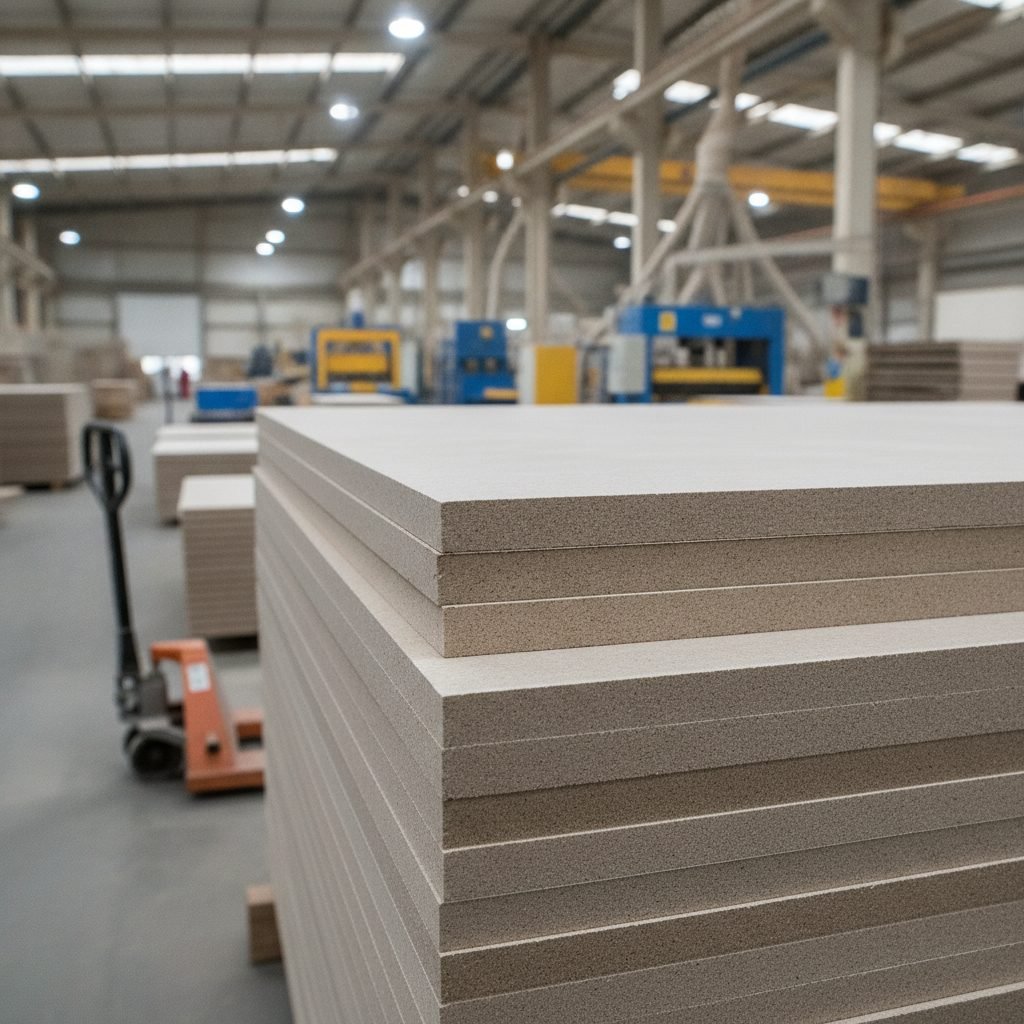


When specifying wood panels for furniture, flooring, or construction, the choice between HDF and MDF determines durability, machinability, cost, and performance under load. While both are engineered from wood fiber and synthetic resin, their density profiles create distinct trade-offs that reshape project economics and production workflows. Understanding these differences prevents costly specification errors and unlocks competitive advantage in procurement.
Market Snapshot
HDF and MDF occupy distinct price tiers within the global engineered wood panel market, which exceeded 450 million cubic meters annually as of 2025. Here is where both materials stand today:
- MDF pricing (Europe, ex-mill Q1 2025): €310–360/m³ for standard 16–25 mm thickness; premium grades (white, veneered) command €380–420/m³. Annual capacity across Egger, Kronospan, Pfleiderer, and Sonae totals approximately 28 million m³.
- HDF pricing (Europe, ex-mill Q1 2025): €420–520/m³ for standard 3–6 mm laminate-core and flooring-grade stock; premium structural HDF reaches €560+/m³. Global HDF capacity (Arauco, Norbord, Egger, Sonae) stands at roughly 12 million m³.
- North American reference prices: MDF trades at USD 420–480/MBF (thousand board feet); HDF laminate core (0.25–0.30 in. thickness) ranges USD 550–680/MBF, reflecting higher manufacturing overhead and energy costs.
- Density specification spread: Standard MDF: 600–750 kg/m³. Premium MDF: 750–800 kg/m³. Standard HDF: 800–950 kg/m³. Specialty ultra-high-density HDF: 950–1100 kg/m³.
- Regional price divergence: China and Southeast Asia produce export-grade MDF at 20–35% discounts to European mill prices (€220–280/m³ CIF Central Europe), compressing OEM margins and pressuring European suppliers toward value-added grades.
- Supply-demand imbalance: MDF market operates near 85% utilization globally; HDF runs at 78–82% due to slower adoption in developing markets and competition from plastic laminate alternatives in flooring.
See our panel market prices tracker for real-time quotes across regions and grades.
Deep Analysis: Physical Properties and Manufacturing Pathways
How Density Shapes Performance and Production
Both HDF and MDF begin with identical raw materials: wood fiber recovered from sawmill residues (sawdust, shavings, chippings) and blended with synthetic resin binders—typically urea-formaldehyde (UF), melamine-formaldehyde (MF), or polyvinyl acetate (PVA). The critical divergence occurs in the hot-pressing stage.
MDF presses at 200–250 bar (20–25 MPa) and temperatures of 190–210°C for 6–12 minutes, depending on thickness and moisture target. This moderate pressure yields a uniform density of 600–800 kg/m³ and a relatively homogeneous cellular structure. The fibers remain partially rounded, creating surfaces that accept paint, veneer, and edge-banding readily. Machinability is superior: MDF can be routed, bored, and sanded without edge chipping, and its consistent density permits tight tolerances (±0.3 mm on thickness).
HDF demands higher pressure—typically 300–400 bar (30–40 MPa)—and longer dwell times of 8–15 minutes. This aggressive compression collapses the fiber matrix more completely, yielding densities of 800–1100 kg/m³ and a significantly denser, harder surface. The cellular structure becomes more compact; wood fiber walls are compressed flat, reducing air voids and moisture ingress. Edge surfaces are harder and more resistant to splitting, but machinability becomes challenging: HDF tears and splinters more readily on routed edges, requires diamond-tipped tooling for drilling, and demands slower feed rates. Surface finishing (sanding, edge-banding) is labor-intensive and tool-intensive.
This manufacturing pathway—not raw material choice—creates the performance gap. A furniture OEM using MDF can specify tight router tolerances and rapid production cycles; an HDF flooring mill must invest in hardened tooling and slower machine speeds, raising per-unit labor costs by 15–25%.
Durability, Moisture Resistance, and Environmental Performance
HDF’s superior density delivers measurable advantages in moisture absorption and dimensional stability. Standard MDF absorbs 80–120% moisture by weight when fully saturated and swells 8–12% tangentially and 2–4% radially. HDF absorbs 40–70% moisture at saturation and swells 4–6% tangentially and 1–2% radially. This reduced swelling translates directly to edge stability in high-humidity environments—critical for laminate flooring over concrete slabs and kitchen cabinetry near sinks.
Both materials are hygroscopic and should not be used in wet zones (bathrooms, external applications) without additional moisture barriers. However, HDF’s lower water uptake makes it the standard core layer in engineered laminate flooring precisely because it resists cupping and permanent delamination better than MDF.
Formaldehyde emissions are regulated identically for both: E0 (<0.5 mg/L), E1 (<1.5 mg/L), and E2 (<5 mg/L) by current European standards (EN 120, EN 717). The emission profile depends on resin chemistry and press conditions, not density. Low-formaldehyde MDF using soy-based or no-added-formaldehyde (NAF) binders is widely available at 8–12% cost premiums. The same grades exist in HDF, though at higher absolute cost.
| Property | MDF (Standard) | MDF (Premium) | HDF (Standard) | HDF (Structural) |
|---|---|---|---|---|
| Density (kg/m³) | 600–700 | 750–800 | 800–950 | 950–1100 |
| Modulus of Elasticity (MPa) | 2800–3400 | 3500–4000 | 4500–5500 | 5800–6800 |
| Bending Strength (MPa) | 16–20 | 22–26 | 28–35 | 38–45 |
| Water Absorption @ saturation (%) | 80–120 | 75–100 | 40–70 | 30–55 |
| Thickness Swell after 24h @ 65% RH (%) | 6–10 | 5–8 | 2–5 | 1–3 |
| Surface Hardness (Janka, lbf) | 500–700 | 700–900 | 1200–1600 | 1800–2200 |
| Machinability Rating (1–10) | 8–9 | 7–8 | 5–6 | 4–5 |
Trade Flows and Supply Chain Concentration
MDF production is geographically dispersed: Egger operates mills in Austria, Germany, Russia, and Slovakia; Kronospan runs facilities across 11 European countries plus China and Russia; Pfleiderer maintains European and Asian production. This competition keeps prices volatile but ensures regional supply security. Chinese capacity (Beijing WAGO, Longgeng, and smaller mills) represents 22% of global MDF output and exerts persistent downward pressure on CIF Europe pricing.
HDF production concentrates among four major players: Arauco (Chile, Europe), Norbord (Canada, UK, Ireland), Egger (Austria, Russia), and Sonae (Portugal, Spain). No significant Chinese HDF production exists, limiting supply elasticity. When Arauco or Norbord reduce runs due to energy costs or maintenance, European prices move 5–10% within weeks. This supply inelasticity justifies HDF’s persistent 30–40% price premium and explains why flooring OEMs lock forward contracts 6–12 months ahead.
Market Implications Across Buyer Segments
Furniture OEMs: MDF Dominates, But HDF Surfaces Add Value
Furniture manufacturers consuming 500,000+ m³ annually per major OEM (IKEA, Natuzzi, Steelcase) specify MDF as the primary substrate for cabinet boxes, shelving, and internal structural members. MDF’s machinability enables high-speed CNC routing, edge-banding, and drilling—critical for just-in-time production and modular assembly systems. A typical upholstered sofa or modular seating system uses 8–15 m³ of 16 mm MDF per unit.
However, top-tier OEMs increasingly laminate MDF box cores with 3 mm HDF wear layers for table and desk tops, seating frames, and accent surfaces. This hybrid approach captures HDF’s scratch and impact resistance (essential for commercial office furniture and hospitality) while retaining MDF’s cost and machinability for structural depth. A mid-range office desk might use 0.8 m³ of 18 mm MDF substrate plus 0.3 m³ of 3 mm HDF top layer, raising material cost by 12–18% but commanding 8–12% higher retail pricing due to perceived durability.
Regional impact: European and North American OEMs pay €310–360/m³ for MDF and cannot absorb further cost increases; they are shifting production tooling to accept thinner MDF (12–14 mm instead of 16–18 mm) to reduce cubic meter consumption by 15–20%. Chinese OEMs operating at cost-plus-12% margins are more aggressive in this shift, strengthening competition for mid-range EU and NA brands.
“We locked in Q2 forward contracts for MDF at €340/m³ to mitigate Q3 pricing volatility,” said Marco Rossi, supply chain director at Poltrona Frau, an Italian luxury furniture group. “Our customers expect price stability; we absorb 60% of raw material increases internally through efficiency gains and pass 40% through to list price annually.”
Flooring Manufacturers: HDF Non-Negotiable for Performance
Laminate flooring, engineered hardwood, and vinyl-composite-core (VCC) flooring all require HDF core layers to meet residential and commercial durability standards. Standard residential laminate (AC3 / 23 dB) uses 7–8 mm HDF; commercial laminate (AC4 / 32 dB) demands 10–12 mm HDF with enhanced surface wear layers. A 1,000 m² residential installation consumes approximately 70–80 m³ of HDF core (at 8 mm thickness).
Flooring OEMs cannot substitute MDF for HDF in structural roles: MDF’s higher moisture absorption and lower surface hardness lead to cupping in humid climates and visible denting from heel strikes within 2–3 years—unacceptable for consumer warranty claims. This inelastic demand keeps HDF prices firm despite global oversupply of MDF.
Regional divergence is pronounced: North American flooring mills pay USD 600–680/MBF for HDF laminate core due to tariffs on European imports (anti-dumping duties on Egger and Kronospan imposed 2016–2025) and limited North American HDF capacity (Norbord runs one dedicated mill in Virginia). European mills access HDF at €420–480/m³ directly from Egger, Sonae, and Arauco facilities within 500 km, reducing logistics and working capital costs by 8–10%.
“Flooring is a commodity business; HDF cost represents 35–42% of our COGS,” said Jürgen Weber, procurement manager at Kronospan’s flooring division in Heilbronn, Germany. “We manage supply through quarterly contracts with Arauco and Sonae, accepting 2–3% price premiums for guaranteed allocation and 8–10 week lead times rather than spot-market exposure.”
Panel Distributors: Portfolio Complexity and Margin Pressure
Independent distributors stocking both MDF and HDF for regional furniture, construction, and flooring customers face acute inventory management challenges. MDF inventory turns 8–12 times annually (2–6 week holding periods), while HDF turns only 4–6 times due to lower demand density and longer delivery cycles. Distributors carrying full grades (E0, E1, premium white, melamine-faced) in both product lines require 2,000–3,000 m³ standing inventory—a working capital burden of €800,000–1.2 million for a mid-sized European distributor.
Gross margins compress as OEMs shift to direct mill contracts, bypassing distribution: margins on MDF wholesale have fallen from 8–10% (2015) to 4–6% (2025) in competitive EU markets. HDF margins remain higher (7–9%) but with slower turnover, reducing return on inventory. Distributors increasingly bundle services (just-in-time slicing, edge-banding, precision cutting) to justify their margin and defend market share against direct mill-to-OEM relationships.
Outlook and Buyer Recommendations
Price Direction: 3–6 Month Outlook
MDF prices are likely to decline 3–7% through Q2 2025 as Chinese export volumes increase (post-Lunar New Year ramp-up) and European mills compete for share from idled capacity. The dominant driver is energy cost: European natural gas prices remain 35–45% below 2022 peaks, reducing mill operating costs by €25–40/m³ annually. Egger and Kronospan are passing through modest cost reductions to maintain volume.
HDF prices will remain stable to slightly elevated (+0–3%) due to constrained supply and inelastic flooring demand. Unless major new HDF capacity comes online (no announcements in 2024–2025), supply tightness will persist, protecting HDF producers’ margins.
Risk Scenarios
Upside risk (prices +8–15%): A sharp increase in forestry input costs (pulpwood or residue chips) driven by reduced sawmill runs or export restrictions could ripple into fiber costs within 6 months. Russia’s ongoing timber export curbs have tightened European softwood supply; a similar policy affecting hardwood residues in Southeast Asia would cascade into global fiber prices. Additionally, European carbon border adjustment mechanisms (CBAM) entering implementation in 2025 could impose cost premiums on energy-intensive HDF.
Downside risk (prices –6–12%): A global economic slowdown reducing furniture and construction demand by 12–18% would force Egger, Kronospan, and Pfleiderer to idle capacity and compete aggressively on price. Chinese export competition would intensify as mills seek volume. This scenario materialized in 2019–2020 and again in late 2022; OEMs should model inventory and purchasing strategies assuming a 6–9 month demand contraction.
Buyer Recommendations
- Qualify HDF vs MDF by application end-use, not cost alone. If surface durability, moisture resistance, or foot-traffic tolerance is critical (flooring, commercial furniture, kitchen cabinetry), HDF is non-negotiable despite 30–40% cost premiums. MDF substitution risks warranty claims and brand damage. For interior structural members and non-wear surfaces (cabinet backs, shelving support), MDF remains optimal.
- Lock 6–12 month forward contracts for HDF; use spot/quarterly pricing for MDF. HDF supply is inelastic and price-stable; forward contracting at current levels protects against upside price shocks. MDF, with dispersed global supply, benefits from spot or 3-month rolling contracts that capture downward pressure from Chinese competition.
- Negotiate composite specifications (MDF substrate + HDF wear layer) with mills to unlock volume discounts. Integrated mills like Egger and Sonae offer 4–8% discounts on bundled orders (e.g., 500 m³ 16 mm MDF + 150 m³ 3 mm HDF) versus separate purchases. This hybrid specification maximizes performance while controlling cost.
- Audit formaldehyde grade alignment with end-market regulations. E1-certified MDF and HDF now meet most residential and commercial building codes in EU, North America, and key Asian markets. Specifying E0 adds 8–15% cost with minimal compliance benefit for non-residential applications; reserve E0 for high-end residential where low-VOC marketing adds value.
- Monitor supply announcements from Norbord, Arauco, and Egger for HDF capacity changes. Any mill maintenance, energy investment, or M&A activity moves HDF prices 3–5% within weeks. Subscribe to producer pricing releases and trade journals (Random Lengths, FOEX PIX) to anticipate forward curves.
Closing Perspective
The HDF vs MDF decision is not about inherent material superiority but about cost-benefit trade-offs within specific applications. MDF’s machinability and affordability make it the dominant choice for furniture and cabinetry, supporting global consumption of 380+ million m³ annually. HDF’s density, hardness, and moisture resistance are essential—not optional—for flooring, structural wear surfaces, and high-traffic furniture components, justifying its 30–40% price premium and constrained supply. Buyers who conflate the two materials risk either overspending on unnecessary HDF for structural substrates or absorbing warranty costs from under-specified MDF in high-stress applications. Strategic procurement demands clarity on end-use durability requirements, regional pricing dynamics, and forward supply commitments. For live data and price benchmarks, visit our furniture manufacturing hub on TimberInsider.
Frequently Asked Questions
What is the main difference between HDF and MDF?
HDF (high-density fiberboard) has a density of 800+ kg/m³, while MDF (medium-density fiberboard) ranges from 600–800 kg/m³. This makes HDF significantly harder, denser, and more durable—suitable for high-traffic flooring and structural applications. MDF is more cost-effective and easier to machine, making it ideal for furniture and cabinetry.
Can HDF be used interchangeably with MDF in furniture manufacturing?
Not always. HDF’s superior hardness makes it better for edge-banding and wear-resistant surfaces, but it is harder to cut, drill, and finish than MDF. For cabinet boxes and decorative components, MDF remains the industry standard. HDF works best as a top layer or wear surface combined with MDF substrates.
Why is HDF more expensive than MDF?
HDF requires higher pressing pressures, longer production cycles, and more energy-intensive manufacturing. Its superior density and hardness command a 25–40% price premium over MDF, depending on regional markets and supplier costs.
Which is better for laminate flooring: HDF or MDF?
HDF is the clear choice for laminate flooring because its density resists moisture penetration, foot traffic, and surface wear far better than MDF. Most commercial laminate flooring uses HDF as the core layer, often 8–10 mm thick.
How do formaldehyde emissions compare between HDF and MDF?
Both undergo the same resin-binding process and are subject to identical emission standards (E0, E1, E2). Emissions depend on the resin type and pressing conditions, not inherently on density. Low-formaldehyde HDF and MDF are equally available in certified grades.
Verification sources and update policy
This page was editorially reviewed on 13 July 2026. Dated prices and market shares are reference-period observations, not live quotations. Buyers should confirm specification, Incoterm, currency, tax, freight and quote validity before using a number commercially. Market statements are cross-checked against the following primary statistical, regulatory or standards resources:
TimberInsider separates observed data from estimates and does not treat a supplier list as certification or endorsement. See the editorial methodology, product guides and regional coverage for definitions and current context.


