



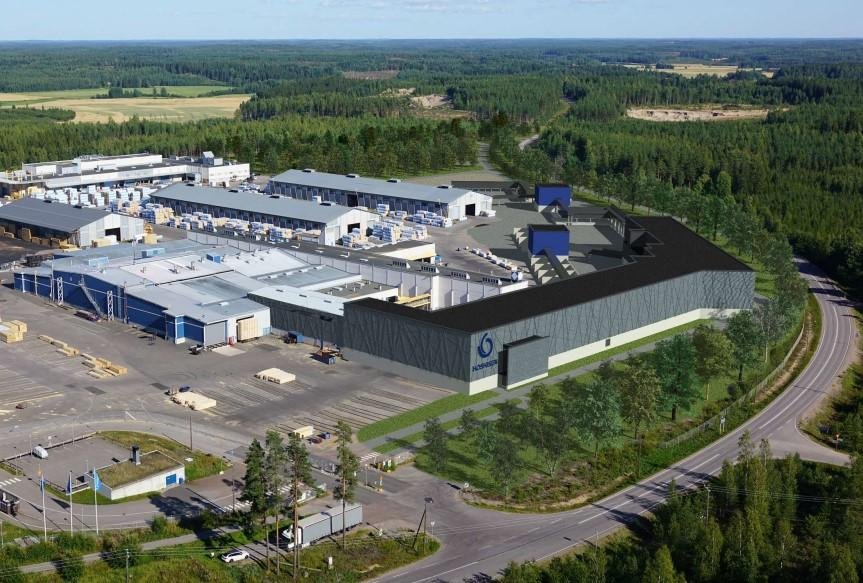


Updated July 13, 2026. Finnish wood-products group Koskisen is moving into the second phase of a three-year investment programme designed to raise annual birch plywood capacity from about 65,000 m³ to 85,000 m³. The latest phase is valued at approximately €7 million and is focused on veneer processing, automation, quality and production yield. Installation is scheduled mainly during the July–August summer shutdown, according to the company’s July 10 operational update.
Koskisen plywood expansion: the key figures
| Measure | Company figure | Timing |
|---|---|---|
| Current stated plywood capacity | About 65,000 m³/year | Before completion of the programme |
| Target capacity | 85,000 m³/year | By the end of the 2025–2027 programme |
| Second-phase investment | Approximately €7 million | Main installations in July–August 2026 |
| First-phase investment | Approximately €12 million | Commissioned by December 2025 |
The planned increase is 20,000 m³, or roughly 31% relative to the stated starting capacity. It should not be read as 20,000 m³ of immediately available supply: capacity will depend on equipment commissioning, ramp-up, raw-material availability, product mix and demand.
What the €7 million phase changes
Koskisen says the second phase concentrates on further processing of veneer. The projects replace or modernise equipment used in veneer composing, scarf-jointing and hot pressing. These stages influence panel consistency, surface quality, material yield and the flow of work through a plywood mill.
More automation can reduce manual handling and bottlenecks, but the strategic value is broader than output alone. Better veneer recovery can improve the amount of saleable panel obtained from each log, while more controlled pressing and joining can support repeatable specifications for industrial buyers. Those quality and yield gains are particularly relevant in specialised plywood markets, where customers often buy to technical requirements rather than treating panels as interchangeable commodities.
First-phase equipment is already in service
The first phase was completed at the end of 2025 at a stated cost of about €12 million. It covered log handling and automation in veneer drying, coating and panel handling. Koskisen reported that this equipment had been commissioned as planned.
The distinction matters for interpreting the project. The €7 million announced in January 2026 is not the total cost of the complete capacity expansion. It follows the first €12 million phase, while Koskisen has not published a single final cost for every investment across the full 2025–2027 programme.
July update confirms the programme remains active
In an April 2026 pre-silent-period update, Koskisen said plywood production had faced cold-weather and new-technology ramp-up challenges, although planned volumes were largely achieved. On July 10, the company said second-quarter plywood production had progressed largely as planned, with the ramp-up still affecting volumes and production costs to some degree.
The same July update stated that Panel Industry investments would mainly be installed during the summer shutdown in July–August. This is the latest available company timetable. Buyers should therefore watch later financial releases for confirmation of commissioning and ramp-up rather than assume the full 85,000 m³ target is already operational.
Where the additional birch plywood could be sold
Koskisen’s Panel Industry produces customised birch plywood for light and heavy transport vehicles, die-cutting tools, interiors, fittings, construction and furniture. These are performance-led applications in which strength, dimensional stability, machining and dependable supply can matter as much as the headline price.
The expansion may therefore affect selected industrial niches before it changes broad European price benchmarks. Procurement teams comparing the development with the wider market can use TimberInsider’s panel price hub and wood-market overview to separate producer capacity news from transaction-level price evidence.
Raw material and execution remain key constraints
New machinery does not remove the need for suitable birch logs. Koskisen’s 2026 origin-of-wood declaration identifies Finland as the origin for its panel-products wood and lists birch, spruce and pine among the species used. It also identifies the Järvelä and Hirvensalmi production units and provides PEFC and FSC chain-of-custody information.
For the plywood programme, the practical constraints are equipment installation, stable ramp-up, trained labour, log quality, adhesives and coatings, energy, logistics and customer qualification. Koskisen noted in April that energy and some input costs had affected profitability. Capacity figures should consequently be treated as an industrial ceiling, not a sales forecast.
What buyers and competitors should monitor
- Commissioning: confirmation that the July–August installations started and entered service as scheduled.
- Ramp-up: evidence that new equipment can sustain higher throughput without compromising yield or quality.
- Order development: Koskisen reported stronger-than-typical first-quarter plywood order volumes, but future demand will determine utilisation.
- Product mix: growth in specialised transport, die-board or interior grades may not translate directly into commodity panel availability.
- Input costs: birch logs, resins, coatings, energy and freight can influence the economics of the added capacity.
For a broader view of manufacturing investment and panel supply, see TimberInsider’s wood-industry hub, wood-products guide and regional market coverage.
Bottom line
Koskisen’s expansion is a staged productivity and quality programme, not a one-off capacity switch. The first €12 million phase is commissioned, the approximately €7 million second phase is being installed mainly during the 2026 summer shutdown, and the programme’s stated end goal is to lift capacity from 65,000 m³ to 85,000 m³ by 2027. The next decisive evidence will be commissioning, ramp-up and utilisation data in subsequent company reporting.
Sources and methodology
This article distinguishes announced capacity from realised production. Figures and timing were checked against Koskisen’s January 9 investment release, its April operational Q&A, the company’s July 10 second-quarter pre-silent-period update, and its 2026 origin-of-wood declaration. Percentage growth is TimberInsider’s calculation from the company’s stated 65,000 m³ base and 85,000 m³ target.


